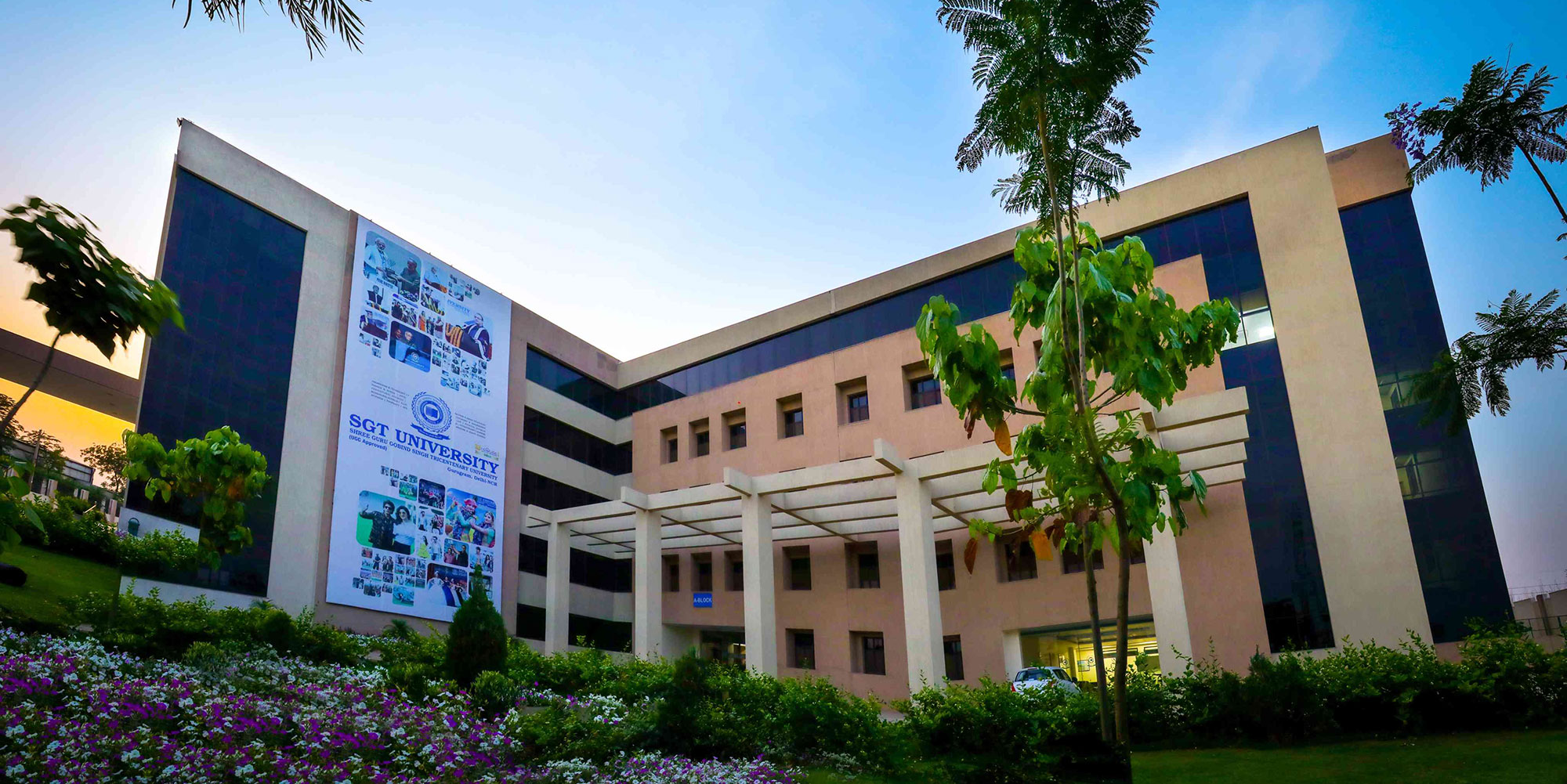
Shree Guru Gobind Singh Tricentenary University (SGT University), Gurugram, is a multidisciplinary educational institution established in 2013, standing tall for its vision to bridge the gap between academics and industrial needs. It holds a 100-acre lush, state-of-the-art campus that thrives as a centre of transformative learning, research, and innovation for about 19 faculties established by it.
Recognising the need for a premier legal education hub, the School of Law at SGT University was established in 2014. It operates with the prestigious statutory recognition from the Bar Council of India (BCI) and the Government of Haryana, while also holding multiple recognitions such as Rank 1, in the category of ‘top law schools in Haryana,’ Rank 2 in the list of ‘top law schools of eminence’ and Rank 2 as a ‘top law school in the north region’ by Global Human Resource Development Centre in 2026. Further, as a mark of commitment towards institutional quality, the University is further distinguished by its NAAC A+ Accreditation, alongside ISO certifications and recognition from the University Grants Commission (UGC). Though these accolades underscore the core values of the School of Law and SGT University, what makes it unique and distinguished from other schools of law, is that it ensures the evolution of its students into world-class legal professionals through a strategic approach towards legal education.
We, at the School of Law, explicitly reject the textbook-bound and archaic idea and description of a lawyer. We believe in training young minds to sustain the waves of seismic transformation currently felt by the profession. For example, courts are being digitised, contracts are being coded, and artificial intelligence is being intensively deployed in documentation review and analytics. These technological advances, among others, have shifted the fundamental expectations and demands of clients with respect to the outcomes of cases. While society still requires retributive justice and adversarial measures at times, clients are looking for modern approaches to resolve disputes that are time and cost-effective, with less legal formalities.
Consequently, the boundaries of the legal profession have expanded, shifting the lawyer’s role from a purely adversarial courtroom combatant to that of an expert facilitator, risk manager, and strategic advisor. Against this backdrop, it must be accepted that the traditional model of legal education, which often depends on textbooks, case laws, statutory interpretation, and moot performers, though necessary, is no longer sufficient.
To address this evolving relationship between law and society, the School of Law at SGT University expands its wings beyond conventional pedagogy. We cultivate a robust culture of experiential learning, clinical legal education, and community-centric education that bridges the gap between abstract black-letter law and real-world human problem-solving. We teach law not in administrative isolation, but at its critical intersection with global geopolitics, market economics, disruptive technologies, and the moral aspirations of a modern democratic society. By nurturing analytical precision alongside a deep sense of social responsibility, we ensure that our students do not merely look at the past to interpret the law, but actively look forward to shaping the future of governance and justice.
We, at the School of Law operationalise this vision through a teaching pedagogy that flows beyond the walls of concrete classrooms. We integrate e-resources, digital research platforms, activity-based learning, case analysis, simulations, group discussions, film screenings, policy debates, memorial drafting exercises, and interactive expert sessions to ensure that students learn law through their own experiences. Legal education here is therefore not confined to passive note-taking, but is built through problem-solving, argument construction, drafting, negotiation, ethical reasoning, public engagement, etc.
The Faculty's focus on experiential learning is reflected in its active centres and academic initiatives. The Sudhir Mishra Centre for ESG, Environmental Law and Climate Change (SMCEC) strives to work as a think tank that speaks and acts for environmental justice. The centre runs full-time to disseminate environmental education through research, conferences, workshops, training programs and outreach activities on various aspects of environmental law. The centre engages students in the form of a council, providing them with training on writing and research on environmental law and provides them with a platform to showcase their creativity in bringing environmental awareness.
At the School of Law, our specialized Centres of Excellence bridge the gap between theoretical legal education and real-world application to empower students across diverse legal domains. The SGT Alternative Dispute Resolution Centre (SADRC) strengthens practical skills in arbitration and mediation, recently highlighted by the 1st Dr. Lalit Bhasin International Mediation Competition 2026. Simultaneously, the Centre for Constitutional Governance and Human Rights fosters profound legal discourse, notably through its newly launched Living Constitution Digital Museum and expert lectures on the Indian Constitution's seventy-five-year journey. In today's rapidly evolving digital landscape, the Centre for Intellectual Property Rights serves as a premier platform for dialogue on critical protections like copyrights, patents, geographical indications among others, while the Centre for Criminal Investigation & Forensic Science offers hands-on exposure to modern law enforcement techniques, demonstrated by immersive field initiatives like the recent Jhajjar Police Station visit where students interacted with practicing professionals on evidence handling and trial advocacy. Expanding our commitment to grassroots empowerment, the Centre for Panchayati Studies organizes interactive workshops focused on rural development and local self-governance. Furthermore, the Faculty actively shapes future legal scholars and magistrates through the Centre for Judicial Services, which provides dedicated mentorship for competitive examinations, including judiciary, civil services, allied exams, and the Centre for Legal Research & Publication Ethics (CLRPE), which cultivates rigorous academic scholarship through training initiatives like its recent expert session on publishing in Scopus-indexed law journals.
Alongside these centres, the Faculty promotes certificate-oriented and skill-based learning that prepares students for emerging areas of legal practice. Workshops on consumer rights and digital literacy, juvenile justice, environmental law, climate change, ESG, legal olympiads, advocacy, memorial drafting, and judicial services expose students to the practical demands of the profession. The coveted Industrial Advisory Board, comprising legal luminaries and industry experts, and our professional collaborations further help align curriculum and training with the expectations of courts, law firms, public institutions, corporate bodies, and policy spaces.
Recognizing the vital role of social responsibility in the legal profession, the Faculty actively engages the community through its Pro Bono Club and Legal Aid Cell. In collaboration with institutions like the District Legal Services Authority, our students drive impactful outreach initiatives and legal awareness programs - such as the recent awareness drive on government schemes held at Iqbalpur Village, Gurugram. Programmes on government policies, welfare schemes, legal aid, health rights, women and child welfare, and access to justice have enabled students to directly engage with patients, attendants, hospital visitors, and marginalized communities. Initiatives such as ‘Beyond the Books: A Diwali of Humanity and Hope’ and Sewa Parv further demonstrate that the Faculty views legal education as a moral practice rooted in compassion, dignity, and service.
Student life at the Faculty is equally enriched through clubs and societies that give students institutional spaces to lead, perform, debate, research, and serve. The Moot Court Society develops advocacy, research, courtroom manner, and memorial drafting skills. The students get dedicated guidance for exhibiting excellence in Inter-Collegiate Competitions. Our students have successively brought laurels to the Faculty and inspired other students to replicate the same. The Pro Bono Club nurtures legal literacy and community responsibility. Cultural activities, fresher’s events, group discussions, constitutional observances, and festival celebrations encourage confidence, teamwork, creativity, and belonging. Together, these societies ensure that students are not only trained as legal professionals but also shaped as articulate, sensitive, and culturally aware citizens.
Competitions form another important pillar of this academic ecosystem. The Faculty organises and encourages participation in moot court competitions, mediation competitions, ITAC-based advocacy exercises, environmental law moots, legal olympiads, and other advocacy-driven platforms. The Summer Intra Moot Court Competition, 2025, organised for first-year students, saw participation from 24 teams and introduced students to the fundamentals of research, drafting, legal argumentation, and courtroom presentation. Skill sessions such as “Learning the Craft of Memorial Drafting” further prepared students for intra and inter-institutional competitions by focusing on citation methods, structure, indexing, formatting, and application of law to facts.
International exposure is another defining feature of the Faculty’s academic environment. Through international seminars, interdisciplinary conferences, faculty development programmes, expert lectures, and global academic collaborations, students and faculty are exposed to comparative legal systems, global policy debates, climate justice, ESG governance, international environmental law, intellectual property, human rights, and technology regulation. Sessions involving experts from institutions and organisations such as SOAS, University of London, IUCN Asia, and other national and international academic spaces have expanded the intellectual horizon of the Department.
The Faculty’s academic growth is further strengthened through Memorandum of Understanding (MOU), institutional collaborations, and professional linkages. Our MOU with UK-India Legal Partnership (UKILP) is aimed towards advancing global legal education, research, and professional training. The collaboration also includes one with the Indian Mediation Centre (IMC), with Panch Parmeshwar Vidyapeeth, among others. These partnerships create opportunities for internships, research, workshops, certificate courses, legal awareness programmes, training sessions, and industry interaction. Students have interned with courts, tribunals, law offices, public institutions, corporate organisations, journals, and legislative bodies, thereby gaining first-hand exposure to the functioning of the legal system.
Faculty contribution remains central to this growth. Faculty members regularly participate in conferences, publish research papers and book chapters, conduct faculty development programmes, mentor student research, and contribute to interdisciplinary scholarship. Research areas have included artificial intelligence and rights, environmental justice, reproductive justice, privacy, plant variety protection, disability rights, constitutionalism, climate justice, and intellectual property. The Faculty has also secured significant research and academic funding, including an ICSSR grant of Rs. 4,00,000 for an international seminar on GST 2.0 Next Gen. Reforms.
Thus, the School of Law at SGT University stands as more than a law school. It is a training ground for advocates, mediators, researchers, policy thinkers, community leaders, and socially conscious professionals. By combining rigorous legal instruction with e-resources, experiential pedagogy, clinical education, centres of excellence, student societies, competitive advocacy, international exposure, research mentoring, institutional partnerships, and funded innovation, the Faculty continues to shape legal professionals who are prepared not merely to enter the profession but to transform it.
By:
Dr. Richa Chaudhary
Dean, School of Law
SGT University, Gurugram