
The Future of Hydrogen as a Fuel: A Game-Changer in Clean Energy
Updated on: April 27, 2026
As the world shifts toward sustainable energy sources, hydrogen is emerging as a promising alternative fuel. Growing concerns about climate change and the depletion of fossil fuel reserves have triggered interest in hydrogen as a resource to assist us in moving towards a cleaner, more efficient energy system. However, what makes hydrogen so exciting, and what does the future of using hydrogen as a mainstream fuel look like?
As one of the most abundant elements, hydrogen can be used in fuel cells or burned as a fuel, producing no carbon emissions at the point of use. When utilized, its primary by-product is water, making it an environmentally friendly energy carrier. Hydrogen can be produced in several ways; one key production method can be done via water electrolysis with renewable-powered electricity. Thus, hydrogen may be a significant tool for achieving net-zero emissions.
In industry, hydrogen could replace natural gas when used in high-temperature processes, thus lowering carbon emissions. Furthermore, hydrogen will contribute toward energy storage, enabling renewable energy to meet supply and demand on the grid more effectively. As technology progresses and costs continue to fall, hydrogen is ready to play a leading role in the global energy transition and could replace natural gas when used in high-temperature processes, thus lowering carbon emissions. Governments and industries around the world are investing in hydrogen infrastructure, research, and regulations to push for adoption. If technological developments continue, hydrogen will likely transform transportation, industry, and power generation, establishing hydrogen as a pillar of a clean energy economy.
Hydrogen’s Expanding Global Footprint
Hydrogen is gaining momentum as a clean energy carrier, with global production reaching around 95 million tonnes in 2023. However, nearly 99% of this is still produced from fossil fuels, mainly natural gas and coal, while green hydrogen, made through electrolysis using renewable energy, accounts for less than 1%. Despite the current imbalance, green hydrogen is expected to scale rapidly, with projections reaching 10 million tonnes annually by 2030. Cost remains a challenge, ranging from $3–6 per kg, but global initiatives aim to bring it down to $1/kg. Hydrogen’s role is especially promising in heavy transport and industrial sectors, though infrastructure development and investment, estimated at $500 billion by 2030, are critical to unlocking its full potential.
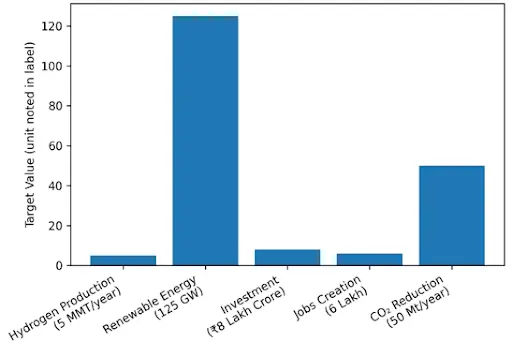
India's transformation as a major country in the hydrogen economy has begun through various policies and initiatives to develop a clean energy economy. India created the National Green Hydrogen Mission to incentivise the development of green hydrogen by increasing the production, use and exportation of hydrogen fuel in 2023. This mission has the goal of creating at least five million metric tonnes per year by 2030. This mission will enable the addition of approximately 125 GW of renewable electrical generation resources to produce hydrogen. It is anticipated that this will create ₹8 trillion in new investments, more than 600,000 jobs and reduce approximately 50 million tonnes of carbon dioxide annually. These plans are in keeping with India's long-term climate commitments to achieve energy independence by 2047 and to become a net-zero emitter of carbon dioxide by 2070. Through these policies and the beneficial characteristics of hydrogen, India is well positioned to be the leading global hydrogen producer and exporter, and thus one critical solution for decarbonising hard-to-electrify sectors such as steel production, fertiliser production, refining of petroleum, global shipping and heavy transportation.
From Prototype to Production: SGT University’s Step Toward a Hydrogen-Powered World
In line with the vision of hydrogen as a future fuel, the Department of Mechanical Engineering at SGT University has developed and fabricated a prototype electrolysis setup in the Hydrogen Engine Lab for clean hydrogen production, in collaboration with CST Envirotech. This initiative reflects a hands-on approach to sustainability and innovation in engineering education. Building on this achievement, the team is now planning to advance the setup toward the development stage for mass hydrogen production with a target capacity of up to 3 kW. These efforts not only support academic research but also contribute to real-world solutions for a cleaner, hydrogen-powered future.
Written By:
Dr. Mayank Choubey
Assistant Professor
Department of Mechanical Engineering