
Role of Microwave Hybrid Heating in Materials Engineering: Why It Makes Mechanical Engineering Future-Ready
Updated on: 06 March, 2026
Understanding Microwave Hybrid Heating
Mechanical Engineering has long been associated with machines, engines, and manufacturing systems. However, modern mechanical engineering is rapidly evolving with the integration of advanced materials, smart manufacturing technologies, and energy-efficient processing techniques. One such emerging technology transforming materials engineering is Microwave Hybrid Heating (MHH).
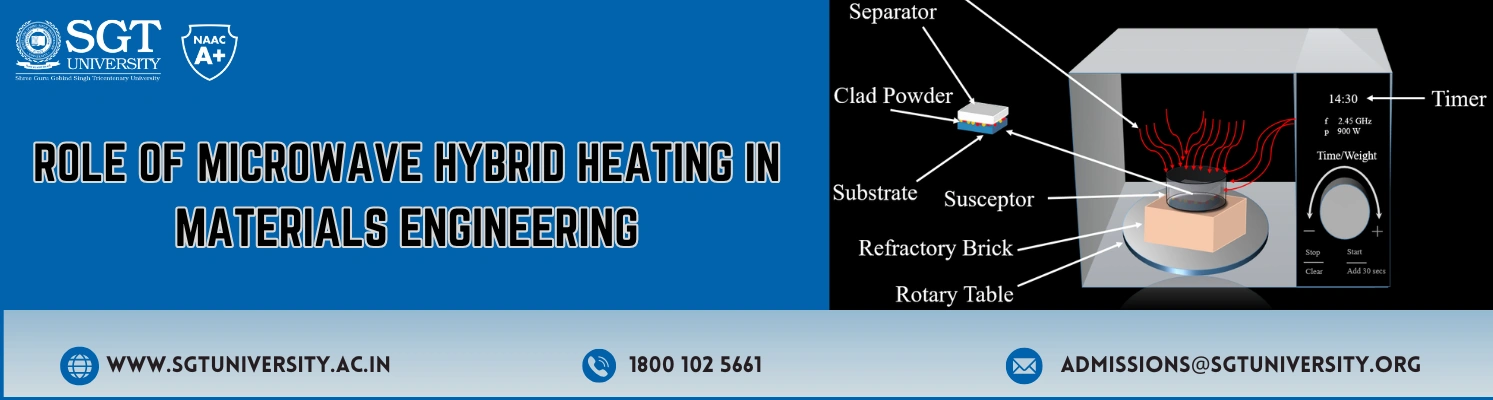
Microwave Hybrid Heating is an advanced processing technique that combines microwave energy with conventional heating methods to process materials effectively. While microwaves can heat certain materials directly through electromagnetic interaction, most metals reflect microwave radiation at room temperature, due to their high conductivity. To overcome this limitation, a hybrid heating system is used. In this approach, a microwave-absorbing material, at room temperature, (called susceptor) is placed along with the sample. The susceptor initially absorbs microwave energy and gets heated, also raising the temperature of the surrounding material through conventional methods. Once the material reaches a critical temperature, it begins to absorb microwave energy directly, enabling rapid heating. This combination of microwave heating and conventional heat transfer results in uniform heating with improved control over microstructure and material properties.
Why Microwave Hybrid Heating Matters in Mechanical Engineering
Mechanical engineers play a critical role in designing, analyzing, and improving manufacturing processes. Microwave Hybrid Heating integrates several key mechanical engineering principles:
- Heat Transfer – Understanding energy absorption and temperature distribution
- Thermodynamics – Efficient energy utilization during materials processing
- Materials Science – Controlling microstructure and mechanical properties
- Manufacturing Engineering – Developing innovative processing techniques
- Sustainable Engineering – Reducing energy consumption and environmental impact
For mechanical engineering students, learning about technologies like MHH provides exposure to modern manufacturing practices and advanced materials processing techniques.
Applications of Microwave Hybrid Heating in Materials Engineering
Advanced Ceramic Processing
Ceramic materials such as alumina, zirconia, chromium carbide, tungsten carbide, boron carbide and silicon carbide are widely used in aerospace, electronics, and biomedical applications. Microwave Hybrid Heating enables faster processing of these ceramics while maintaining fine grain structures.
Key advantages include:
- Reduced processing time
- Improved mechanical properties
- Uniform microstructure
These benefits make MHH a promising technique for producing high-performance ceramic components used in cutting tools, electronic substrates, and thermal barrier coatings.
Metal Processing and Powder Metallurgy
One of the most exciting developments in microwave hybrid heating is its application in metal powder processing. Through hybrid heating, metals can be effectively processed and densified without excessive energy consumption.
Mechanical engineers working in manufacturing industries benefit from this process because it:
- Improves material densification
- Reduces processing energy
- Enhances mechanical properties
- Supports the production of lightweight components
Such advancements are particularly important in automotive and aerospace industries where high-strength, lightweight materials are essential.
Fabrication of Metal Matrix Composites
Metal matrix composites (MMCs) combine metals with reinforcing particles to improve strength, stiffness, and wear resistance. Microwave Hybrid Heating enables efficient fabrication of such composites by ensuring uniform heating and bonding between the matrix and reinforcement.
These composites are widely used in:
- Aerospace structures
- Automotive engine components
- Defense applications
- High-performance machinery
Mechanical engineers are actively involved in designing and optimizing such advanced materials.
Surface Engineering and Claddings
Microwave Hybrid Heating is also used for surface modification and cladding processes. It can enhance surface hardness, wear resistance, and improved tribological properties without significantly affecting the substrate properties.
Applications include:
- Protective layers on industrial components
- Surface hardening of steel parts
This improves the service life and reliability of engineering components
Advantages of Microwave Hybrid Heating
Microwave Hybrid Heating offers several advantages compared to conventional heating methods.
- Energy Efficiency
- Faster Processing
- Improved Material Properties
- Sustainable Manufacturing
Relevance to Industry 4.0 and Smart Manufacturing
Modern manufacturing systems are moving toward Industry 4.0, where automation, digital monitoring, and advanced processing technologies are integrated. Microwave Hybrid Heating supports this transformation by enabling:
- Energy-efficient manufacturing
- Rapid materials processing
- Advanced materials development
- Integration with smart process monitoring systems
Mechanical engineers trained in these technologies become valuable contributors to next-generation manufacturing industries.
Career Opportunities for Mechanical Engineers
Students who understand advanced materials processing technologies such as Microwave Hybrid Heating can explore careers in:
- Automotive manufacturing
- Aerospace industries
- Defense research laboratories
- Materials research and development
- Advanced manufacturing companies
- Renewable energy technologies
Organizations involved in cutting-edge engineering research require professionals who understand both materials science and modern manufacturing techniques, making mechanical engineers highly versatile in the job market.
Research Opportunities for Students
Microwave Hybrid Heating is still an evolving research area, offering exciting opportunities for undergraduate and postgraduate students. Research topics include:
- Development of advanced ceramic materials
- Microwave processing of metal composites
- Energy-efficient manufacturing systems
- Hybrid heating systems for industrial applications
- Integration of microwave processing with additive manufacturing
Exposure to such research fields allows students to develop innovation skills and contribute to technological advancements.
Mechanical Engineering: A Future-Ready Discipline
Technologies like Microwave Hybrid Heating demonstrate that mechanical engineering is not limited to traditional machines or manufacturing methods. Instead, it is continuously evolving with modern technologies such as:
- Advanced materials engineering
- Smart manufacturing systems
- Energy-efficient processing
- Sustainable engineering solutions
Mechanical engineers today work on challenges that range from electric vehicles and renewable energy systems to aerospace technologies and advanced materials development.
Conclusion
Microwave Hybrid Heating represents a powerful advancement in materials engineering, offering faster processing, improved material properties, and energy-efficient manufacturing. By integrating microwave technology with conventional heating techniques, engineers can overcome processing challenges and develop high-performance materials for modern industries. For students considering their future careers, this technology highlights the innovation, research opportunities, and industrial relevance of Mechanical Engineering. As industries move toward smarter and more sustainable manufacturing systems, mechanical engineers equipped with knowledge of advanced processing techniques like Microwave Hybrid Heating will play a vital role in shaping the future of engineering.
Written By:
Dr. Sandeep Bansal
Assistant Professor
Mechanical Engineering Department
School of Engineering & Technology
SGT University, Gurgaon