Why Choose B. Tech. in Mechanical Engineering - A Forward-Looking Guide for Aspirants
Updated on: 27 February, 2026
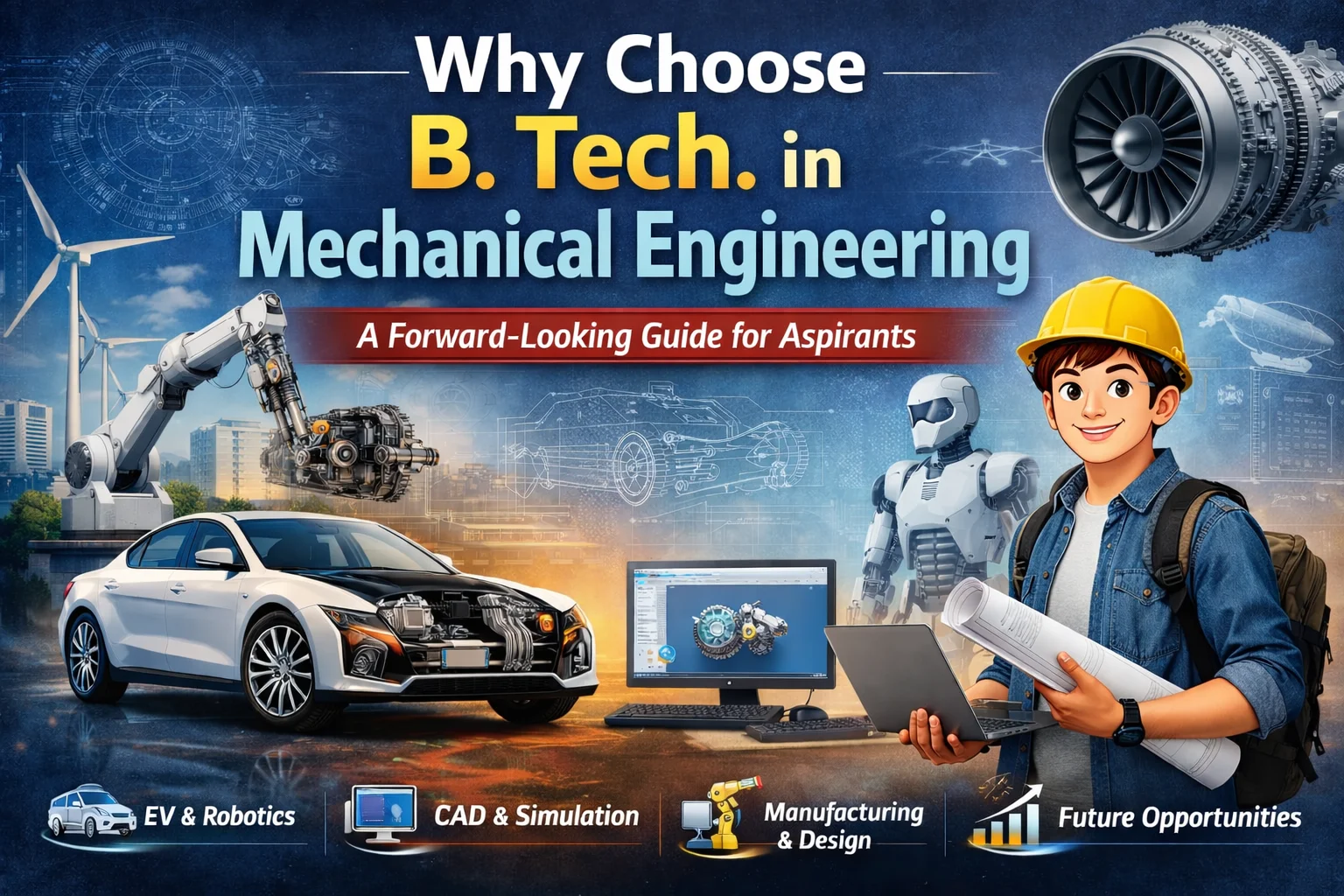
Mechanical engineering remains the bedrock of industrial development, and today it is reinventing itself. If you're thinking about pursuing a B. Tech. in Mechanical Engineering, you're picking a field that combines cutting-edge technologies (electric mobility, automation, advanced manufacturing) with ageless principles (mechanics, thermodynamics, materials). Below is a clear, practical guide: market forecasting, why core engineering still matters, how SGT University approaches core engineering education, and the skills you'll need to flourish.
Market & industry forecast - why demand is rising now?
- Electric mobility and vehicle electrification are driving rapid demand for mechanical engineering talent. India's battery EV production is forecast to expand sharply (production nearly tripling in 2025 compared with 2024 in recent industry reporting).
- The India EV market's value is projected to grow strongly (multi-billion USD by the end of the decade) with high compound annual growth rates, meaning sustained demand for engineers who understand vehicle systems, batteries, thermal management, and manufacturing.
- Government incentives and production-linked schemes have accelerated manufacturing investments and on-shore production, boosting opportunities in precision manufacturing, electronics for vehicles, and component supply chains. This strengthens job prospects in design, production, testing and R&D.
- Engineers with cross-domain skills (mechanics, electronics, and software) will be in high demand as electrification and automation continue to grow globally. Sales and adoption trends for electric cars are rapidly increasing.
Over the next 5 - 10 years, mechanical engineers who can work at the intersection of traditional machine design and modern systems, EVs, robotics, additive manufacturing, and thermal systems will have strong career prospects.
Why core engineering still matters (and what "core" means)?
Core mechanical engineering statics, dynamics, materials, manufacturing, and thermos-fluids give you the physical intuition and problem-solving toolkit that software alone cannot replace.
Core skills let you:
- Translate a system requirement into a reliable mechanical design
- Understand failure modes, safety factors, and manufacturability
- Optimize systems for efficiency (energy, weight, cost)
- These are the abilities companies will always value, even as specific tools change.
SGT University's approach to core engineering
At SGT University, the Mechanical Engineering curriculum is being shaped around four practical pillars:
- Digital Manufacturing & Additive Technologies - CAD/CAE, CAM, CNC practice, and hands-on labs.
- 3D Modelling & Simulation - strong emphasis on modelling, FEA, and virtual prototyping.
- Electric & Autonomous Vehicles - EV fundamentals, battery systems, powertrain integration, and EV lab exposure.
- Robotics / Mechatronics - sensors, actuators, embedded systems, programming, and system integration.
The department pairs classroom theory with project-based labs, industry collaborations (CSR labs, testing facilities), and competitions (Synergy and Gyanotsav) so students graduate with real prototypes and industry-ready experience. (This approach aligns core theory with applied projects and placements.)
What employers will expect from a future Mechanical Engineer?
Employers increasingly look for engineers who combine mechanical depth with interdisciplinary fluency:
Technical stack (must-have):
- Firm grasp of mechanics, materials, and manufacturing processes.
- CAD (SolidWorks/ CATIA), CAE (ANSYS/ Simulia ABAQUS), Robotics Programming, and CAM/ CNC fundamentals.
- Simulation & modelling skills (FEA, CFD basics).
- Basic electronics & embedded systems for mechatronics/EV interfaces.
- Programming & data literacy - Python, MATLAB, basics of control/signal processing.(Industry trend reports show these hybrid skills rising in demand.)
High-value modern skills:
- Systems thinking for mechatronics and EV powertrains.
- Familiarity with Industry 4.0 concepts: IoT sensors, predictive maintenance, digital twins.
- Additive manufacturing and lightweight materials knowledge.
- Test & validation skills: data acquisition, instrumentation, and experimental methods.
Soft skills:
Teamwork on cross-disciplinary projects, clear technical communication, problem framing, and project management.
Practical roadmap for aspirant candidates (what to do during B. Tech.)
- First year: Build fundamentals on mechanics, math, materials, basic programming.
- Second year: Get comfortable with CAD + basic labs (materials, manufacturing). Take basic courses on specializations like Robotics/ Electric Vehicles/ Digital Smart Manufacturing. Start small projects.
- Third year: Take electives in thermal & fluids/machine design/mechatronics. Take advanced courses on specialisation in Robotics/ Electric Vehicles/ Digital Smart Manufacturing. Join an EV or robotics project team.
- Fourth year: Capstone project/ Trainings with industry or lab (EV subsystem, robotic arm, optimized mechanism). Display projects at events (Synergy, Gyanotsav).
Extra: Certifications (CAD, CATIA, ANSYS, PLC basics), internships in manufacturing, EV companies, or R&D groups.
Opportunities & roles you can aim for
Design engineer, test engineer, manufacturing/process engineer, EV powertrain engineer, controls & mechatronics engineer, R&D for materials & thermal systems, and roles in automation/robotics or product development teams.
If you want to study B. Tech. Mechanical Engineering , you are entering a field that's foundational and forward-thinking. Combine strong fundamentals with projects that involve subjects like electric vehicles, automation and digital manufacturing, and you will become the kind of engineer that industry requires. Someone who is practical, creative and able to adapt.
Also Read: Why Choose B.Tech in Civil Engineering After 12th?
Written By:
Dr. Dinesh Deshwal
Assistant Professor & Head
Mechanical Engineering Department