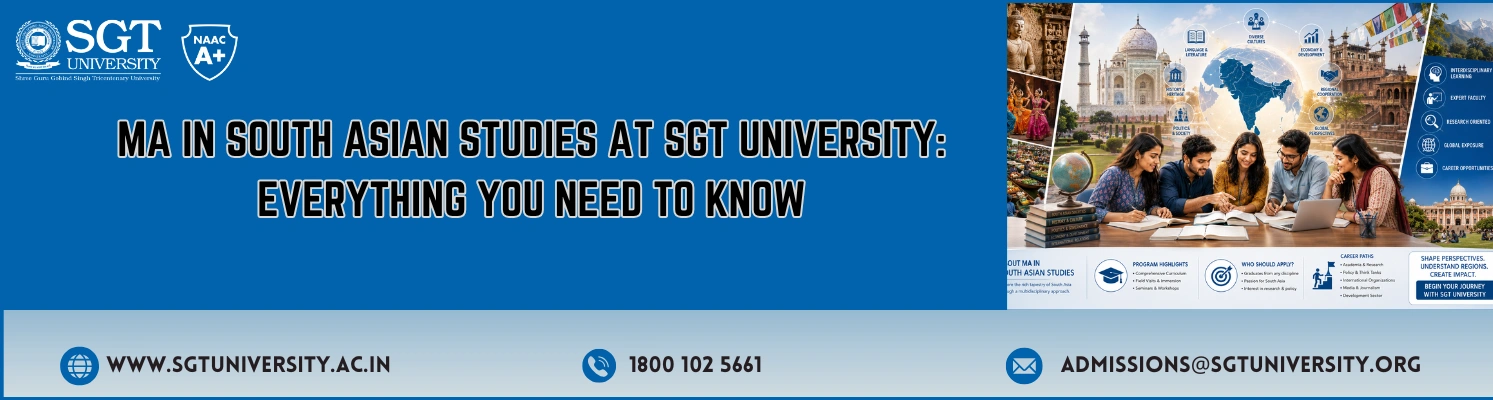
MA in South Asian Studies at SGT University: Everything You Need to Know
Updated on: June 19, 2026
If you've ever asked yourself, "Why does India work the way it does?" this degree is just for you.
South Asia is home to nearly two billion people, multiple languages, ancient civilisations, and some of the world's most complex democracies. Yet most university programmes treat this region as a footnote, a few chapters in a history book, or a module in a political science course; that's it. The MA in South Asian Studies at SGT University is built on the belief that this region deserves dedicated, serious, and research-driven study.
This is not a degree that asks you to memorise facts. It is a degree that asks you to think about power, about identity, about how India became what it is today, and what it might become tomorrow. Whether you are interested in history, politics, culture, or economics, this programme provides the fundamentals to engage more deeply with South Asia than most graduates ever do.
Table of Contents
- What is South Asian Studies?
- Why Study South Asia Now?
- About the School of Humanities, Social Sciences and Liberal Arts at SGT University
- Programme Details at SGT University
- What Will You Study?
- How Is the Programme Taught?
- Eligibility and Admission Process
- Fees and Scholarships
- What Can You Do After This Degree?
- Life at SGT University
- Conclusion
- FAQs
What is South Asian Studies?
South Asian Studies is an interdisciplinary field that looks at the countries and cultures of South Asia, primarily India, but also in relation to Pakistan, Bangladesh, Sri Lanka, Nepal, and the broader region through multiple lenses. These include history, political science, economics, sociology, cultural studies, and literature.
What makes it "interdisciplinary" is that it does not belong to one department or one way of thinking. A South Asianist might read the colonial-era archives one week and analyse contemporary policy documents the next. They might study a Mughal painting alongside a modern election result. The connecting thread is always the region and the questions it raises about civilisation, governance, identity, and change.
At the postgraduate level, South Asian Studies allow one to ask better questions and answer them with rigour.
Why Study South Asia Now?
India is one of the fastest-growing major economies in the world. It has the largest population on the planet. It is a nuclear state, a democracy, a civilisational hub, and a space where tradition and modernity collide every single day. And yet, the serious academic study of India is not as a case study in someone else's theory, but on its own terms, it remains surprisingly rare.
There is a growing demand for people who genuinely understand South Asia: in foreign policy, development work, media, business, and academia. Think tanks, international organisations, NGOs, government ministries, and cultural institutions all need people who can read the region clearly and communicate about it well.
Beyond career value, there is an intellectual urgency to understanding South Asia. From the question of how a billion-person democracy functions, to how partition shaped modern identity, to how caste and class interact in economic life, these are among the most important questions of our time. A programme in South Asian Studies puts you at the centre of those conversations.
The School of Humanities, Social Sciences and Liberal Arts at SGT University
School of Humanities, Social Sciences and Liberal Arts (HSLA) at SGT University is built on a clear vision: to develop critical thinkers, ethical leaders, and socially responsible professionals. The school combines interdisciplinary education with real-world research and industry collaboration, preparing graduates for careers in media, education, public policy, and the creative industries.
HSLA includes two departments, the Department of English and Humanities and the Department of Liberal Studies and Social Sciences, alongside a Centre for Foreign Languages. The faculty includes professors, associate professors, and research-track faculty across these departments.
The MA in South Asian Studies is offered jointly by HSLA and the Advanced Study Institute of Asia (ASIA) at SGT University, which gives it a distinctly research-led character. The programme is not just a humanities degree; it is a space for serious intellectual inquiry into one of the world's most consequential regions.
You can explore more about SGT University's accreditations and rankings here.
Programme Details at SGT University
This is a postgraduate programme designed for graduates who want to understand India and South Asia in depth. Here is a quick overview of the key details:
| Detail | Information |
|---|---|
| Programme Name | MA in South Asian Studies — The Idea of South Asia |
| Level | Postgraduate (Master's) |
| Duration | 1 Year (2 Semesters) / 2 Years (4 Semesters) |
| Mode | Full-Time, In-Person |
| Fee — 1 Year | ₹1,75,000 per semester |
| Fee — 2 Years | ₹1,50,000 per semester |
| Scholarship | Up to 40% on tuition fees (merit-based, individual assessment) |
| Application Status | Open |
The programme is offered in two formats. The one-year intensive format is globally aligned and designed for students who want a fast-track, rigorous postgraduate experience. The two-year format goes deeper, is more research-oriented, and suits those who want time to develop a full-length dissertation and engage with the field thoroughly. Both formats maintain the same academic standards and intellectual expectations.
Apply online here or download the programme brochure for more details.
What Will You Study?
The programme is built around four interconnected domains: history, culture, politics, and economy. Rather than treating these as separate subjects, the curriculum asks students to examine how they interact, how economic policy shapes cultural identity, how history informs political decisions, and how culture and politics together produce the India we see today.
Students also pursue integrated specialisations, which include:
Political Economy — Understanding how political power and economic systems shape each other in South Asia, from colonial extraction to liberalisation.
Public Policy — Looking at how policy is made, who it serves, and how governance actually works on the ground in countries like India.
Cultural Policy — Examining how the state, institutions, and communities manage — and sometimes contest — culture, heritage, and artistic expression.
Development Studies — Engaging with questions of inequality, poverty, infrastructure, and human development in one of the world's most unequal regions.
These specialisations are not add-ons. They are built into the programme's structure, combining theoretical depth with real-world application.
The programme's learning outcomes reflect what it actually prepares students to do:
| Semester Focus | What You Will Develop |
|---|---|
| Historical and Civilisational Thinking | A rigorous, interdisciplinary understanding of India across history, culture, politics, and economy |
| Critical Engagement with "India" | The ability to interrogate the idea of India as a complex, evolving construct rather than a fixed entity |
| Power and Knowledge | Skills to identify dominant narratives, biases, and exclusions in how knowledge about the region is produced |
| Research Methods | Proficiency in qualitative and interdisciplinary research, including fieldwork, archival work, and textual analysis |
| Academic Writing | The ability to construct clear, evidence-based written arguments |
| Practical Output | Skills to translate academic learning into policy briefs, cultural documentation, reports, and public communication |
| Research Ethics | An understanding of representation, consent, and academic integrity |
| Independent Practice | The ability to function as an informed practitioner in institutional and public settings |
How Is the Programme Taught?
This is where the MA in South Asian Studies stands apart from many postgraduate programmes in India. The teaching is seminar-based, which means students are expected to actively participate in discussions, critically engage with primary and secondary texts, and develop their own independent perspectives. Lectures have their place, but the classroom culture is one of dialogue and debate.
Assessment is entirely research-driven. There are no rote examinations. Students are evaluated through essays, seminar papers, fieldwork reports, and a final dissertation. This mirrors the standards of leading international humanities and social science programmes and prepares graduates for doctoral study, policy writing, and other forms of high-level analytical work.
Importantly, the programme integrates field-based practice alongside conceptual learning. Students work with archives, engage in fieldwork, receive structured research training, and explore digital tools and methods. Academic learning is brought into contact with real-world practice throughout the programme, not just in a final internship, but continuously across semesters.
Eligibility and Admission Process
The programme is open to students from a wide range of academic backgrounds. You do not need to have studied History or Political Science at the undergraduate level.
Eligible disciplines include: Humanities, Social Sciences, Law, Media, Design, Development Studies, Engineering, Management, Environmental Studies, and Natural Sciences. If you can demonstrate a genuine interest in interdisciplinary study and in South Asia, you are encouraged to apply.
Minimum Requirement: 60% aggregate marks from a recognised university.
Selection process: Admissions are based on assessment, not on a single entrance score. The university will evaluate your academic record, your statement of purpose, and your shown interest in the field, and then the shortlisted candidates will be invited for a personal interview.
To begin your application, visit the SGT University Admissions Portal or read through the admission procedure here.
Fees and Scholarships
SGT University offers merit-based scholarships of up to 40% on tuition fees for eligible students, assessed on an individual basis.
| Programme Format | Annual Fee |
|---|---|
| MA — 1 Year (Intensive) | ₹3,50,000 |
| MA — 2 Years (Research-Oriented) | ₹6,00,000 |
For students coming from outside Gurugram, SGT University provides separate hostel facilities for boys and girls, with modern amenities, security, and recreational spaces. The campus is well-connected and located in Gurugram's accessible western belt. For details on accommodation and transport, visit the Life at SGT page.
For the latest information on scholarship eligibility and terms, refer to the SGT University Scholarship Policy.
What Can You Do After This Degree?
An MA in South Asian Studies opens doors in a range of sectors. This is not a narrowly vocational degree; it is one that builds transferable analytical, research, and communication skills while also giving you deep regional expertise.
Career pathways for graduates include:
Research and academia are perhaps the most natural fit. Many graduates of programmes like this go on to pursue PhDs at Indian and international universities. SGT University also supports this pathway through its PhD programme , and the research training built into the MA is specifically designed to prepare students for doctoral work.
Policy institutions and governance are another strong path. India has a growing ecosystem of policy research bodies, government think tanks, and planning departments that need people who understand the social, historical, and economic dimensions of public life.
Museums, archives, and the heritage sector are natural destinations for students interested in cultural history and preservation. India has a significant and growing investment in its heritage infrastructure, and trained researchers are in demand.
Media and publishing, both traditional and digital, need writers and analysts who can explain South Asia accurately and thoughtfully to general audiences. Graduates from interdisciplinary humanities programmes often excel in long-form journalism, editorial roles, and content strategy.
The development sector, including NGOs, international organisations, and civil society groups, consistently seeks people who understand ground realities in South Asia and can bridge the gap between academic research and fieldwork.
Think tanks and research organisations in India and abroad increasingly focus on South Asia and hire researchers who combine area expertise with strong analytical skills.
Finally, Civil Services and other state services remain a significant goal for many students with humanities and social science backgrounds. This programme's emphasis on policy, governance, and research is directly relevant to civil service preparation.
Life at SGT University
SGT University is a large, multi-faculty residential campus located in Gurugram, Haryana, one of India's most dynamic cities and part of the National Capital Region. The university's 100-acre campus brings together students from medicine, law, engineering, design, management, and the humanities under one roof, creating a genuinely diverse intellectual and social environment.
At SGT University, students can easily get access to the university's central library, research labs, academic clubs, and cultural events. The Student Welfare Centre supports student wellbeing throughout the academic year, and the university hosts a range of events and seminars through the HSLA Events calendar.
Research support is also available through SGT's Research and Innovation, including access to publications, project funding pathways, and the IPR Cell.
Conclusion
The MA in South Asian Studies at SGT University is one of the very few programmes in India that takes the study of this region seriously as an intellectual project. This degree helps individuals understand how the world's most complex, most populated, and most historically layered region came to be what it is.
Whether your goal is academic research, a career in policy, work in the cultural sector, or simply the kind of deep knowledge that makes you genuinely useful in any room you walk into, this programme can give you that foundation. Providing flexible duration options, merit-based scholarships, research-driven assessment, and a seminar format that builds real analytical skills, the MA in South Asian Studies at SGT University is a serious choice for serious students.
To learn more or apply, visit the official programme page or connect with SGT University directly at sgtuniversity.ac.in.
Frequently Asked Questions (FAQs)
Q1. Who can apply for the MA in South Asian Studies at SGT University?
The programme is open to graduates from almost any discipline, including Humanities,
Social Sciences, Law, Media, Design, Management, Engineering, Environmental Studies, and
more. The main requirement is a minimum of 60% aggregate marks from a recognised
university and a genuine interest in the interdisciplinary study of South Asia.
Q2. What is the duration of this programme at SGT University?
The programme is available in two formats: a one-year intensive model (2 semesters) and
a two-year research-oriented model (4 semesters). Both lead to the same MA degree.
Q3. What is the fee structure?
The one-year programme costs ₹3,50,000 per annum, and the two-year programme costs
₹6,00,000 per annum. Merit-based scholarships of up to 40% on tuition fees are available
for eligible students.
Q4. Is hostel accommodation available at SGT?
Yes. SGT University provides hostel facilities for students (separate boys' and girls'
hostels), with modern amenities, security, and recreational spaces. The campus is easily
accessible from Gurugram and the broader NCR region.
Q5. What kinds of jobs can I get after this degree?
Graduates can pursue careers in academia and research, public policy, civil services,
museums and the heritage sector, media and publishing, development organisations and
NGOs, and think tanks. The programme also prepares students well for PhD applications in
India and abroad.
Q6. Can I apply if I studied engineering or science at the undergraduate
level?
Yes. The programme explicitly welcomes students from Engineering, Management,
Environmental Studies, and Natural Sciences, as long as they can demonstrate a clear
interest in South Asian Studies through their statement of purpose and interview.
Q7. How is SGT University's MA in South Asian Studies different from a general
Political Science or History MA?
It is specifically focused on South Asia as a region, and it crosses disciplinary lines,
combining history, culture, politics, and economics in a single integrated programme
rather than treating them as separate subjects. It is also strongly research-oriented
from the first semester, with a seminar format that builds analytical and writing skills
throughout.