
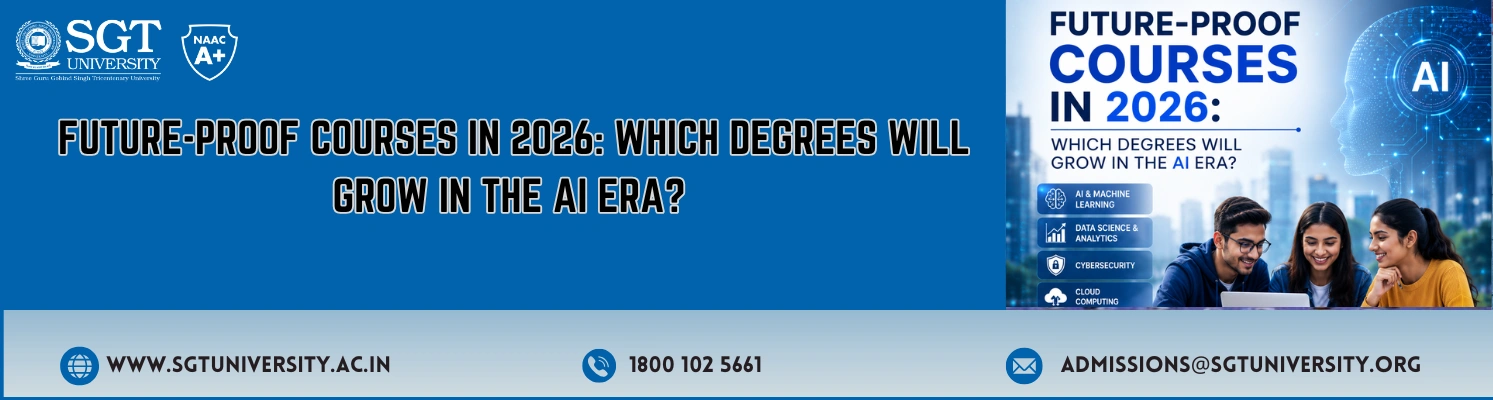
Artificial intelligence is influencing everything from what we study to what we work on and how we build careers. Some courses are becoming less useful because they focus only on repetitive tasks, while others are growing fast because they combine technology, problem-solving, and human skills at their core. Students aren't supposed to wonder “Which course is popular today?” It is “Which course will still matter five years from now?” In 2026, the safest choice is a course that builds strong basics, implications, and artificial intelligence advancements.
Table of Contents
- Will Courses Shrink?
- Courses Likely to Grow
- A course that will stay
- How Students Should Choose
- Why AI Is Changing Career Choices?
- Future-Proof Courses Students Should Look For
- Skills That Will Stay Important
- Flagship Programs at SGT University
- Careers Linked to Growing Courses
- FAQs
Will Courses Shrink?
AI is good at tasks that are routine, repetitive, and rule-based. That means courses that prepare students only for basic data entry, simple reporting, or narrow manual tasks may lose value over time unless they include AI tools and modern skills.
This does not mean these fields will disappear completely. It means the old version of the course may become weak if it does not change with the market trends. Students who learn only one simple tool or only one fixed process may find it harder to compete.
Courses Likely to Grow
The courses that might grow in the next 5 years are probably the ones that work with data, AI, digital systems, security, business strategy, and human decision-making. AI, machine learning, data science, cybersecurity, cloud computing, and engineering specialisations linked to automation are among the most future-ready options.
Courses that combine technology with business are also growing. For example, product management, business analytics, engineering management, and digital marketing with AI tools are becoming increasingly useful, as companies seek people who can use technology while still thinking strategically.
A course that will stay
If you are looking for a future-proof course, look for one that matches these three things: strong demand, AI relevance, and human value need. Courses in AI/ML, data science, cybersecurity, cloud, software engineering, engineering with smart systems, healthcare technology, sustainability, and business analytics fit this pattern well.
How Students Should Choose
Students should not choose a course only because it sounds modern. They should ask whether the course gives real projects, industry exposure, modern tools, and skills that can be used in many jobs. A smart course in 2026 should help students learn to work with AI, not blindly compete with it. The best careers will belong to people who can use technology, understand people, and solve real problems. They should ask a few practical questions before making a choice.
Ask:
- Does this course still have demand in the future?
- Will I learn tools that companies use?
- Does the course include projects and practical learning?
- Can I build more than one career path from this program?
- Does it prepare me to work with AI instead of avoiding it?
A smart student should look for courses that open many doors. The best option is usually not the easiest one. It is the one that gives long-term value.
Why AI Is Changing Career Choices?
Artificial intelligence is making advancements in the world very fast. It is not just helping companies work faster; it is also changing the kinds of jobs people need, the skills students must learn, and the courses that will stay useful in the future.
In 2026, students are asking one big question: Which courses will still matter when AI becomes a normal part of every industry? The answer is simple: the courses that teach one routine, repetitive work may lose value, while courses that build problem-solving, technology, data, and human skills will grow. This does not mean old subjects are useless. It means students must choose smarter and learn in a way that prepares them for change.
AI can now do many basic tasks that once needed human employment. It can sort data, write simple content, answer basic customer questions, create reports, and even support coding and design work. Employers now want employees who can work with AI, understand data, and solve real problems instead of just doing repetitive tasks.
This is why the AI impact on careers is so important for students today. A degree alone is no longer enough. Students need to look for practical knowledge, digital tools, communication skills, and the ability to keep learning throughout their careers.
At the same time, AI is creating new roles in AI-related fields, such as machine learning, data science, cybersecurity, cloud systems, product strategy, and AI consultancy, which are growing rapidly. So the future is not about “AI replacing all jobs.” It is about AI changing the skills needed for jobs.
Courses That May Decline
Some courses may lose demand if they remain too narrow and fail to adapt to new technology. The courses most at risk are the ones that focus mainly on repetitive, rule-based, low-skill tasks.
Examples include:
- Basic data entry training.
- Very simple office support work.
- Routine clerical work without digital skills.
- Narrow job training that ignores AI tools, data, and communication.
- Courses that teach one old software or one fixed process only.
These courses are not disappearing completely. But students who only know manual work may face more competition. Employers now prefer candidates who can use modern tools and think beyond fixed instructions; all they are looking for is creative efficiency.
Another important point is that some traditional courses will still remain useful, but only if they are updated. For example, accounting, marketing, administration, and retail are still important fields. However, students in these areas will need AI tools, analytics, and digital communication to stay relevant.
Courses That Will Grow
In-demand courses in 2026, that are growing at a rapid pace, are as follows:
- Artificial Intelligence and Machine Learning
AI and ML are among the most future-ready fields. Students in these courses learn how smart systems work, how models are trained, and how machines can support human decision-making. These programs are becoming more popular because every industry now wants AI-based solutions. So it won't actually transform job roles, but have a different style of jobs. - Data Science and Analytics
Data is the base of every smart decision. Courses in data science teach students how to collect, clean, study, and use data. These skills are useful in business, healthcare, finance, education, retail, and many other sectors. - Cybersecurity
As more work moves online, the need for secure systems is growing. Cybersecurity courses are more valuable because companies need people who can protect data, systems, and users from attacks in the world. - Cloud Computing
Cloud systems specializations are for businesses to store, manage, and access data from anywhere. Courses in cloud computing are in demand because most companies now use cloud platforms for daily operations. - Software Development with AI Tools
Software development is still strong, but the skill set is changing. Students who learn coding along with AI tools, automation, and modern frameworks will have an advantage. The future is not just about writing code; it is about building useful digital products. - Engineering with Specialisations
One of the most useful career pathways is still engineering, particularly if it includes specializations in robots, cloud computing, data science, cybersecurity, behavioral sciences, artificial intelligence, or future technologies. These programs are effective because they integrate modern industrial skills with core engineering knowledge. - Statistics and Data-Driven Courses
Students who study statistics, mathematics, and data science will continue to have strong career options. These subjects help students understand trends, patterns, and business decisions in a smart and practical way.
Future-Proof Courses Students Should Look For
A future-proof course is not just about a popular subject name. It is a course that stays useful even when the job market changes. The best future-proof courses have three things in common: strong demand, AI relevance, and human value.
A good course should help students learn:
- Practical tools and software.
- Real-world projects.
- Communication and teamwork.
- Problem-solving and critical thinking.
- Industry exposure and internships.
- How to use AI responsibly.
Courses that combine technical knowledge with human skills are the safest choice. This is because AI can support many tasks, but it cannot fully replace creativity, leadership, ethics, empathy, and smart judgment.
Skills That Will Stay Important
Even in the AI era, some skills will always matter. These are the skills that make people different from machines.
The skills that are inevitable are:
- Communication
- Creativity
- Teamwork
- Leadership
- Problem-solving
- Adaptability
- Emotional intelligence
Students who develop these skills along with academic knowledge will always have an edge. In fact, employers are now looking for people who can work with technology and also work well with people.
Flagship Programs at SGT University
For an SGT University blog, it makes sense to connect this topic with the university’s current and future-ready programs. SGT University offers a B.Tech in CSE with specialisations in areas such as Artificial Intelligence & Machine Learning, Data Science, Cyber Security, and more. It also offers a B.Tech CSE work-integrated program.
For students interested in data-focused careers, SGT University offers a B.Sc. Hons. Statistics and Data Science, M.Sc. in Data Science.
SGT University also offers more than just traditional programs. It offers forward-looking courses such as BSc/MSc in Cognitive Science, along with other industry-relevant options that help students build strong, future-ready careers.
With a focus on practical learning, new-age skills, and real-world relevance, SGT gives students the chance to explore fields that connect technology, human behaviour, and innovation. Its wide range of courses is designed to meet changing career needs and help students choose paths that truly fit the future.
These courses are perfectly aligned with the employment market's direction in 2026, since they promote both technical knowledge and industrial readiness. They are fantastic examples of programs that might help students prepare for future jobs.
Careers Linked to Growing Courses
Students often choose a course because of the career it can lead to. That is a good approach, especially in a changing market. Some of the most promising careers in 2026 are linked to AI, engineering, data, cloud, and security.
Some of the examples include:
- AI Engineering
- Machine L earning Engineering
- Data Scientists
- Data Analysts
- Cybersecurity Analysts
- Cloud Engineering
- Software Developing
- AI Consultancy
- Product Manager
- Digital Strategy Specialists
These roles are growing because businesses need people who can help them use technology wisely. Students with these skills are likely to find better job opportunities across industries.
The AI era is not ending education. It is improving it. Students who choose wisely will not fear AI; they will use it as a career advantage.
The strongest courses in the future will be the ones that teach both modern tools and human strengths. That is why students should look for programs that are practical, flexible, and aligned with real industry needs. In simple words, choose a course that grows with the world, not one that lets you remain adaptable. Be it any course, being in a learning yet adaptable state is a must for developing a lifelong learning mindset.
FAQs
Q1. Which courses are best for the future?
The
courses that are most suitable for the future include AI, Machine Learning, Data
Science, Cybersecurity, Cloud Computing, and Business Analytics.
Q2. Will AI replace all jobs?
No, AI will replace
many jobs, but human abilities like creativity, problem-solving, and communication
will still be crucial.
Q3. What skills will stay important in the AI
era?
In the AI era, the skills that will remain valuable are
communication, leadership, teamwork, adaptability, critical thinking, and emotional
intelligence.
Q4. How can students choose the right
course?
Students can choose the right course that offers practical
learning, industry exposure, modern tools, and strong career opportunities.
Q5. Why are AI and Data Science courses
growing?
These courses are growing day by day by helping businesses to
use data, automation, and technology effectively, thus creating a strong demand for
skilled professionals.