
International Conference to Celebrate a Legendary Mathematician Srinivasa Ramanujan
Updated on: January 23, 2026
ABOUT RAMANUJAN
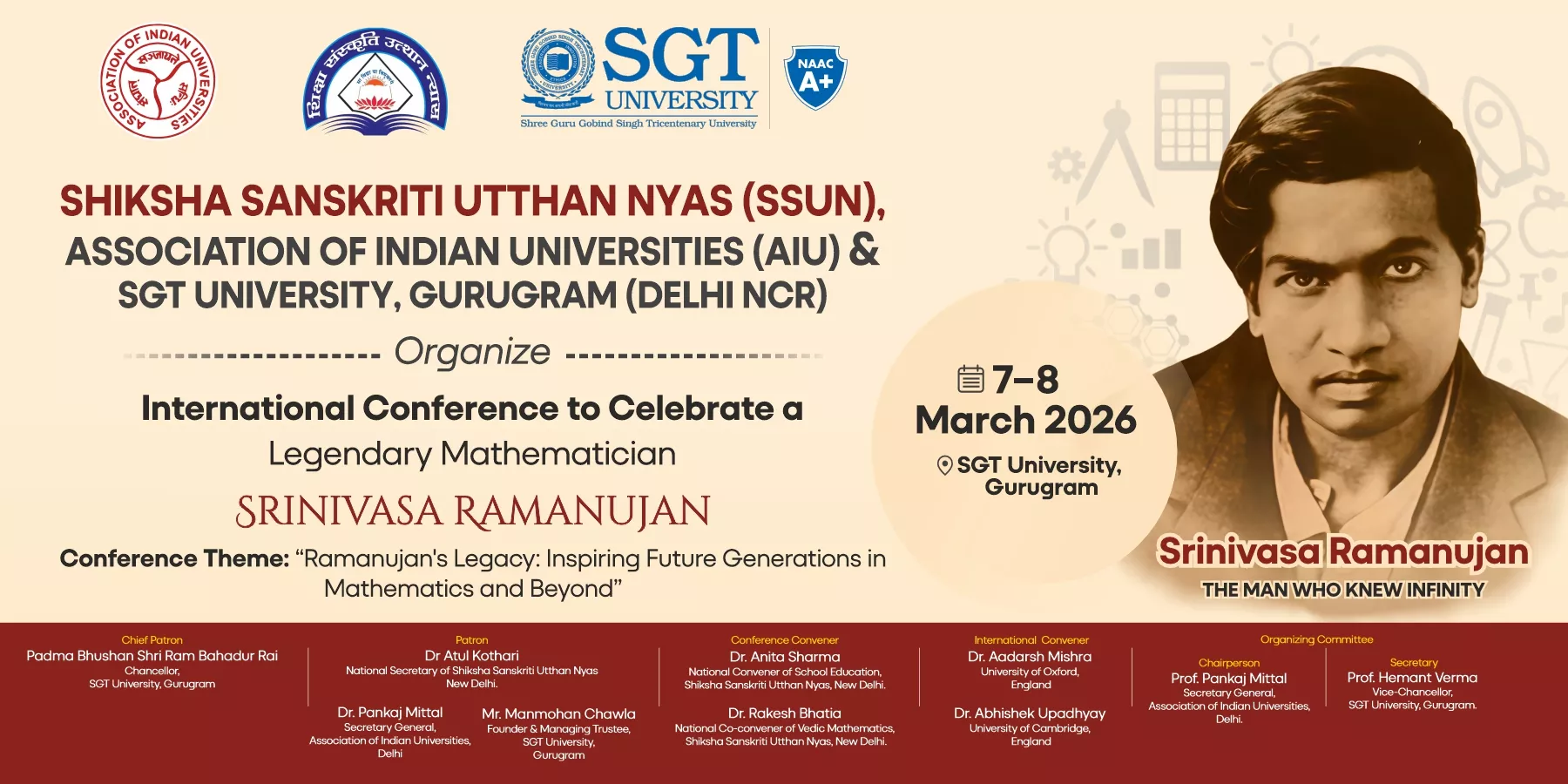
Srinivasa Ramanujan was one of the greatest mathematical geniuses in history, whose extraordinary contributions continue to influence modern mathematics. Born on 22 December 1887 in Erode, Tamil Nadu, Ramanujan displayed exceptional mathematical ability from a very young age. Largely self-taught, he developed deep insights into complex mathematical ideas despite limited formal training and severe financial hardship. Ramanujan made remarkable contributions to number theory, infinite series, continued fractions, partitions, and modular forms. His work revealed intuitive results that often surprised even the most accomplished mathematicians of his time. In 1913, his life took a decisive turn when he wrote to Professor G. H. Hardy of Cambridge University, who immediately recognised Ramanujan's genius and invited him to England. Their collaboration produced some of the most significant mathematical results of the early 20th century. Ramanujan was elected as a Fellow of the Royal Society in 1918, one of the youngest mathematicians to receive this honour. Tragically, his life was short; he passed away on 26 April 1920 at the age of 32. Despite his brief life, Ramanujan's ideas continue to inspire mathematicians worldwide, symbolising the power of creativity, intuition, and perseverance in the pursuit of knowledge.
About Organizers
About Shiksha Sanskriti Utthan Nyas, New Delhi
Bharat has been a global center of knowledge, science, spiritual consciousness, intellectual development, and economic prosperity since ancient times. Renowned institutions such as Nalanda, Takshashila, and Vikramshila, along with extensive trade activities, gave Bharat international recognition. Today, the world realizes that colonial thinking and Eurocentric knowledge systems have caused serious harm to human civilization, and therefore it is once again looking towards Bharat with hope. With this objective, the Shiksha Sanskriti Utthan Nyas was established in 2007 with the guiding principle, “If the nation is to be transformed, education must be transformed.” The Nyas works in the areas of character building, personality development, Bhartiya Mathematics, environmental education, and the promotion of Indian languages. Through the Bharatiya Bhasha Manch, Bhasha Abhiyan, and academic forums such as Gyanotsav, Gyan Kumbh, and Gyan Sabha, it strives to build confidence and a spirit of collaboration among educators for building a developed Bharat in accordance with the National Education Policy 2020.
About Association of Indian Universities (AIU)
The Association of Indian Universities (AIU) is one of the premier higher education institutions in the country, established in 1925. It serves as a research-based policy advisory institution to the Government of India in the fields of higher education, sports, culture, and internationalisation. Dr Sarvepalli Radhakrishnan, Dr Zakir Hussain, and Dr Shyama Prasad Mukherjee are among some of the stalwarts who served AIU as its presidents. At present, it has a membership of 1141 universities, including 20 international universities. Since its inception, it has been playing a vital role in shaping Indian higher education. Being an apex institution, it constitutes an integral part of all major decision-making committees and facilitates cooperation and coordination among Indian universities and international bodies of higher education in other countries in matters of common interest. As a National Sports Promotion Organisation (NSPO), it promotes sports among Member- Universities.
About SGT University
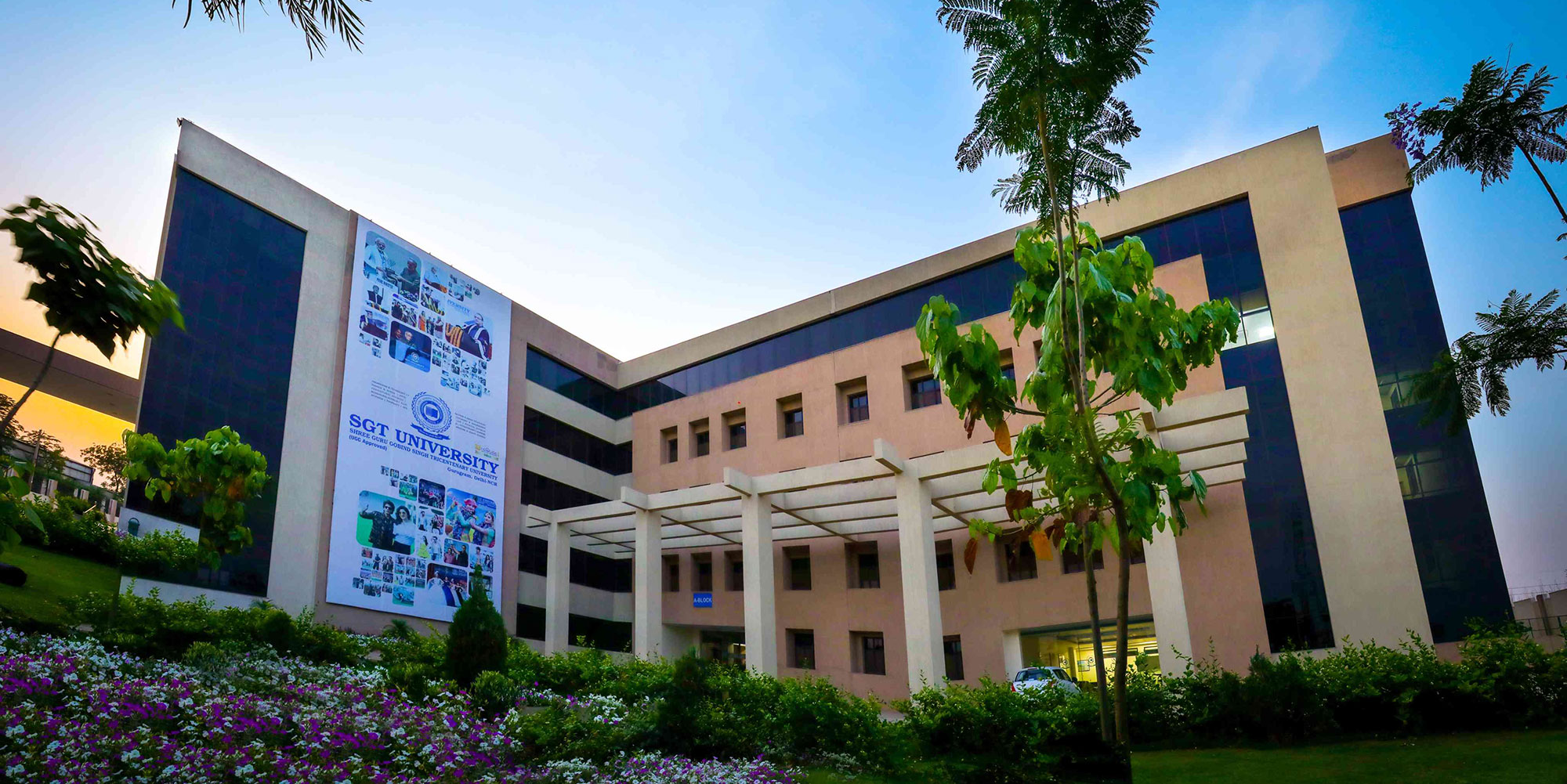
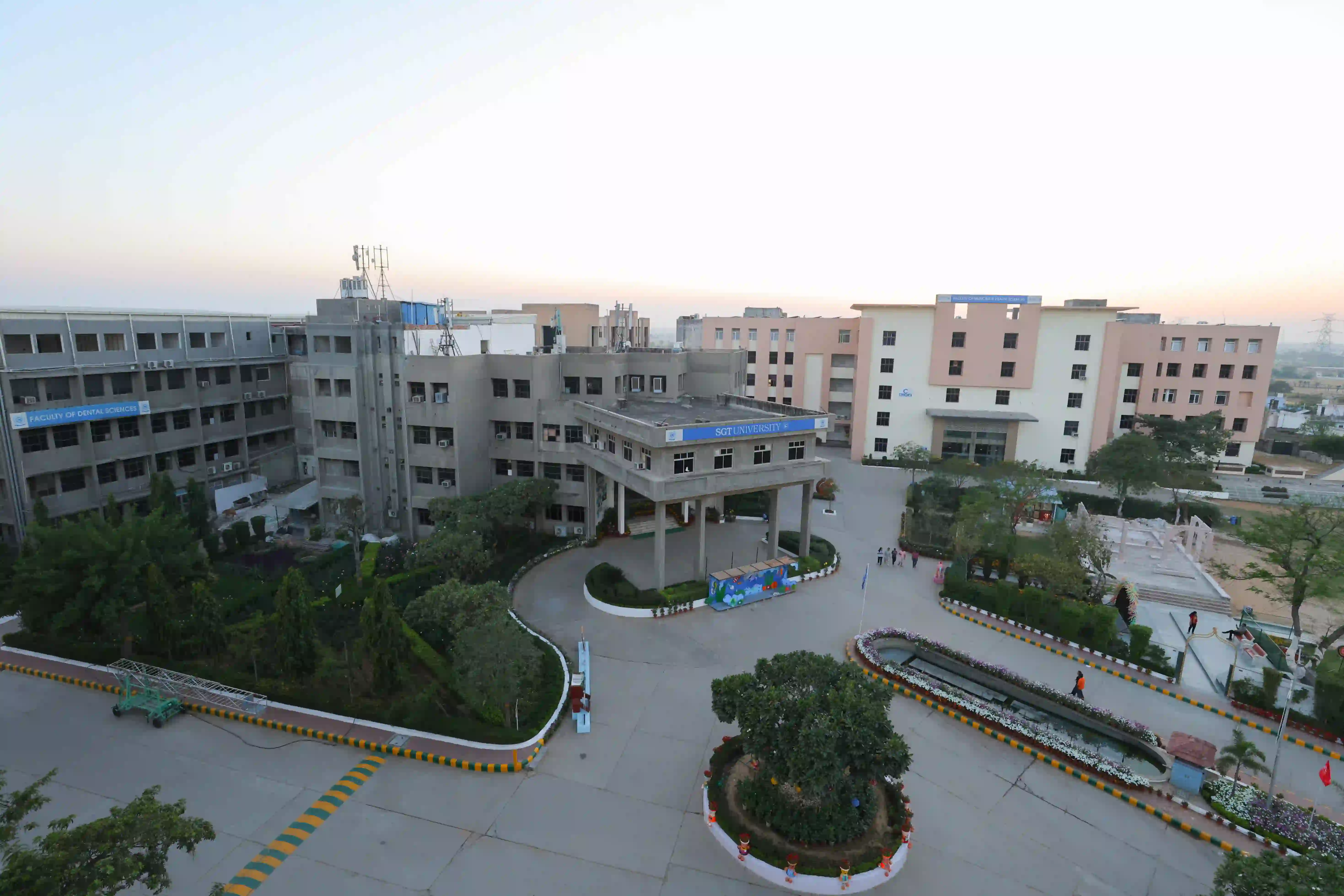
Shree Guru Gobind Singh Tricentenary University (SGT University) is a leading private university located in Budhera, Gurugram, Haryana. Established in 2013 by an Act of the Haryana State Legislature, the university is recognised by the University Grants Commission (UGC) and is NAAC-accredited with an 'A+' grade, reflecting its strong academic standards and institutional excellence. Spread over a sprawling, green campus, SGT University offers a vibrant, multidisciplinary learning environment supported by modern infrastructure, advanced laboratories, well-equipped libraries, and residential facilities. The university offers a wide range of undergraduate, postgraduate, and doctoral programmes in disciplines such as science & engineering, medicine and health sciences, management, law, humanities, agriculture, fashion, and mass communication.

OBJECTIVES OF THE CONFERENCE
The key objectives of this conference are:
- Scholarly Exploration: To present and discuss Ramanujan's contributions to number theory and other mathematical domains through expert talks and research papers, and to facilitate scholarly discussions on Ramanujan's groundbreaking work and its modern application and to foster interdisciplinary dialogue between foundational mathematical ideas and contemporary fields such as theoretical physics and computer science. To highlight the enduring relevance and applied potential of Ramanujan's work for students and early-career researchers.
- Documentation: To compile comprehensive research and documentation on various aspects of Ramanujan's mathematical contributions.
- Curriculum Development: To initiate the process of designing syllabus frameworks and to develop curriculum materials focused on Ramanujan Mathematics for educational institutions in UG and PG programmes, and to promote initiatives aimed at identifying, encouraging, and nurturing talent in the mathematical sciences.
- Capacity Building: To identify and engage resource persons or teaching, mentoring and developing teaching materials on Ramanujan' mathematics.
- Academic Collaboration: To foster cooperation between universities, institutions and research organisations, both national and international, for advancing Ramanujan studies.
- Cultural Linkages: To highlight Ramanujan's contributions as part of India's intellectual heritage and connect them with global mathematical traditions.
To publish conference proceedings, research papers, and educational materials to serve as valuable academic resources for the future.
| Important Dates | |
|---|---|
| Abstract Submission | Feb 10, 2026 |
| Acceptance of abstract | Feb 15, 2026 |
| Submission of full-length Paper | Feb 28, 2026 |
| Last Date of Registration | March 01, 2026 |
| Conference Dates | 07 and 08 March, 2026 |
| Registration Fees | |
|---|---|
| Category | Fee |
| For Faculty and Academician: | Rs. 500, USD 50 |
| For Research Scholar and Students: | Rs. 250, USD 20 |
Core Thematic Tracks
- Ramanujan's Contributions to Number Theory
- Modular Forms and Theta Functions
- Partition Theory and Combinatorics
- Mock Theta Functions and Modern Applications
- Suggested topic after Mock Theta Functions: Special Function and Orthogonal Polynomials
- Q-series and continued fractions Hypergeometric Functions
- Tau functions and L-functions
- String Theory & Black Holes: The role of mock modular forms and q-series in quantum gravity and black hole entropy calculations.
- Quantum Field Theory: Applications of Ramanujan summation in modelling phenomena like the Casimir effect.
- Ramanujan Graphs: Design of optimal expander graphs for data centres, error-correcting codes, and post- quantum cryptography.
- Machine Learning: Implementation of Ramanujan graph structures for efficient neural network architectures in computer vision and AI.
- Influence of modular forms and class invariants on modern encryption (RSA, ECC).
- Ramanujan complexes and 'golden gates' in quantum computation frameworks.
- The Ramanujan Machine Project: AI-driven discovery of mathematical conjectures for fundamental constants.
- High-precision computation using Ramanujan's series for ð and related algorithms in Fast Fourier Transforms.