
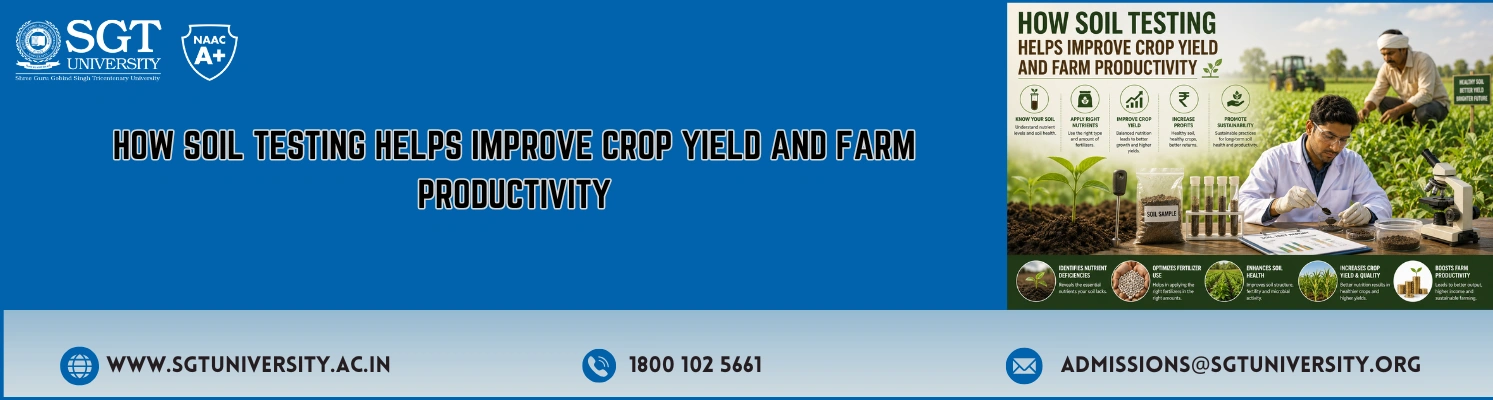
How Soil Testing Helps Improve Crop Yield and Farm Productivity
Updated on: June 30, 2026
Introduction
Walk into any farm, and you'll notice something most farmers never talk about, yet never really ignore either: the soil under their feet. Everyone's busy thinking about seeds, fertilisers, irrigation timing, and weather updates, but honestly, none of that counts for much if the soil itself can't support healthy growth in the first place. This is where soil testing comes in. It doesn't get much attention, but it often ends up being the real reason one harvest does well, and another barely scrapes by.
For generations, Indian farmers have gone by instinct, what their fathers did, what worked last season, a bit of trial and error along the way. That kind of experience counts for something, sure, but it has limits. Soil isn't static. Years of the same cropping pattern, too much chemical fertiliser, and unpredictable rains, all of this drains nutrients or shifts pH levels slowly, with no obvious sign until yields start dropping. Soil testing takes away that guesswork and replaces it with something you can actually measure.
This blog covers what soil testing actually involves, why it's become so important for sustainable farming, and how it affects both crop yields and overall farm productivity. We'll also talk about a recent initiative by SGT University that's putting a lot of this into practice with farmers in Haryana.
Table of Contents
- What Is Soil Testing and Why Does It Matter
- The Direct Link Between Soil Health and Crop Yield
- Major Parameters Checked During Soil Testing
- How Soil Testing Supports Sustainable Farming Practices
- SGT University's Soil Testing Laboratory
- Khet Bachao Abhiyan 2026: SGT University's Outreach in Rewari Villages
- Common Mistakes Farmers Make Without Soil Testing
- Conclusion
- FAQs
What Is Soil Testing and Why Does It Matter
Soil testing is pretty straightforward; you take a sample of soil from the farm, send it to a lab, and it gets analysed for nutrient levels, pH, organic matter, along with many other parameters. It's basically a checkup, except the patient is your land rather than your body. A doctor can't always tell what's wrong just by looking at someone, and the same goes here; a soil test picks up on deficiencies that you'd never spot just by walking the field.
A lot of farmers go by what they see. If the crop looks green, it must be fine. Not necessarily. Soil health doesn't always show up that obviously. A field can look perfectly healthy and still be running low on phosphorus, potassium, or micronutrients like zinc and boron. And if that goes unnoticed long enough, it eventually catches up to lower yield, weaker plants, and more pest problems than you'd expect.
This is exactly why testing matters. It tells you what's actually going on beneath the surface, what your land needs, how much, and when, instead of leaving you to guess.
The Direct Link Between Soil Health and Crop Yield
There's a reason you keep hearing the phrase "healthy soil, healthy crop" from agricultural experts. Soil isn't just there to hold the plant up; it's basically where almost all of a crop's nutrition comes from, right from germination through to flowering and harvest.
When the soil's missing key nutrients, plants don't develop the way they should, with weaker roots, thinner leaves, and poor flowering. And that shows up later as lower yields, smaller produce, and, honestly, less money at the market, too. Soil that's properly balanced, on the other hand, gives you stronger, more resilient plants that perform consistently season after season and not just a one-off good year.
Testing lets a farmer apply fertiliser based on what the land actually needs, not just a rough estimate. That's a big shift from the usual approach of just adding more fertiliser when something looks off, which, more often than not, backfires. Over-fertilising wastes money, sure, but it also destroys soil structure over time, pollutes groundwater, and can even reduce yields because the nutrient balance gets thrown off. With testing, every input has a reason behind it rather than being a shot in the dark.
Major Parameters Checked During Soil Testing
A classic soil test includes a handful of core indicators that show how well a piece of land can support a crop. Here's what gets measured and why each one matters.
| Parameter | What It Tells the Farmer |
|---|---|
| Soil pH | Whether the soil is acidic, neutral, or alkaline, which affects nutrient availability |
| Nitrogen (N) | Needed for leaf growth and overall plant vigour |
| Phosphorus (P) | Important for root development and flowering |
| Potassium (K) | Helps with water regulation and disease resistance |
| Organic Carbon | Indicates soil fertility and microbial activity |
| Micronutrients (Zinc, Boron, Iron, etc.) | Prevents hidden deficiencies that stunt growth |
| Electrical Conductivity | Measures salinity, which can harm sensitive crops |
Once this data is in hand, experts can work out a fertiliser plan tailored to that field, rather than a generic, one-size-fits-all recommendation. This is the idea behind Integrated Nutrient Management (INM): combining organic and inorganic fertilisers in the right ratio. Hence, the soil stays fertile over the long run rather than becoming depleted.
How Soil Testing Supports Sustainable Farming Practices
Sustainable farming gets thrown around a lot as a buzzword, but it's becoming less of an option and more of a necessity. Soil testing plays a big part in that, mainly because it stops two things that quietly wreck soil over time, over-fertilising and nutrient depletion, before they get out of hand.
Once a farmer actually knows what the soil needs, there's no reason to keep dumping in extra chemicals. That saves money, cuts down the risk of groundwater contamination, and keeps the soil's natural microbial life intact, which matters more for long-term fertility than people realise. It also means less fertiliser being manufactured and transported than necessary, which has its own environmental cost.
Testing also opens the door to organic options like vermicomposting and biofertilisers, especially in soils where organic carbon is running low. These help with soil structure and water retention in a way that synthetic inputs don't. And once a farmer understands their land's actual nutrient profile, it becomes much easier to diversify into fruits, exotic vegetables, and even flowers, since each crop has different soil requirements.
At the end of the day, soil testing isn't just about this season's yield. It's about making sure the land remains productive for whoever farms it next.
SGT University's Soil Testing Laboratory
Given how important this is, SGT University established its own Soil Testing Laboratory within the Faculty of Agricultural Sciences. The lab handles soil testing along with advisory support, so farmers aren't just getting numbers back, they're getting guidance on fertiliser use, crop choices, and how to manage their land over time.
Booking a slot is simple; it's all done online, so there's no need for repeat visits or paperwork back and forth. You can book a soil testing slot directly through SGT University's official portal: Book a Lab Slot at SGT University
This kind of access matters a lot, especially for small- and mid-sized farmers who otherwise wouldn't have an easy way to get proper lab testing. By bringing this closer to the farming community, SGT University is helping close that gap between agricultural research and what's actually happening in the field. For more on the university's research work in agriculture, you can check the official site at sgtuniversity.ac.in
Khet Bachao Abhiyan 2026: SGT University's Outreach in Rewari Villages
On June 24, 2026, the Faculty of Agricultural Sciences (FASC) at SGT University, Gurugram, in collaboration with Krishi Vigyan Kendra (KVK), Rewari, and IFFCO Haryana organised an awareness programme as part of the Khet Bachao Abhiyan 2026, held in the villages of Khaliawas and Khatwali in Rewari district. The campaign was a month-long initiative, a nationwide push by the Government of India aimed at improving soil health and advancing sustainable farming.
During the sessions, experts walked farmers through balanced fertiliser use, what a Soil Health Card actually is, and Integrated Nutrient Management, basically combining organic and inorganic fertilisers. Hence, soil fertility holds up over the years. Farmers were also introduced to low-cost methods like vermicomposting and biofertilisers, as well as the idea of diversifying into fruits, vegetables, and flowers to bring in more income without putting extra strain on the land.
Common Mistakes Farmers Make Without Soil Testing
Without testing, even farmers who genuinely know what they're doing end up making mistakes that hurt both yield and soil health over time. Piling on nitrogen-based fertiliser is one of the most common practices, usually done with good intentions, in hopes of faster growth. Still, it can end up burning the crop or throwing off the nutrient balance enough to mess with flowering and fruiting.
Ignoring pH is another big one. If the pH's off, plants can't absorb nutrients properly, even if those nutrients are there in the soil, so all that fertiliser money basically goes to waste. Micronutrient deficiencies get missed a lot, too, mainly because they don't show obvious symptoms early on, but they can quietly stunt growth across an entire season.
Testing helps avoid all of this by giving farmers real numbers to work with, rather than relying on habit or guesswork.
Conclusion
Soil testing isn't a luxury only big commercial farms can afford; it's a practical tool for any farmer, regardless of how much land they have, and it helps protect that land for the future, too. Once a farmer knows exactly what the soil needs, input costs go down, yields go up, and the whole approach shifts toward something more sustainable. Programmes like SGT University's Khet Bachao Abhiyan 2026 outreach in Rewari show what's possible when academic institutions actually show up on the ground and connect research with real farming practice. And through services like its Soil Testing Laboratory, SGT University continues to make that connection easier for farmers who want better soil and better harvests.
If you're a farmer, an agriculture student, or just someone curious about sustainable farming, getting your soil tested is one of the easiest and most useful things you can do. You can book your slot at SGT University here: Book a Lab Slot.
FAQs
Q1. How often should soil testing be done?
Generally, once every season works well, or at least once a year if you're running a fairly stable cropping system enough to keep track of how nutrient levels are shifting.
Q2. Does soil testing really increase crop yield?
Yes. Once you know exactly what's missing, you can target fertiliser use rather than guessing, which shows up in better plant health and yield.
Q3. Is soil testing expensive for small farmers?
Not really, it's fairly affordable, and places like SGT University make it even more accessible with proper lab services open to farmers of any scale.
Q4. What is a Soil Health Card?
It's a report, usually government-issued, that lays out your soil's nutrient status, along with recommendations on which fertilisers to use and how much to apply, based on actual test results.
Q5. Can soil testing help reduce farming costs?
Yes, mainly because it stops over-fertilising. You only spend on what the soil actually needs, which adds up to real savings over time.
Q6. How can I get my soil tested at SGT University?
Just book a slot through the official portal - https://sgtuniversity.ac.in/research/book-a-lab
