BSc Radiology: A Booming Career Option for Science Students
Updated on: 10th February, 2025
BSc Radiology is a course for students who love science and want to help doctors find health problems using machines like X-rays, MRIs, and ultrasounds. At SGT University (SGTU), students learn how to use these machines and understand how the body works. The course takes 3 to 4 years to complete and offers great job opportunities like working as a radiologist or MRI technician. With easy admission process, good faculties, and modern labs, SGT University is a great place to study radiology after completing 12th grade.
What is Radiology?
Radiology is the science of performing various scans like CT, MRI, ultrasound, and X-rays to generate detailed images of the internal body. In particular, it is useful for detecting health issues that cannot be identified through pathology tests. Moreover, with the advancement of science and technology, radiology has emerged as one of the most promising career options in the medical field.
Therefore, if you're interested in pursuing a course in radiology after 12th grade, then you're in the right place. Furthermore, this article will provide you with full information about BSc Radiology eligibility, course duration, admission process, fee structure, and much more. So, without further ado, let's dive in!
What Is BSc Radiology?
BSc Radiology is one of the most popular courses among science stream students because it provides in-depth knowledge of medical imaging. Specifically, it covers radiography principles and techniques, equipping students to efficiently use advanced imaging technology for diagnostics. Furthermore, radiologists specialise in conducting various diagnostic tests such as X-rays, PET scans, CT scans, MRIs, and ultrasounds to detect the root cause of medical conditions. In fact, these healthcare professionals are often the first to detect diseases and alert patients to potential health concerns.
Why Choose a BSc in Radiology After 12th Grade?
As we live in an era of rapid technological advancements, the future of radiology looks very promising. Notably, the increasing demand for diagnostic imaging in the healthcare industry has made radiology an attractive career choice for 12th-grade students. Compared to the intense competition of the NEET exam for MBBS, the admission process for a BSc in Radiology is relatively easy, which in turn reduces mental pressure on students.
- First and foremost, competitive salary
- Secondly, technical focus
- Moreover, Work-Life Balance
- Unlike other medical fields, no odd working hours
- As a result of increasing demand, high market demand
- Lastly, Wide Range of Specialisations
BSc Radiology: Full form
The full form of BSc Radiology or (BSc RIT) is Bachelor of Science in Radiology & Imaging Technology.
BSc Radiology After 12th: Eligibility Criteria
To enrol in a radiology course, a student must complete their 10+2 with at least 60% marks in Physics, Chemistry, and Biology/Mathematics, with English as one of the subjects. Additionally, there is a provision for lateral entry for those who possess a two-year diploma in Radiology/RIT after 12th.
BSc Radiology at SGT University
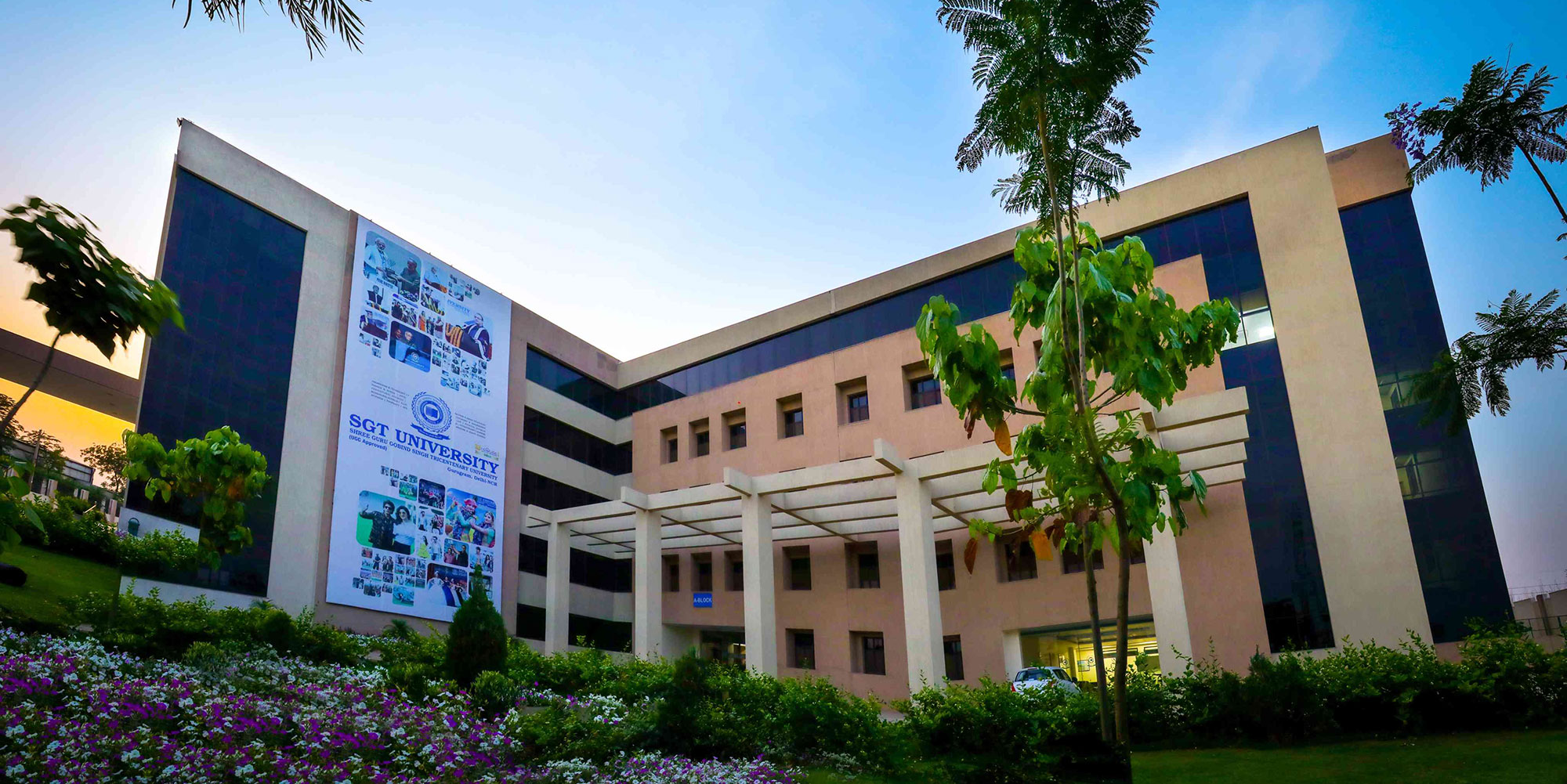
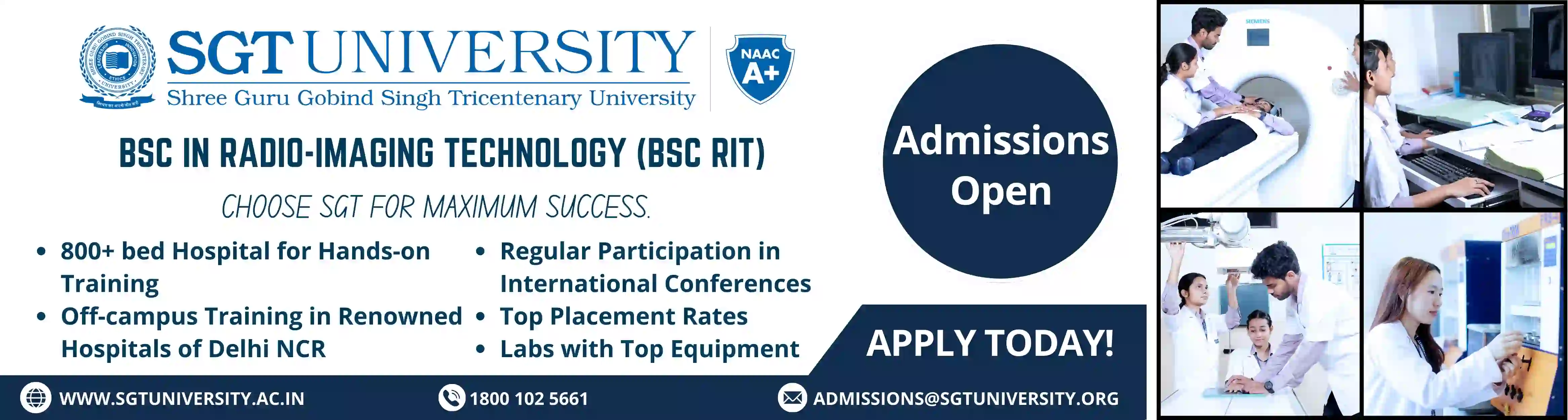
A well-equipped radio imaging technology lab, a robust syllabus, experienced faculty, and hands-on practical exposure make SGTU stand out among other medical schools offering paramedical courses.
BSc Radiology After 12th: Admission Process
SGT University, ranked among "Emerging Bachelor of Science (BSc) Colleges in India" by India Today in 2023 and 2024, offers a 3- and 4-year full-time radiology course.
The process of admission at SGT University is very easy and student-friendly.
- Register on the website and submit your query.
- Get personalised counselling.
- Register on the university's website and fill the application form online or offline.
- Assessment through personal interview or interaction.
- If selected, make payment and secure the seat.
- Submit your documents and get enrolled.
BSc Radiology: Course Duration
| Programme | Duration |
|---|---|
| BSc in Radio-Imaging Technology (BSc RIT) | 3 years (6 semester) |
| BSc in Radio-Imaging Technology (BSc RIT(Honours with research) | 4 years (8 semesters) |
BSc Radiology: Course Fees
| Institution | Course Fees (per annum) |
|---|---|
| SGT University | 1.7 Lakhs |
| KGMU Lucknow | 2 Lakhs |
| BMCRI Bangalore | 2.5 Lakhs |
BSc Radiology: Syllabus Overview
| Year | Key Subjects Covered |
|---|---|
| 1 | Human Anatomy, Human Physiology, General Microbiology and Pathology, Radiation Physics & Fundamental of Medical Imaging |
| 2 | General Radiography Positioning & terminology, Ultrasound & Doppler including 4D & Echocardiography, advanced physics and instrumentation in digital imaging and computed tomography, nuclear medicine and PET scan, Special Investigations& Pathology, Magnetic Resonance Imaging-Basic principle and techniques |
| 3 | Hospital Management & Medical Ethics, MRI Clinical Applications & Imaging protcols,Research Methodology & Biostatistics, Intervention in diagnostic radiology |
| 4 | Research/Dissertation on the topic of your choice |
Career Options and PayScale in BSc Radiology
| Job Role | Salary (INR) |
|---|---|
| Diagnostic radiologist | 5-30 LPA |
| Cardiovascular radiologist | 4-8 LPA |
| Neuroradiologist | 4-12 LPA |
| Paediatric radiologist | 5-10 LPA |
| Musculoskeletal radiologist | 5-15 LPA |
BSc Radiology: FAQs
What is radiology?
Radiology is a science of performing different diagnostic scans to diagnose and treat disease.
Is a radiologist an MBBS doctor?
Yes, radiologists are the doctors who are specialised in radiology.
What does a radiologist do?
These are the doctors who are specialised in conducting various diagnostic tests like x-rays, PET scans, CT scans, MRIs or ultrasounds to detect health problems.
What is the highest-paid job in radiology?
MRI technologists, radiologic technologists, and sonographers are some of the highest-paid options in radiology.
Is radiology a good career option?
As this is the era of technology and advancement, the future of radiology is very bright.
Which is the best course in radiology?
BSc Radiology and Imaging Technology (RIT) is one of the most popular courses in radiology. For applying, you can click here...
What is the future of radiology?
After pursuing radiology, one can become a radiographer, CT technologist, sonographer, radiation oncologist and many more. Countries like Japan, Singapore, and South Korea boast some of the world's best healthcare facilities, making them promising options for those who stay well-informed and updated.