
Myths About Studying Psychology in India: 5 Major Misconceptions You Should Know
Updated on: October 30, 2026
Introduction
Psychology is one of the most popular choices after Class 12, and also one of the most misunderstood. Many students think they need a science background to study it, or that any psychology degree will let them practise as a clinical psychologist. Families are often surprised to learn, three or four years into a degree, that a BA or B.Sc. on its own does not lead to registration as a clinical psychologist.
Quick answer: In India, you can study psychology after Class 12 in arts, commerce or science; most BA psychology courses accept all streams, though a few specialised courses ask for science. A general BA, B.Sc., MA or M.Sc. in Psychology does not make you a clinical psychologist. To practise as one, you need a professional qualification recognised by the Rehabilitation Council of India (RCI), such as the two-year Master in Clinical Psychology (M.Clin.Psy) that has replaced the M.Phil, and registration on the RCI's Central Rehabilitation Register (CRR).
This article explains the difference between academic and professional qualifications, clears up five common misconceptions and shows how to decide which psychology course is right for you.
Table of Contents
- Myths vs Facts at a Glance
- Misconception 1: Only Science Students Can Study Psychology
- Misconception 2: A Psychology Degree Makes You a Clinical Psychologist
- Misconception 3: You Need an M.Phil to Become a Clinical Psychologist
- Misconception 4: Psychology Graduates Earn Little and Only Work in Clinics
- Misconception 5: One Body Regulates All Psychology Careers
- Psychology Programmes at SGT University
- How to Choose the Right Psychology Course
- Key Takeaways
- FAQs
- Sources
Myths vs Facts at a Glance
| Myth | Fact |
|---|---|
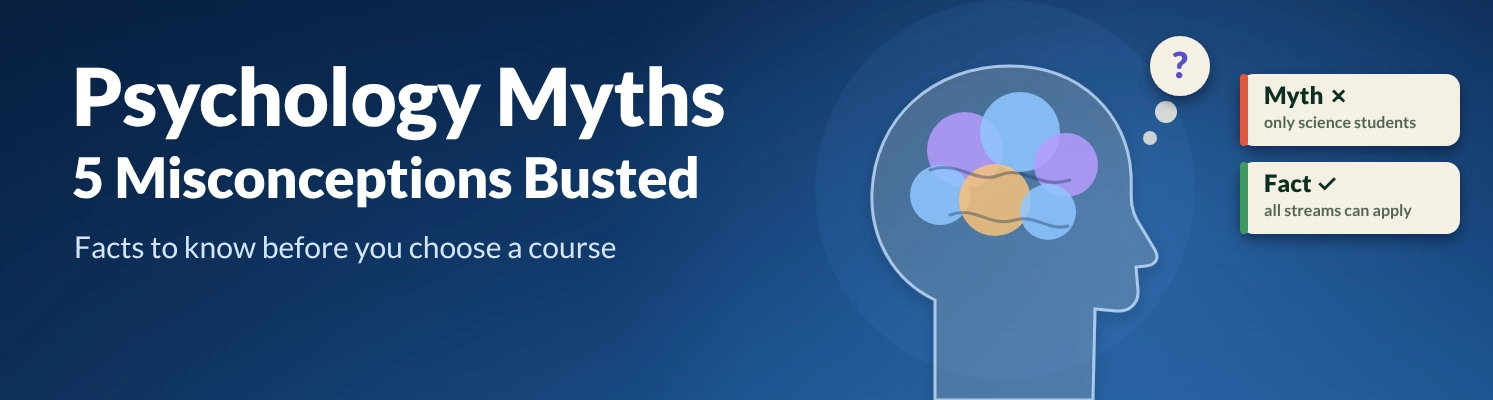
| Only science students can study psychology | Most BA psychology courses accept arts, commerce and science students; a few specialised courses ask for science |
| A psychology degree makes you a clinical psychologist | Only an RCI-recognised professional qualification and CRR registration allow you to practise as one |
| You need an M.Phil to become a clinical psychologist | From 2026-27, the two-year Master in Clinical Psychology (M.Clin.Psy) replaces the M.Phil |
| Psychology graduates earn little and only work in clinics | They also work in HR, UX research, education, sports, law and research; pay depends on role, qualification and experience |
| One body regulates all psychology careers | RCI covers clinical psychologists; the NCAHP covers other psychologists |
Misconception 1: Only Science Students Can Study Psychology
Fact: Students from arts, commerce and science backgrounds can study psychology, depending on each university's entry requirements. Psychology is an interdisciplinary subject that draws on biology, sociology, philosophy, statistics and behavioural science, so you do not always need a science background to study it at a higher level.
Entry requirements
Many universities accept students from all Class 12 streams but set a minimum percentage, compulsory subjects or an entrance test. For example, SGT University's BA (Hons./Hons. with Research) Applied Psychology asks for at least 60% aggregate marks in Class 12 with English as one of the subjects, and does not name a required stream.
Some specialised courses do ask for science. At SGT University, the Bachelor in Clinical Psychology (B.Clin.Psy) (RCI) lists the science stream with at least 50% marks, and the B.Sc. (Hons. with Research) Cognitive Science asks for physics, chemistry and one of mathematics, biology or psychology, with at least 60% marks and English. Always check the programme page before you apply.
BA or B.Sc.?
BA courses usually focus more on social science, human development and psychological theory. B.Sc. courses may give more weight to research methods, statistics and the biological side of psychology.
At SGT University's School of Behavioural Sciences, students can choose from the BA (Hons./Hons. with Research) Applied Psychology, B.Sc. (Hons. with Research) Psychology, the Bachelor in Clinical Psychology (RCI) and the B.Sc. Cognitive Science. Choose the course that suits your interests, your eligibility and your career goals. Our guide on why to choose BA Psychology after 12th explains the BA route in more detail.
Misconception 2: A Psychology Degree Makes You a Clinical Psychologist
Fact: There is a difference between an academic qualification and a professional one.
The Rehabilitation Council of India (RCI) was set up in 1986 and became a statutory body under the Rehabilitation Council of India Act, 1992. It regulates the training of rehabilitation professionals, including clinical psychologists, and maintains the Central Rehabilitation Register (CRR). A general BA, B.Sc., MA or M.Sc. in Psychology does not, on its own, let you register as a clinical psychologist.
| Qualification | What it gives you |
|---|---|
| Bachelor's in Psychology (BA or B.Sc.) | A foundation in behaviour, cognition, personality and research |
| MA or M.Sc. in Psychology | Advanced knowledge and a specialisation, such as clinical or counselling psychology; an academic degree, not a licence to practise |
| RCI-recognised professional course, such as the Master in Clinical Psychology | The route to registration on the CRR as a clinical psychologist |
| Ph.D. in Psychology | Research and academic skills; it does not, on its own, lead to registration as a clinical psychologist |
If you want to practise as a clinical psychologist, check which courses are professionally recognised. SGT University's School of Behavioural Sciences has departments of Psychology, Clinical Psychology and Cognitive Sciences, and offers two RCI-recognised postgraduate programmes: the two-year Master in Clinical Psychology (M.Clin.Psy) (RCI) and the one-year Professional Diploma in Clinical Psychology (RCI), after which graduates can register with the RCI as a Clinical Psychologist (Associate).
Check the course's current RCI approval and the entry requirements for the year you plan to apply. This confirms that you will be eligible to register on the CRR. Our guide to the difference between M.Sc. and M.A. in Clinical Psychology explains how the two routes differ.
Misconception 3: You Need an M.Phil to Become a Clinical Psychologist
Fact: The M.Phil route is being phased out, and a two-year master's programme is now the main professional route.
- The change: under the National Education Policy 2020, the UGC discontinued M.Phil programmes. A UGC letter attached to an RCI public notice of September 2024 allowed admissions to the M.Phil in Clinical Psychology only up to the 2025-26 session, with the programme offered under a new name from 2026-27.
- The new programme: RCI's guidelines describe a two-year, full-time MA in Clinical Psychology that replaces the M.Phil. Applicants need a four-year BA or B.Sc. in Psychology with at least 55% marks (50% for SC/ST candidates). Those with a three-year degree must complete a bridge course or the first year of a master's in psychology.
- The new name: an RCI office memorandum dated 3 May 2026 renamed the MA in Clinical Psychology as the Master in Clinical Psychology (M.Clin.Psy), and the B.Sc. in Clinical Psychology as the Bachelor in Clinical Psychology (B.Clin.Psy).
- Earlier students: students admitted to the M.Phil under the previous framework follow the provisions that applied when they joined.
What to check
- Your institution is currently approved by the RCI for the course.
- The course itself is recognised for registration on the CRR.
- Your bachelor's degree meets the entry requirement, which may mean a four-year degree.
- Whether you need a bridge course before you can apply.
SGT University's Master in Clinical Psychology (M.Clin.Psy) is listed on its website as approved by the RCI. It asks for a bachelor's degree in psychology with at least 55% marks (50% for SC/ST candidates), and notes that updated norms may require a four-year degree. Our guide to clinical psychology courses after 12th maps the full pathway.
Misconception 4: Psychology Graduates Earn Little and Only Work in Clinics
Fact: Psychology graduates work in many sectors, and earnings depend on qualification, experience, specialisation, location and employer.
Psychology is no longer used only in hospitals and private clinics. Many organisations now draw on behavioural science in recruitment, consumer research, education, technology and development work. Some of the career areas open to psychology graduates:
| Career area | What you would do |
|---|---|
| Clinical psychology | Assess, diagnose and treat mental health conditions; requires an RCI-recognised qualification and CRR registration |
| Counselling | Support people dealing with stress, relationships, studies or career choices |
| Corporate and organisational psychology | Improve hiring, employee engagement, wellbeing and organisational development |
| UX research | Study how people use products and services so they can be designed better |
| Educational psychology | Support learning and help students with learning difficulties |
| Sports psychology | Help athletes improve concentration, motivation and performance |
| Forensic psychology | Apply psychology in legal and criminal justice settings, such as assessments and victim support |
| Research and teaching | Teach and carry out research, usually after a Ph.D. |
Each career needs a different mix of academic background, experience and, in some cases, professional recognition. Read more about forensic psychology as a career in India and about a Ph.D. in Psychology versus Clinical Psychology.
Misconception 5: One Body Regulates All Psychology Careers
Fact: The RCI and the National Commission for Allied and Healthcare Professions (NCAHP) have different roles, so check which rules apply to the career you want.
- RCI: regulates the training and registration of clinical psychologists and maintains the Central Rehabilitation Register. If you plan to work in clinical psychology, follow the RCI's requirements.
- NCAHP: the National Commission for Allied and Healthcare Professions Act, 2021 covers psychologists under Category 7, "Community Care, Behavioural Health Sciences and Other Professionals". Clinical psychologists are expressly excluded, because they remain under the RCI.
- NCAHP registration: eligible psychologists can now apply to register, but registration is not automatic. It depends on the qualification, course duration, mode of learning and experience in health settings.
- Not the same thing: NCAHP registration is not a clinical psychology licence and should not be confused with RCI recognition.
If you plan to work in a non-clinical area of psychology, keep up with the latest guidance on professional recognition, as the rules are still being put in place.
Psychology Programmes at SGT University
SGT University, Gurugram, offers the following psychology programmes through its School of Behavioural Sciences. Details are taken from the university's website in October 2026; confirm them for the year you apply.
| Programme | Level and duration | Eligibility | Recognition |
|---|---|---|---|
| BA (Hons./Hons. with Research) Applied Psychology | Undergraduate, 3 or 4 years | 60% in Class 12, with English | Academic degree |
| B.Sc. (Hons. with Research) Psychology | Undergraduate, 3 or 4 years | Class 12 with English; see the programme page for marks | Academic degree |
| Bachelor in Clinical Psychology (B.Clin.Psy) | Undergraduate, 4 years | 50% in Class 12, science stream | RCI-approved |
| B.Sc. (Hons. with Research) Cognitive Science | Undergraduate, 4 years | 60% in Class 12, with physics, chemistry, and mathematics, biology or psychology | Academic degree |
| M.Sc. Psychology (Clinical); M.Sc. Psychology (Counselling); M.Sc. Cognitive Science | Postgraduate | A relevant bachelor's degree; see each programme page | Academic degrees |
| Master in Clinical Psychology (M.Clin.Psy) | Postgraduate, 2 years | Bachelor's in psychology with 55% (50% SC/ST); a four-year degree may be needed | RCI-approved |
| Professional Diploma in Clinical Psychology | Diploma, 1 year | MA or M.Sc. in Psychology with 55% (50% SC/ST) | RCI-recognised; register as Clinical Psychologist (Associate) |
| Ph.D. in Psychology/Clinical Psychology | Doctorate | See the programme page | Research degree |
Related reading: how SGT University prepares students for careers in cognitive science and why choose a diploma in clinical psychology.
How to Choose the Right Psychology Course
Do not choose on the university's name or placement claims alone. Check that:
- You meet the entry requirements, including minimum marks, compulsory subjects and any entrance test.
- The course covers research methods, statistics, psychological assessment and practical work.
- If you want to become a clinical psychologist, the course and the institution are approved by the RCI.
- There are chances to gain practical experience through internships, laboratory work and supervised practice.
- You know what alumni have gone on to do: where they work and how many went on to postgraduate study.
If you are considering SGT University, you can find the course structure, entry requirements and admission steps on each programme page and on the university's admissions portal. Finally, work out the full cost of your education, including tuition, postgraduate study and any professional training you need. Planning your whole pathway from the start will help you make an informed decision.
Key Takeaways
- Students from arts, commerce and science can study psychology; a few specialised courses ask for science.
- A general psychology degree is an academic qualification, not a licence to practise as a clinical psychologist.
- Clinical psychologists need an RCI-recognised professional qualification and registration on the CRR.
- From 2026-27, the two-year Master in Clinical Psychology (M.Clin.Psy) replaces the M.Phil in Clinical Psychology.
- Psychology graduates work in clinics, companies, schools, sports, law, technology and research.
- The RCI regulates clinical psychologists, while the NCAHP covers other psychologists.
FAQs
Q1. Can I study psychology after Class 12 arts in India?
Yes. Students from arts, commerce and science can apply for most undergraduate
psychology courses, such as a BA in Psychology. Entry requirements vary by university,
and a few specialised courses ask for science subjects.
Q2. Do I need maths to study psychology?
Not for most undergraduate psychology courses. You will, however, study statistics and
research methods as part of the degree. Some specialised courses, such as cognitive
science, ask for science subjects in Class 12.
Q3. What is the difference between BA Psychology and BSc Psychology?
BA psychology courses usually focus more on psychological theory, social behaviour and
human development. BSc psychology courses may give more weight to biological
psychology, research and quantitative methods. The exact balance depends on the
university.
Q4. Does SGT University offer psychology courses?
Yes. SGT University's School of Behavioural Sciences offers undergraduate,
postgraduate, diploma and doctoral programmes in applied psychology, clinical
psychology and cognitive science, including the RCI-approved Bachelor in Clinical
Psychology and Master in Clinical Psychology.
Q5. What are the entry requirements for BA (Hons) Applied Psychology at SGT
University?
According to SGT University's website, you need at least 60% aggregate marks in Class
12 with English as one of your subjects. Check the programme page or the admissions
portal for the year you apply.
Q6. What is the difference between applied psychology and clinical psychology?
Applied psychology uses psychological principles to solve real-world problems in
settings such as education and the workplace. Clinical psychology focuses on
assessing, diagnosing and treating mental health conditions.
Q7. Can I become a clinical psychologist after a BA in Psychology?
Not with a BA alone. You will need an RCI-recognised professional qualification, such
as the two-year Master in Clinical Psychology, and registration on the RCI's Central
Rehabilitation Register.
Q8. What is RCI registration?
The Rehabilitation Council of India maintains the Central Rehabilitation Register of
qualified professionals. To practise as a clinical psychologist, you need a recognised
qualification and registration on this register.
Q9. Is an MA in Psychology enough to become a clinical psychologist in India?
No. A general MA or M.Sc. in Psychology does not make you a clinical psychologist. You
need an RCI-recognised professional course, now called the Master in Clinical
Psychology (M.Clin.Psy).
Q10. Is M.Phil in Clinical Psychology still valid in India?
Admissions to the M.Phil in Clinical Psychology were allowed only up to the 2025-26
session. From 2026-27, the two-year Master in Clinical Psychology replaces it.
Students admitted earlier follow the rules that applied when they joined.
Sources
The facts and figures in this article come from the sources below.
- Rehabilitation Council of India (RCI), About Us (accessed October 2026). Used for: the history and role of the RCI and the Central Rehabilitation Register.
- RCI, Public notice on continuing M.Phil. Clinical Psychology and M.Phil. Rehabilitation Psychology (September 2024). Used for: M.Phil admissions allowed up to 2025-26 and the change from 2026-27.
- RCI, Master of Arts in Clinical Psychology: RCI regulated programme guidelines (2025). Used for: the two-year programme that replaces the M.Phil and its eligibility rules.
- RCI, Change of nomenclature of courses in Clinical Psychology / Rehabilitation Psychology (3 May 2026). Used for: the new names M.Clin.Psy and B.Clin.Psy.
- Psychologs, NCAHP registration guidelines for psychology students and professionals (2 October 2026). Used for: the NCAHP category for psychologists, the exclusion of clinical psychologists and how registration works.
- Careers360, Psychology courses caught in UGC, NCAHP, RCI tangle, causing confusion (17 July 2026). Used for: how the NCAHP and RCI divide responsibility for psychologists.
SGT University programme details (eligibility, duration and RCI status) are taken from the programme pages linked in this article, as they appeared in October 2026.
