
MBA vs PGDM: Which Is Better for Your Career in 2027?
Updated on: October 15, 2026
Introduction
If you are planning management studies, you will see two labels again and again: MBA and PGDM. They look alike on a brochure, cost similar amounts, and lead to similar jobs, yet many students only learn the difference when a PhD application or a government job form asks for a 'degree'.
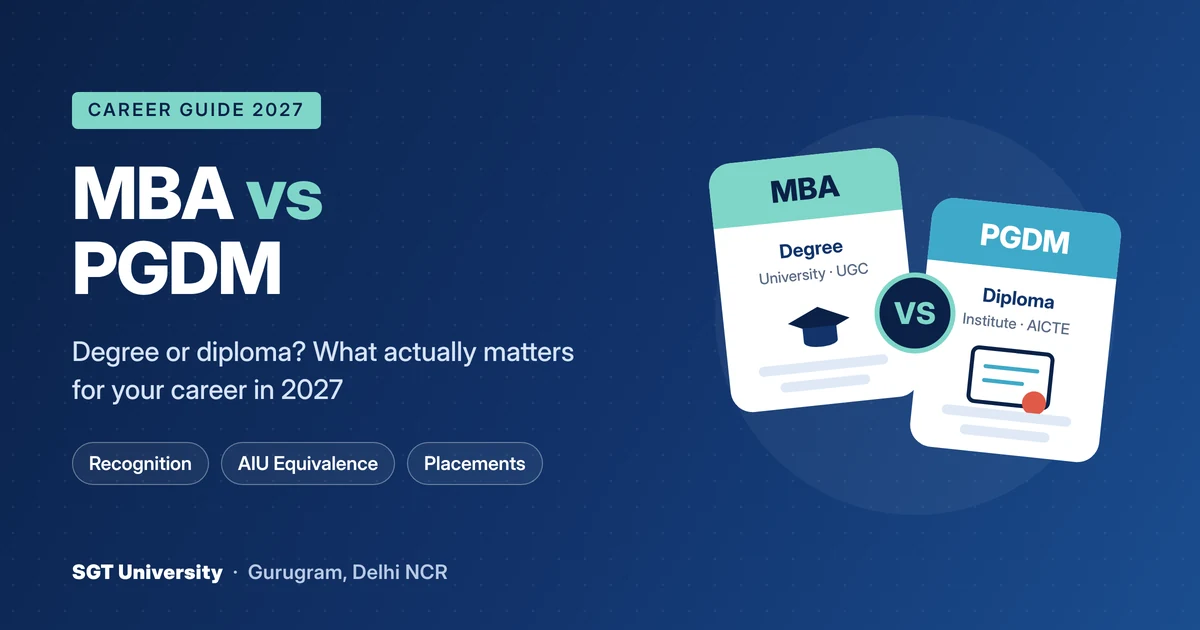
Quick answer: An MBA (Master of Business Administration) is a postgraduate degree awarded by a UGC-recognised university. A PGDM (Post Graduate Diploma in Management) is a postgraduate diploma awarded by an AICTE-approved autonomous institute. For corporate jobs, the quality of the institute matters much more than the label. Choose an MBA if you may later want a PhD, a government job or study abroad, because a university degree rarely faces recognition questions. Choose a PGDM only from an AICTE-approved institute whose programme is recognised as equivalent to an MBA by the Association of Indian Universities (AIU), and only if its curriculum and placements are clearly stronger than your MBA options.
This guide compares the two side by side, explains AIU equivalence in plain terms, and gives you a checklist to verify any programme before you pay a fee.
Table of Contents
- MBA vs PGDM at a Glance
- What Is an MBA?
- What Is a PGDM?
- MBA vs PGDM: Key Differences
- Is PGDM Equivalent to MBA? AIU Equivalence Explained
- MBA vs PGDM for Government Jobs, PhD and Study Abroad
- Placements and Salary: What Really Decides Them
- Entrance Exams for MBA and PGDM in 2027
- Which Should You Choose? A Decision Guide
- How to Verify an MBA or PGDM Before You Pay
- MBA at SGT University
- Key Takeaways
- FAQs
MBA vs PGDM at a Glance
| Particular | MBA | PGDM |
|---|---|---|
| Full form | Master of Business Administration | Post Graduate Diploma in Management |
| Type of qualification | Postgraduate degree | Postgraduate diploma |
| Awarded by | A university recognised by the UGC (central, state, private or deemed) | An autonomous institute approved by the AICTE |
| Duration | Usually 2 years, full time | Usually 2 years, full time |
| Curriculum | Set within the university's academic framework; changes go through university bodies | Set by the institute itself; can be updated more often |
| Recognition as a master's | Automatic, as a university degree | Through AIU equivalence, granted programme by programme |
| Entrance exams | CAT, XAT, MAT, CMAT, GMAT, state tests, university tests, CUET PG | CAT, XAT, MAT, CMAT, ATMA, GMAT |
| Typical eligibility | Bachelor's degree, usually with at least 50% marks (relaxation for reserved categories) | Bachelor's degree, usually with at least 50% marks (relaxation for reserved categories) |
What Is an MBA?
An MBA is a master's degree in management. In India, only universities can award degrees, so an MBA comes from a university established under a central or state law, or one declared a deemed-to-be university, and recognised by the University Grants Commission. Colleges affiliated with a university also teach MBA programmes, but the degree is awarded by the parent university.
Because it is a degree, an MBA is accepted wherever a master's degree is required, for further study, teaching, government recruitment or evaluation abroad, without any equivalence certificate. The trade-off is that changes to the syllabus pass through the university's academic council, which can make the curriculum slower to change.
The IIMs show how much the label matters. Under the Indian Institutes of Management Act, 2017, they became institutions able to award degrees and, from 2018, began awarding MBA degrees in place of their earlier postgraduate diploma (Careers360).
What Is a PGDM?
A PGDM is a postgraduate diploma in management awarded by an autonomous institute, often called a standalone business school, that is not part of a university. Such institutes cannot award degrees, so they award a diploma instead. To run a PGDM, the institute needs approval from the All India Council for Technical Education (AICTE), which it must renew every year through an Extension of Approval.
The main advantage of a PGDM is flexibility. The institute designs its own curriculum and can add courses in areas such as analytics, fintech or digital marketing as soon as industry demand appears. The main risk is recognition: a PGDM is treated as equal to an MBA only when the AIU has granted equivalence to that specific programme.
MBA vs PGDM: Key Differences
| Factor | MBA | PGDM | What it means for you |
|---|---|---|---|
| Recognition | Degree from a UGC-recognised university | Diploma from an AICTE-approved institute | MBA needs no extra proof; PGDM needs AIU equivalence for many academic purposes |
| Regulator | UGC (and AICTE where applicable) | AICTE | Check approval status for every year of your course |
| Curriculum updates | Through university academic bodies | Decided by the institute | PGDM can be more current; a good MBA can still be industry-relevant |
| Focus | Often a balance of theory and application | Often more case studies and industry projects | Depends more on the institute than on the label |
| Fees | Wide range; government universities are usually cheapest | Often higher at well-known autonomous institutes | Compare the full two-year cost |
| PhD and UGC-NET | Eligible as a master's degree | Usually needs an AIU equivalence certificate | Choose an MBA, or an AIU-recognised PGDM, if academia is a possibility |
| Government and PSU jobs | Meets 'degree' requirements | Accepted if the notification allows an equivalent qualification | Read each recruitment notice's eligibility clause |
| Study and work abroad | Generally easier to evaluate | Treatment varies by country | Check the destination country's evaluation rules |
| Placements | Depend on the university's brand and recruiters | Depend on the institute's brand and recruiters | The institute matters far more than the label |
Is PGDM Equivalent to MBA? AIU Equivalence Explained
This is the question most students ask, and the honest answer is: only if that particular programme has been granted equivalence. The Association of Indian Universities (AIU), the body that decides academic equivalence between qualifications in India, assesses PGDM programmes one institute at a time.
An AIU equivalence letter issued in January 2026 to one PGDM institute shows how it works in practice (AIU letter, 19 January 2026):
- It is granted to a specific programme, in that case a two-year full-time PGDM, not to PGDMs in general.
- It is linked to approvals. The equivalence was based on the institute's AICTE approval and NBA accreditation.
- It is granted for admission to higher studies, such as a PhD.
- It is time-bound. That letter is valid for three years, or until the AICTE and NBA approvals lapse, whichever comes first.
The AIU publishes a list of PGDM institutions whose programmes it recognises. Before you accept an offer, look for the institute on the AIU PGDM institution list (June 2026) and ask the institute for its current equivalence letter. If the institute is not on the list, assume you may need to prove your qualification separately later.
MBA vs PGDM for Government Jobs, PhD and Study Abroad
Government and PSU jobs
Recruitment notices set their own eligibility rules. Many management posts in public sector undertakings ask for a two-year MBA or an equivalent PGDM approved by the AICTE, while others ask for a degree. An MBA from a UGC-recognised university meets both kinds of requirement. A PGDM meets them only when the notice allows an equivalent qualification and the programme is AICTE-approved, and some employers also ask for AIU equivalence. Read the eligibility clause of the exact notification you are targeting.
PhD, UGC-NET and teaching
Universities admit students to PhD programmes on the basis of a master's degree or an equivalent qualification. MBA graduates apply directly. PGDM graduates are usually asked for an AIU equivalence certificate, which is exactly what the AIU grants equivalence for. If you think you might one day teach or research, an MBA, or a PGDM already on the AIU list, keeps that door open.
Study and work abroad
Foreign universities and credential evaluators generally assess a university degree more easily than a diploma. Some PGDM programmes are well known abroad because of the institute's reputation, but treatment varies by country. If you plan to move abroad, check the destination's evaluation rules before you decide.
Placements and Salary: What Really Decides Them
Recruiters hire from institutes, not labels. A PGDM from a top autonomous school will usually place better than an MBA from a weak university, and an MBA from a strong university will place better than a PGDM from an unknown institute. When you compare offers, focus on these factors, which drive your salary far more than the word on your certificate:
- Recruiter list and roles: which companies hired in the last two years, and for which roles?
- Median salary, not just the highest: the highest package is one student; the median tells you what a typical graduate earns.
- Share of students placed: how many of the batch who opted for placement actually received offers?
- Specialisation fit: strong placements in finance do not help if you want healthcare management or marketing.
- Internships and live projects: summer internships often turn into pre-placement offers.
- Alumni network: alumni in your target industry help with referrals for years after you graduate.
For a sense of where an MBA can lead, see our guide to the highest-paying jobs after an MBA in India.
Entrance Exams for MBA and PGDM in 2027
The same entrance exams lead to both MBA and PGDM programmes, so you do not need separate preparation. CAT 2026, conducted by the IIMs, is scheduled for 29 November 2026 in three sessions (Deccan Herald; official site: iimcat.ac.in).
| Exam | Conducted by | Accepted for |
|---|---|---|
| CAT | IIMs | IIM MBA programmes and many universities and PGDM institutes |
| XAT | XLRI | XLRI and many PGDM institutes and universities |
| CMAT | National Testing Agency | AICTE-approved MBA and PGDM institutes |
| MAT | All India Management Association | Many private universities and PGDM institutes |
| ATMA | AIMS | Several PGDM institutes and universities |
| GMAT | GMAC | Selected Indian institutes and international programmes |
| CUET PG / university tests | NTA / individual universities | MBA programmes at universities that use them |
Many private universities also admit MBA students through their own entrance test or interview. Check each institute's admission notice for the exams it accepts and the cut-off it uses.
Which Should You Choose? A Decision Guide
| If you are… | Lean towards | Why |
|---|---|---|
| A fresher aiming for a corporate job | Whichever institute has the stronger placement record in your target role | Recruiters judge the institute, not the label |
| Considering a PhD, UGC-NET or teaching later | MBA (or an AIU-recognised PGDM) | No equivalence certificate needed for an MBA |
| Preparing for government or PSU management roles | MBA | Meets degree requirements in every type of notification |
| Planning to study or work abroad | MBA from a recognised university | Easier for foreign evaluators to assess |
| Keen on a niche, fast-changing area such as analytics or fintech | Compare curricula; a PGDM may update faster, but many MBAs now offer these specialisations | Check the actual course list, not the brochure headline |
| Targeting a sector such as healthcare or pharma | A programme with a dedicated specialisation and industry links | Sector exposure matters more than the label |
| Working on a tight budget | A well-regarded university MBA | University MBAs are often less expensive |
How to Verify an MBA or PGDM Before You Pay
- For an MBA: confirm the university appears on the UGC website's list of recognised universities.
- For a PGDM: confirm the institute holds AICTE approval (Extension of Approval) for the current year and for the programme you are joining.
- For PGDM equivalence: check the AIU PGDM institution list and ask for the current equivalence letter.
- Accreditation and rankings: look for NAAC accreditation (for universities), NBA accreditation (for programmes) and the NIRF management ranking.
- Placement report: ask for the latest report with the median salary, the percentage placed and the recruiter list.
- Total cost: get the full two-year fee in writing, including hostel, examination and other charges.
Our guide to private university accreditation in India explains what each approval means.
MBA at SGT University
SGT University, Gurugram, is a NAAC A+ accredited private university, so the MBA it offers through its Faculty of Commerce and Management is a university degree. That means no separate equivalence certificate is needed for higher studies or government recruitment.
The faculty offers MBA specialisations that include dual specialisations, hospital administration and pharmaceutical management. The last two draw on the university's healthcare ecosystem, including its associated hospital.
These pages cover the next steps:
- Commerce and Management blogs: guides on BBA, MBA and specialisations
- MBA courses: syllabus, eligibility, scope and salary
- MBA in digital marketing: career opportunities
- Why pursue business analytics in India
- Applying for PG courses in Gurgaon: fees and deadlines
- Admission procedure at SGT University: the online and offline steps
- How to get college scholarships: a beginner's guide
Key Takeaways
- An MBA is a degree from a UGC-recognised university; a PGDM is a diploma from an AICTE-approved autonomous institute.
- A PGDM counts as equal to an MBA only when the AIU has granted equivalence to that specific programme, and that equivalence is time-bound.
- For corporate placements, the institute's reputation, recruiters and median salary matter far more than the label.
- Choose an MBA if a PhD, teaching, government jobs or study abroad are possibilities.
- CAT 2026 is on 29 November 2026, and the same exams lead to both MBA and PGDM admissions.
- Verify UGC or AICTE status, AIU equivalence, accreditation and the placement report before you pay any fee.
We will update this guide as admission notices for the 2027 session are released.
FAQs
Q1. What is the main difference between MBA and PGDM?
An MBA is a postgraduate degree awarded by a university recognised by the University Grants
Commission (UGC). A PGDM is a postgraduate diploma awarded by an autonomous institute
approved by the All India Council for Technical Education (AICTE). Both usually take two
years and cover similar management subjects; the difference lies mainly in who awards the
qualification and how often the curriculum can change.
Q2. Is PGDM equivalent to MBA?
Not automatically. The Association of Indian Universities (AIU) grants equivalence to
individual PGDM programmes, institute by institute. Recent AIU letters link equivalence to
AICTE approval and NBA accreditation, grant it for admission to higher studies, and make it
valid for a fixed period, such as three years. Check the AIU's published list of PGDM
institutions before you join.
Q3. Which is better, MBA or PGDM?
Neither is better in every case. For placements, the reputation of the institute, its
faculty and its recruiters matter far more than whether you get a degree or a diploma. An
MBA is the safer choice if you may want a PhD, a government job or study abroad, because a
university degree rarely faces recognition questions. A PGDM from a well-established,
AICTE-approved and AIU-recognised institute can be equally strong for corporate careers.
Q4. Is PGDM valid for government jobs?
It depends on the job notification. Many government and PSU posts ask for a master's degree
in management or an equivalent qualification, and a PGDM is usually accepted only if it is
AICTE-approved and, in many cases, recognised as equivalent by the AIU. Always read the
eligibility clause of the specific recruitment notice. An MBA from a UGC-recognised
university meets degree requirements without this extra check.
Q5. Can I do a PhD after PGDM?
Yes, if your PGDM is recognised as equivalent to a master's degree. Universities usually ask
PGDM holders for an AIU equivalence certificate when they apply for PhD programmes or
UGC-NET. Graduates with an MBA from a UGC-recognised university do not need this step.
Q6. Do IIMs award MBA or PGDM?
IIMs now award MBA degrees. Under the Indian Institutes of Management Act, 2017, IIMs became
institutions of national importance able to award degrees, and they began awarding MBA
degrees in place of the earlier postgraduate diploma from 2018.
Q7. Is PGDM more expensive than MBA?
Often, but not always. Autonomous PGDM institutes set their own fees and frequently charge
more than university MBA programmes, especially government universities. Private university
MBA fees also vary widely. Compare the total two-year cost of each programme you are
considering, including hostel and other charges.
Q8. Which entrance exams are accepted for MBA and PGDM?
Both accept similar exams: CAT, XAT, MAT, CMAT, ATMA, GMAT and state-level tests, depending
on the institute. Some universities run their own entrance tests or use CUET PG for MBA
admission. CAT 2026 is scheduled for 29 November 2026.
Q9. Is a PGDM accepted abroad?
Recognition abroad varies by country and university. A degree from a recognised university
is generally easier to evaluate for higher studies or work visas. If you plan to study or
work abroad, check how the destination's credential evaluation bodies treat a PGDM before
you choose one.
Q10. Does SGT University offer an MBA or a PGDM?
SGT University, Gurugram, offers an MBA, which is a degree awarded by the university. Its
Faculty of Commerce and Management offers MBA specialisations, including dual
specialisations, hospital administration and pharmaceutical management.