New Labour Codes: What Changes in Your First Salary, PF and Gratuity
Updated on: November 6, 2026
Introduction
You have just received your first job offer. The CTC looks good, but the salary breakup is full of terms like basic pay, HRA, PF and gratuity, and someone has told you that India's new labour codes change all of them. They do change some of them, and knowing how will help you read your offer letter with confidence.
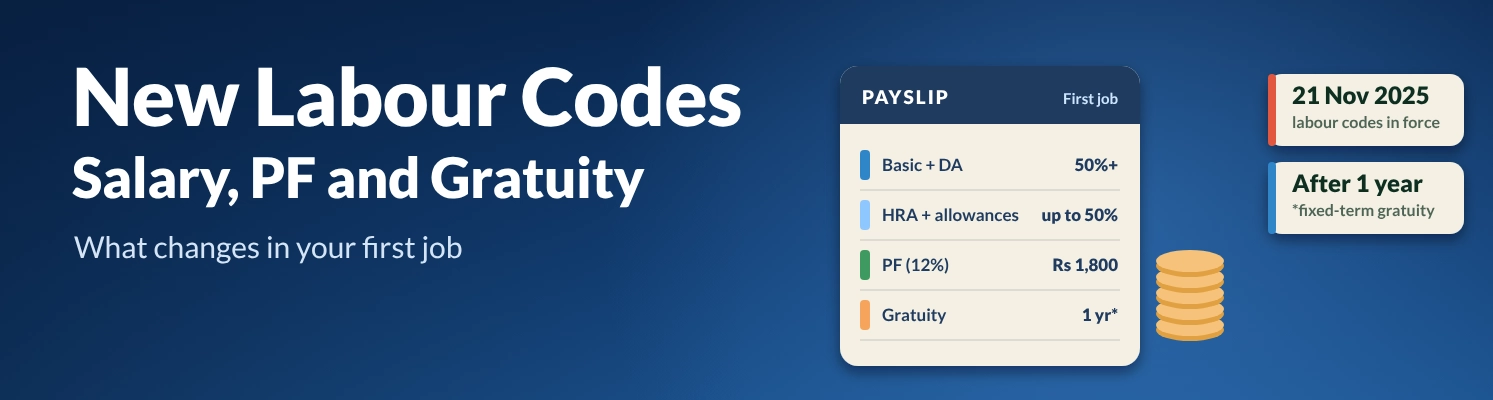
Quick answer: India's four new labour codes came into force on 21 November 2025. For a first job, the biggest changes are: wages for PF and gratuity must make up at least 50% of your total pay; PF on the Rs 15,000 wage ceiling stays the same, so take-home pay does not fall if your PF is calculated on that ceiling; fixed-term employees now get gratuity after one year instead of five; salaries must be paid before the 7th of the next month; and your dues must be settled within two working days of leaving. Appointment letters are now mandatory.
This guide explains each change in plain language, with worked examples, a checklist for your offer letter and a note for parents. It is general information, not legal advice; your employer's HR team and the official rules for your state have the final word.
Table of Contents
- Labour Codes at a Glance: What Changes for You
- What Are the New Labour Codes?
- The 50% Wage Rule: How Your Salary Structure May Change
- Will Your PF Deduction and Take-Home Pay Change?
- Gratuity: Who Gets It After One Year
- Salary Dates, Working Hours and Leave
- Appointment Letters and Leaving a Job
- Checklist Before You Sign Your First Offer Letter
- What Parents Should Know
- Why This Matters for HR, Payroll and Finance Careers
- Key Takeaways
- FAQs
- Sources
Labour Codes at a Glance: What Changes for You
| Area | What changed | What it means for you |
|---|---|---|
| Start date | Four codes in force from 21 November 2025, replacing 29 laws | Applies to your first job |
| Wages | Excluded allowances above 50% of total pay count as wages | Basic pay and DA are likely to be a bigger share of your salary |
| PF | Deductions remain based on the Rs 15,000 wage ceiling; contributions above it are voluntary | No fall in take-home pay if your PF is on the ceiling |
| Gratuity | Fixed-term employees qualify after one year; permanent employees after five | Short contracts can now carry gratuity |
| Salary date | Monthly wages before the end of the 7th day of the next month | Predictable pay dates |
| Leaving a job | Wages payable within two working days of resignation | Faster final pay |
| Paperwork | Appointment letters mandatory | Your terms in writing from day one |
| Leave | Annual leave after 180 days of work; carry forward up to 30 days | Leave starts sooner |
| Hours | Up to 48 hours a week; overtime at twice the ordinary rate | Extra hours must be paid at double rate |
What Are the New Labour Codes?
The labour codes bring 29 separate labour laws together into four codes:
- The Code on Wages, 2019: minimum wages, the definition of wages, payment dates and bonus.
- The Code on Social Security, 2020: PF, ESI, gratuity, maternity benefit and social security for gig and platform workers.
- The Industrial Relations Code, 2020: trade unions, standing orders, layoffs and disputes.
- The Occupational Safety, Health and Working Conditions Code, 2020: working hours, leave, safety and welfare.
The codes took effect on 21 November 2025. The Central Government notified its final rules under all four codes on 8 May 2026, and states are notifying their own rules in phases. So the exact details at your workplace can depend on whether the Centre or the state is the "appropriate government" for your employer.
The 50% Wage Rule: How Your Salary Structure May Change
Under the Code on Wages, "wages" means basic pay, dearness allowance (DA) and retaining allowance. Some items are excluded, such as house rent allowance (HRA), conveyance and overtime. The key rule: if the excluded items together add up to more than 50% of your total pay, the extra amount is added back to wages. Wages matter because PF, gratuity and several other benefits are calculated on them.
Here is a simple example with a monthly salary of Rs 50,000:
| Component | Old-style structure | How the 50% rule treats it |
|---|---|---|
| Basic pay and DA | Rs 20,000 (40%) | Counts as wages |
| HRA and other excluded allowances | Rs 30,000 (60%) | Only Rs 25,000 (50%) can stay excluded |
| Wages for PF and gratuity | Rs 20,000 | Rs 25,000 (Rs 20,000 plus the extra Rs 5,000) |
Many employers are therefore restructuring salaries so that basic pay and DA make up at least half of the total. Your CTC does not change because of this rule; what changes is how it is split.
Will Your PF Deduction and Take-Home Pay Change?
This is the question most freshers ask, and the answer depends on how your employer calculates PF. On 10 December 2025, the Labour Ministry clarified that the new codes do not reduce take-home pay if PF is deducted on the statutory wage ceiling. PF deductions remain based on the wage ceiling of Rs 15,000, and contributions above it are voluntary.
| How your PF is calculated | Your PF (12% of PF wages) before | After the 50% rule | Effect on take-home pay |
|---|---|---|---|
| On the Rs 15,000 ceiling | Rs 1,800 | Rs 1,800 | No change |
| On full wages | Rs 2,400 (on Rs 20,000) | Rs 3,000 (on Rs 25,000) | Down by Rs 600 a month, but your retirement savings grow, and your employer's contribution rises too |
The figures use the Rs 50,000 example above and the standard 12% employee PF rate. Your payslip may differ, so ask HR which method your company follows.
Gratuity: Who Gets It After One Year
Gratuity is a lump sum your employer pays when you leave after a qualifying period of service. The labour codes made one big change and kept one rule the same:
- Fixed-term employees: people hired on a contract for a set period now qualify for gratuity after one year, and get the same benefits as permanent staff.
- Permanent employees: still need five years of continuous service, except in cases such as death or disablement.
- The formula: 15 days' wages for every completed year: last monthly wages x 15 / 26 x years of service.
- Tax: gratuity is tax-free up to Rs 20 lakh for private-sector employees.
| Example | Monthly wages | Service | Gratuity |
|---|---|---|---|
| Fixed-term employee | Rs 25,000 | 1 year | Rs 14,423 |
| Permanent employee, old structure | Rs 20,000 | 5 years | Rs 57,692 |
| Permanent employee, after the 50% rule | Rs 25,000 | 5 years | Rs 72,115 |
Because wages now make up a larger share of pay for many people, the 50% rule can raise gratuity even when the CTC stays the same. A common myth is that everyone now gets gratuity after one year; that applies only to fixed-term employees.
Salary Dates, Working Hours and Leave
- Salary date: for a monthly wage period, wages must be paid before the end of the seventh day of the following month.
- Working hours: up to 48 hours a week. Daily hours, including breaks, cannot exceed 12.
- Overtime: work beyond 8 hours a day is paid at twice the ordinary rate.
- Four-day week: permitted but not mandatory; it would mean longer working days within the 48-hour cap.
- Annual leave: you qualify after 180 days of work in a year, down from 240, and can carry forward up to 30 days of unused leave.
- Night shifts for women: allowed with the employee's consent and safety measures in place.
- Health check-ups: employers must provide a free annual health check-up to workers above 40 years of age.
Appointment Letters and Leaving a Job
When you join: appointment letters are now mandatory for all workers. Read yours carefully: it should state your role, pay, working hours and whether you are a permanent or fixed-term employee.
When you leave: Section 17(2) of the Code on Wages says that when an employee resigns, or is removed, dismissed or retrenched, the wages payable must be paid within two working days. The two-day rule covers wages; PF withdrawals and gratuity follow their own processes.
Checklist Before You Sign Your First Offer Letter
- What is the monthly breakup of my CTC, and what counts as "wages"?
- Is my PF calculated on the Rs 15,000 ceiling or on my full wages?
- Am I a permanent employee or on a fixed-term contract, and when do I become eligible for gratuity?
- What are my working hours, and how is overtime paid?
- On what date is salary credited each month?
- What is the notice period, and how is the final settlement handled?
- How many days of leave do I get, and how much can I carry forward?
If you are looking at roles in multinational companies, our guide to GCC jobs for commerce and management graduates explains where the jobs are and how to get hired.
What Parents Should Know
If your son or daughter is starting a first job, three points are worth knowing. First, a lower in-hand salary than expected may simply reflect a higher PF contribution, which is savings, not a loss. Second, a fixed-term contract now carries gratuity after one year, which makes such roles fairer than before. Third, an appointment letter is a legal requirement, so ask to see one before the joining date.
Why This Matters for HR, Payroll and Finance Careers
The labour codes have created strong demand for people who understand payroll, compliance and employee benefits. HR teams are redesigning salary structures, finance teams are recalculating PF and gratuity costs, and companies need managers who can explain the changes to employees.
At SGT University, Gurugram, the MBA (General), BBA (General) and B.Com (Hons.) build the management, HR and accounting foundations these roles need. Read more about how HR roles are evolving and career opportunities after an MBA in HR.
Key Takeaways
- The four labour codes came into force on 21 November 2025; central rules were notified in May 2026.
- Wages must be at least 50% of total pay for PF and gratuity purposes.
- PF on the Rs 15,000 ceiling stays the same, so take-home pay does not fall in that case.
- Fixed-term employees get gratuity after one year; permanent employees still need five years.
- Salaries are due before the 7th of the next month, and dues within two working days of resigning.
- Ask for your CTC breakup, PF method and employment type before you sign an offer.
FAQs
Q1. When did the new labour codes come into effect in India?
All four labour codes came into effect on 21 November 2025, replacing 29 older labour
laws. The Central Government notified its final rules in May 2026, and states are
notifying their own rules in phases.
Q2. Will my take-home salary reduce under the new labour codes?
Not if your PF is calculated on the statutory wage ceiling of Rs 15,000. The Labour
Ministry clarified in December 2025 that the codes do not reduce take-home pay in that
case. If your employer calculates PF on your full wages and your wages go up under the
50% rule, your PF deduction rises, so take-home pay can fall slightly while your
retirement savings grow.
Q3. What is the 50% wage rule in the new labour codes?
Wages include basic pay, dearness allowance and retaining allowance. If excluded items
such as HRA, conveyance and overtime add up to more than 50% of total pay, the extra
amount is counted as wages. This affects PF, gratuity and other benefits linked to
wages.
Q4. Is gratuity now payable after one year of service?
Only for fixed-term employees, who now qualify after one year. Permanent employees
still need five years of continuous service, except in cases such as death or
disablement.
Q5. How is gratuity calculated under the new labour codes?
Gratuity is 15 days' wages for each completed year of service: last monthly wages x 15
/ 26 x years of service. For example, monthly wages of Rs 25,000 for five years give
about Rs 72,115.
Q6. Is the PF wage ceiling still Rs 15,000?
Yes. The Labour Ministry said in December 2025 that PF deductions remain based on the
wage ceiling of Rs 15,000, and contributions above this limit are voluntary.
Q7. How soon must my company pay my dues after I resign?
Under Section 17(2) of the Code on Wages, the wages payable must be paid within two
working days of your resignation, removal, dismissal or retrenchment. Other dues, such
as PF and gratuity, follow their own processes.
Q8. By what date must my monthly salary be paid?
For a monthly wage period, the Code on Wages requires payment before the end of the
seventh day of the following month.
Q9. Do the new labour codes allow a four-day work week?
They permit it but do not require it. Weekly working hours are capped at 48, and daily
hours including breaks cannot exceed 12, so a four-day week would mean longer days.
Q10. When do I become eligible for annual leave under the new codes?
Workers qualify for annual leave after 180 days of work in a year, down from 240 days.
Up to 30 days of unused leave can be carried forward to the next calendar year.
Sources
The facts and figures in this article come from the sources below.
- Business Standard, Govt enforces four labour codes; rationalises 29 existing labour laws (21 November 2025). Used for: the start date, the four codes, appointment letters, gratuity for fixed-term employees and women's night shifts.
- KPMG India, Tax Flash News: GOI notifies implementation of Labour Codes (21 November 2025). Used for: mandatory appointment letters and free annual health check-ups for workers above 40.
- EY India, Final rules published by Central Government under new labour codes (May 2026). Used for: the notification of final central rules on 8 May 2026 and phased state rules.
- iPleaders, Labour Codes 2026 implementation: what is in force (last verified 8 May 2026). Used for: the definition of wages and the 50% rule, the gratuity basis, working hours, overtime and the four-day week.
- Business Today, New labour codes won't cut your take-home pay if PF stays on Rs 15,000 ceiling (11 December 2025). Used for: the Labour Ministry's clarification on PF and take-home pay.
- AdvocateKhoj (bare act), Code on Wages, 2019, Section 17: time limit for payment of wages (accessed November 2026). Used for: monthly salary deadlines and the two-working-day rule.
- LiveLaw, Two working days: Code on Wages and employee's final settlement (3 October 2026). Used for: how the two-day settlement rule applies.
- Upstox, 13 gratuity FAQs every employee should know under the new labour codes (29 November 2025). Used for: gratuity eligibility, the 15/26 formula and the Rs 20 lakh tax-free limit.
- Outlook Money, New labour codes change how you earn, carry and encash leave (25 March 2026). Used for: annual leave eligibility after 180 days and the 30-day carry-forward.
Worked examples in this article are illustrations calculated from the rules above; your employer's payroll policy and state rules may differ. This article is general information, not legal or tax advice.