The Quiet Erosion: Ego in Academia and Its Ripple Effect on Research Culture
Updated on: September 17, 2026
Introduction
Academia thrives on humility, critique, and the collective pursuit of truth. Yet a quiet but rising tide of ego — expressed as intellectual arrogance, gatekeeping and hierarchical rigidity — is transforming the way professors and PhD scholars interact with each other. This piece explains how ego permeates academic culture, how it spreads, and pragmatic, values-aligned tactics for reinstating a healthier research ecosystem.
Table of Contents
- Introduction
- The Problem: When Expertise Curdles into Ego
- How Ego Spreads in Hierarchical Systems
- Consequences: What We Lose When Ego Leads
- Reclaiming Humility: Practical Solutions
- Engineering a Culture That Holds
- Related Blogs
The Problem: When Expertise Curdles into Ego
Ego in academia is not confidence; it is the over-identification of self-worth with status, citations, grants, or administrative power. Here it looks like this:
- Intellectual gatekeeping – The meritoriousness of a method or opinion is ignored and dismissed based on who said it.
- Uneven authorship – Senior authors take the lion's share of papers even when early-career researchers have a disproportionate hand in them.
- Pedagogical rigidity – Teaching and tutelage for obedience, demonising questions that challenge the established narrative.
- Performative productivity – Focus on quantity of publications rather than on rigour, reproducibility, or social relevance.
These behaviours are not only ego busters; they also distort incentives, kill innovation and eat away at trust. In an industry such as civil engineering, where the public good, sustainability and safety are dependent upon good judgment, ego-driven decisions can have real, tangible consequences.
How Ego Spreads in Hierarchical Systems
In hierarchical systems, ego is contagious. Transmission occurs along known routes.
Modelling and Social Learning
PhD scholars learn by watching their supervisors. If mentors mistake authority for infallibility, students learn to assume the same stance at the cost of getting ahead. Questioning becomes risky over time. Conformity becomes survival.
Reward Systems and Incentive Structures
Academic reward systems tend to reward visibility over substance — keynote invitations, editorial board appointments, and high-impact publications. They become proxies for worth, and so encourage self-promotion and territoriality. Junior researchers imitate these behaviours in a quest for validation, to gain recommendations, collaborations and positions.
Rituals and Language
Academic language silently supports hierarchy: “my lab”, “my students”, “my method”. Rituals such as making unilateral decisions about a project's direction, authorship order or representation at conferences without consultation normalise power asymmetries. These micro-dynamics create a culture where ego is not only acceptable, but required.
Digital Amplification
Social media and professional networks feed the ego with counts of followers, citation badges, and “top scientist” labels. Across generations, the urge to perform and to seem irreplaceable is more powerful than ever, as identity is woven into online standing.
Consequences: What We Lose When Ego Leads
- Stifled innovation – Early-career researchers' new ideas that challenge the status quo go unheard.
- Less collaboration – Territoriality may inhibit interdisciplinary collaboration, which can slow progress in addressing complex problems such as sustainable infrastructure and climate-resilient materials.
- Psychological cost – Anxiety, burnout and attrition of PhD scholars in a culture of intimidation and conditional validation.
- Ethical drift – When reputation trumps rigour, corners can get cut in data reporting, peer review or authorship attribution.
In many fields where people do careful, ego-free work together, based on science and facts, inquiry is not an option; it is the basis for credible, impactful results.
Reclaiming Humility: Practical Solutions
Restoring balance requires action at multiple levels. Below are concrete, implementable steps aligned with academic values.
For Professors, Senior Research Fellows and New-Era Facilitators
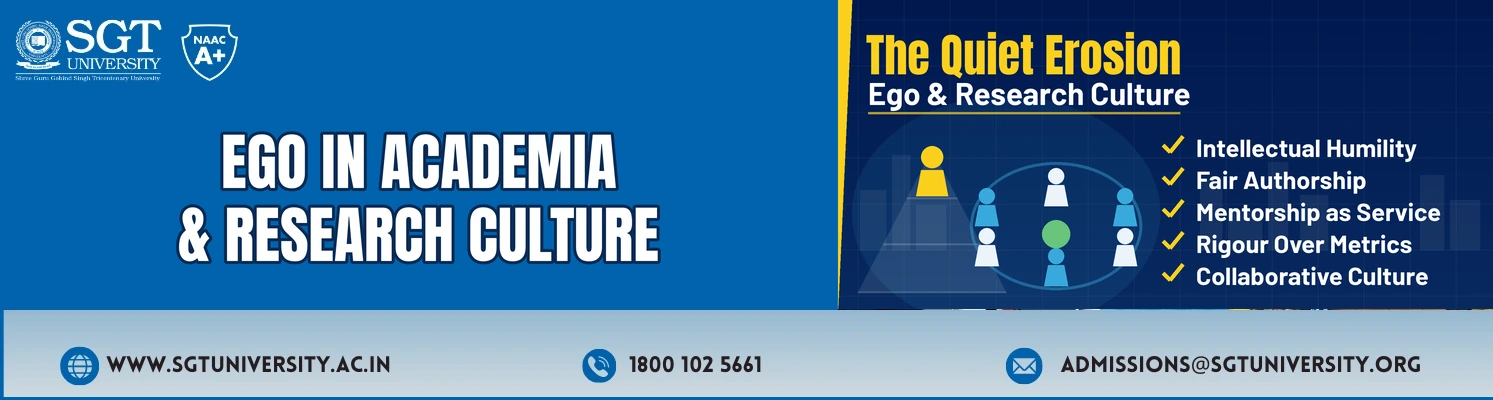
- Be intellectually humble – Know the limitations of your own work. Solicit feedback in seminars and lab meetings. Treat disagreement as an opportunity to learn, not an attack on your turf.
- Adopt good authorship policies – Use transparent, contribution-based authorship guidelines such as the CRediT taxonomy. Discuss authorship at the beginning of the project and revisit it as roles evolve.
- Treat mentorship as service – Shift from “supervisor” to “sponsor”: actively generate opportunities for scholars to present, write manuscripts, and build their own independent networks.
- Model collaborative language – “My lab” becomes “our research group”; “my students” becomes “our team”. Minor language changes indicate shared ownership.
For PhD Scholars and Early-Career Researchers
- Build critical confidence – Understand the difference between respecting expertise and submitting to authority. Create questions from evidence. Feed them into the collective knowledge.
- Create your mentorship network – Build a network that extends beyond your primary advisor to include interdisciplinary collaborators, industry professionals, and senior scholars within established supportive cultures.
- Document contributions – Maintain a living record of your roles in projects (conceptualisation, experimentation, analysis, writing). This helps with fair authorship discussions and future citations.
- Prioritise rigour, not metrics – Measure your value by your questions, your methods, your reporting — not by journal impact factors.
For Departments and Institutes
- Update evaluation criteria – Weigh publication counts against indicators of mentorship quality, open science practices, data sharing, and societal impact. The San Francisco Declaration on Research Assessment (DORA) offers a widely adopted starting point.
- Create feedback channels – Anonymous, periodic surveys on lab culture, authorship fairness, and psychological safety, with findings presented clearly.
- Provide ethical leadership training – Workshops with faculty and senior researchers on inclusive mentorship, bias mitigation and conflict resolution. Guidance from bodies such as the Committee on Publication Ethics (COPE) is a useful reference.
- Celebrate collaborative wins – Use institutional communications to highlight team-authored papers, interdisciplinary projects and scholar-led initiatives that change cultural narratives.
Engineering a Culture That Holds
Still, ego does not disappear by sheer individual will; it recedes when systems reward humility, collaboration, and integrity. As civil engineers and materials scientists, we design structures that must withstand loads, environmental stresses, and time. Our academic culture isn't any different. It must be engineered to withstand the corrosive forces of ego, to bear the weight of discovery and public trust.
The way forward is not to diminish expertise, but to anchor it in service to students, science and society. When professors and facilitators model curiosity over certainty, and scholars are empowered to question without fear, academia becomes not a hierarchy of egos but a community of learners. That is the foundation on which lasting innovation and lasting infrastructure are built.
If the measure of a professor is not how many cite them but how many they enable to think independently, then the antidote to ego is already within reach: a return to the core academic virtue of humility, practised daily, in labs, classrooms, and corridors. Hence, the structures we build — both concrete and intellectual — will stand longer for it.
Written By:
Dr Akshay Sharma
Department of Civil Engineering, SOET
SGT University
Related Blogs
- Green Technology and Sustainability Engineering: Shaping the Future of Civil Engineering
- The Career Guide to BTech Civil Engineering Course
- Sustainable Infrastructure Careers: BTech Civil Engineering Guide
- Top Engineering Colleges in Haryana: Courses, Admissions, Fees, Placements
- School of Engineering and Technology (SOET), SGT University
- All SGTU Engineering Blogs