MATLAB and Simulink Applications in Mechanical Engineering | SGT University
Updated on: 22 May, 2026
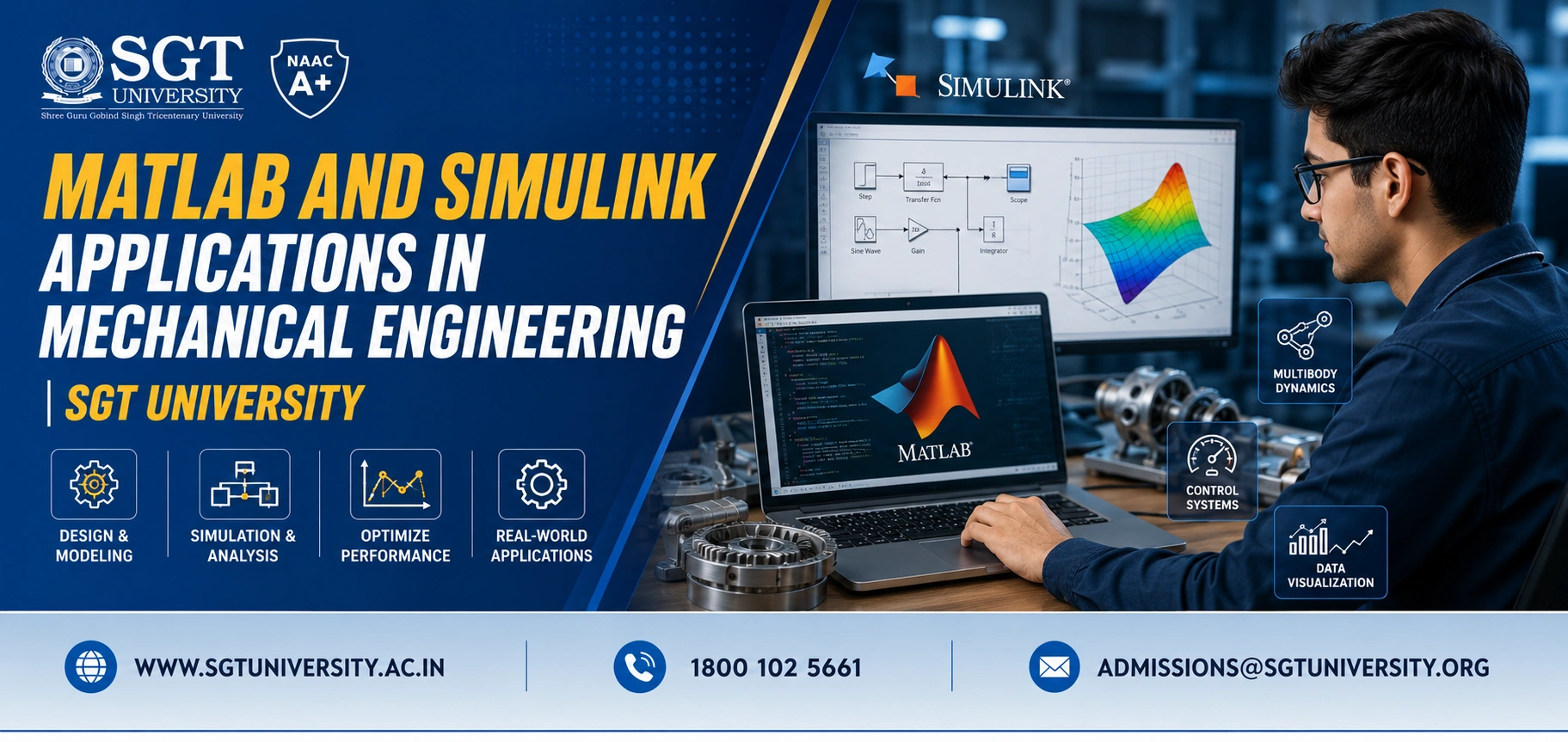
Mechanical Engineering today extends far beyond traditional machine design and manufacturing. These days, engineers use data-driven technologies, automation, intelligent systems, and simulation tools. MATLAB and Simulink, which are crucial for teaching, research, and industry applications in a variety of mechanical engineering fields, are two of the most significant software platforms assisting this transition.
MATLAB is widely used for numerical computing, mathematical modeling, data analysis, and visualization. It is used by mechanical engineers to solve complex problems associated with fluid mechanics, thermodynamics, vibrations, heat transfer, machine design, and engineering component optimization. When compared to traditional manual calculations, it greatly increases speed and accuracy and facilitates the effective analysis of large data sets by engineers. In modern businesses, MATLAB also facilitates simulation-based decision-making, performance monitoring, and predictive maintenance.
Simulink provides a graphical environment for modeling and simulating dynamic systems. It is especially useful in control systems such as robotic arms, autonomous vehicles, conveyor systems, drones, and HVAC applications. Engineers may theoretically design and test PID controllers, sensor responses, and system behavior prior to actual implementation, which reduces development expenses, risk, and time. This allows safer testing and faster development of engineering solutions.
In electric vehicles and robotics, these tools are highly valuable for battery management systems (BMS), vehicle dynamics, motor control, sensor integration, and autonomous navigation. Students and researchers can successfully model real-world engineering challenges before physical testing, leading to improved innovation and system performance. Examples of their industrial importance include applications in line-following robots, mobility robotics, and EV battery analysis.
At SGT University, the Mechanical Engineering Department strongly promotes hands-on learning pedagogy supported by advanced laboratories and industry-relevant software. Faculty use the campus-wide licensed suite of MATLAB and Simulink to teach electric vehicles, robotics, automation, control systems, and project-based learning. Students also gain exposure to Abaqus, CATIA, and SolidWorks for design, simulation, structural analysis, and product development.
With the support of cutting-edge labs, modern software, and hands-on experience, students may become engineers who are industry-ready for the future of advanced engineering technologies, sustainability, mobility, and smart manufacturing.
Written By:
Mr. Asad Habeeb