
Surface Wettability: A Transformation to Modern Mechanical Engineering Systems
Updated on: 16 March, 2026
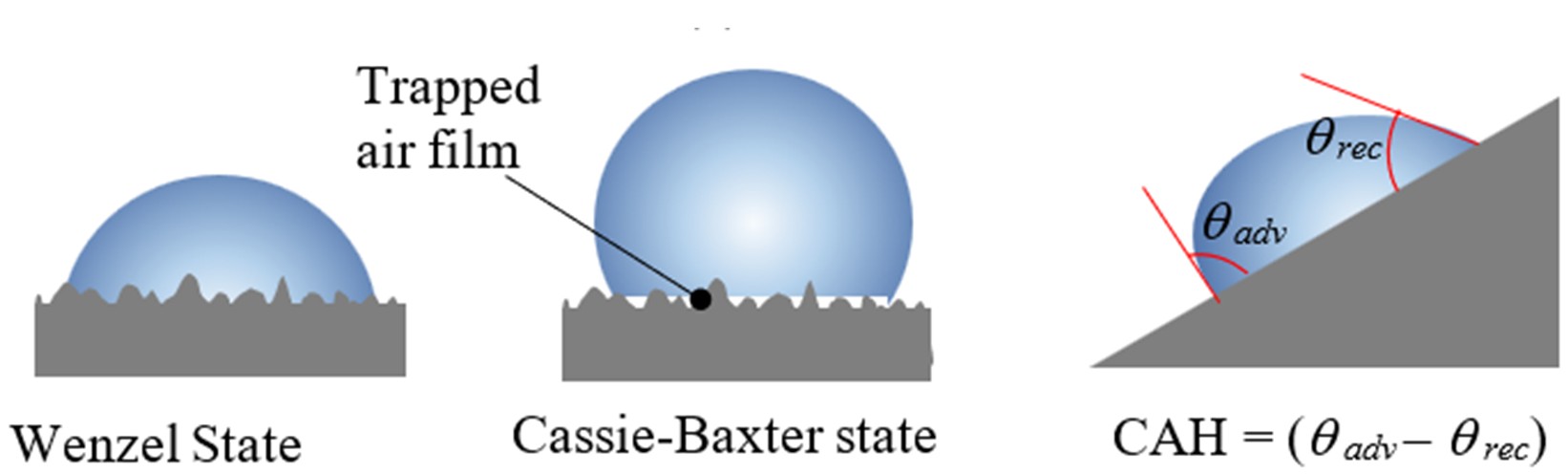
Introduction: In mechanical engineering, the characteristics of many systems are governed by bulk materials as well as surfacing attributes. Perhaps the most important of these is surface wettability, which determines how a liquid interacts with a solid surface. It defines the behavior of a liquid over a surface (spreading vs droplet formation) and governs processes like heat transfer, lubrication, corrosion resistance/coating as well as fluid transport. Surface wettability is simplified to a measure called the contact angle (θ), which is defined as the angels formed by liquid droplet resting on solid surface at their intersection point (as shown in Fig. 1). A contact angle below 90° indicates the wetting of the liquid over the surface, also known as hydrophilic behavior. A high contact angle suggests hydrophobic behavior, minimizes contact with the surface. Therefore, superhydrophobic surfaces present extraordinary water repellence.
Phenomenon
- Wenzel Model: This is because the liquid wets all the surface structure. Description: The true area of contact between the liquid and water surface is greater than the geometric area, thus improving inert wettability. A hydrophilic surface turns more hydrophilic (friendly with the water molecules) and a hydrophobic surface turns more hydrophobic (unfriendly).
- Cassie–Baxter Model: This is where air pockets are trapped within surface microstructures. The liquid sits partially on the solid surface, and partially on the trapped air. This minimizes the contact area, producing superhydrophobic characteristics: droplets roll off easily.
There are several advanced techniques used by the engineers for modifying surface wettability, such as:
- Change surface energy by chemical surface treatment
- Microstructure creation by laser surface texturing
- Plasma treatment for surface activation
- Thin-film and nanocoatings
- Electrochemical deposition and etching
- They allow for fine-tuning how liquids interact with solid surfaces.
- Importance of Surface Wettability in Thermo-Hydraulic Enhancement
Engineering applications: Heat transfer is an important research domain in mechanical engineering applications such as power generation plants & other energy systems (like refrigeration, electric cooling devices), automotive engines, renewable energy (solar thermal systems). Boiling, condensation or evaporation processes are significantly affected by surface wettability. For boiling heat transfer, hydrophilic surfaces enable liquid to more efficiently spread on the surface that is being heated thus improving the supply of liquid and avoiding dry spots. This increases the critical heat flux, the highest rate of heat transfer possible that maintains stability at the boiling surface. Surface wettability also influences the condensation mode, whether droplets grow on a solid substrate or continuous liquid film are formed during condensation. For hydrophilic surfaces, heat transfer efficiency decreases due to the formation of a thermal resistance layer during filmwise condensation. Conversely, on hydrophobic surfaces the dropwise condensation allows droplets to depart quickly and shed clean surfaces for subsequent condensation leading to much larger heat transfer rates. Current research is aiming at tailoring hybrid surfaces with the right combination of hydrophilic and hydrophobic regions to achieve maximum heat transfer efficiency through boiling and condensation.
Surface wettability is an important factor in the design of the latest energy storage and conversion technologies, including fuel cell systems, batteries and supercapacitors. For fuel cells, it is essential to consider the distribution of water and reactant gases in porous electrodes since such an information can greatly influence performance. By removing excess water so as not to flood gas diffusion layers, hydrophobic coatings ensure efficient electrochemical reactions. Hydrophobicity of electrode materials is a major limiting factor for electrolyte to fill up the porous electrodes in lithium-ion battery. Better electrolyte wetting boosts ion transport, raises energy density, and improves battery lifetime. Conversely, low wettability results in partial consumption of electrodes that cause poorer performance. As such, surface engineering is utilized to enhance the wettability of battery electrodes and separators that plays a crucial role in both charge storage ability and cycle life.
Microfluidics is dealing with the handling of tiny amounts of fluids within channels having dimensions in the micrometre to millimetre range. Surface wettability has a direct impact on fluid transportation in such micro-channels. In lab-on-chip devices used in chemical and biomedical diagnostics, capillary-driven flow is widely exploited due to hydrophilic surfaces. Droplet movement, mixing and separation processes can be controlled using hydrophobic surfaces.
Working in interdisciplinary fields, mechanical engineers help design surfaces that control exactly how fluids behave at small scales. Some applications of wettability-controlled surfaces in microfluidics.
- Drug delivery systems
- Biomedical diagnostic devices
- Inkjet printing technologies
- Microreactors for chemical synthesis
Surface wettability is also very important in many manufacturing processes including coating, painting, welding, soldering and additive manufacturing. One such example is that in coating applications, correct wettability results in liquids spreading evenly over the surface and producing smooth, defect-free coatings. For example, in welding and soldering processes, wettability affects how well the molten metal can wet the base material. Good wettability leads to a large contact area and strong joint. For instance, surface wettability affects the powder spreading and melt pool dynamics at the micro-scale in metal-based 3D printing processes contributing significantly towards affecting quality and mechanical properties of printed components during Additive Manufacturing Practices.
Emerging Technologies and Future Opportunities: Advancements in nanotechnology have led to the design of smart surfaces capable of altering their wettability under the influence of environmental stimuli including temperature, electric field and light. Some promising emerging applications include:
- Manmade lotus leaves: Self-cleaning surfaces for buildings and solar panels
- Anti-icing coatings for jet aircraft, wind turbines, and utility lines
- Surfaces for ships and underwater vehicles that reduce drag
- Case studies of water harvesting for arid regions
- Anti-corrosion coatings for industrial equipment
These breakthroughs offer examples of how engineering through the formation of surface wettability can lead to sustainable and high-efficiency solutions in engineering.
Conclusion: Surface wettability transitioned from being a basic physical property to an influential engineering parameter that has profound effects on the functionality of modern mechanical systems. Controlling the interaction of liquids with solid surfaces can allow engineers to maximize heat transfer, streamline friction and wear processes, increase energy efficiency and improve manufacturing processes. As researchers in fields such as nanotechnology, materials science, and advanced manufacturing continue to investigate this area, the capacity to engineer surfaces with finely tuned wettability will only broaden. Addressing these challenges will be critical in the widespread introduction of smart materials, green energy applications, and advanced mechanical technologies in the future through surface wettability engineering.
Written By:
Dr. Chayan Das
Assistant Professor
Mechanical Engineering Department
School of Engineering & Technology
SGT University, Gurgaon