

Dengue vs Viral Fever: Symptoms, Warning Signs and When to Go to Hospital
Updated on: October 21, 2026
Introduction
Every October, fever cases rise across Delhi NCR, and families face the same worry: is this an ordinary viral fever that will pass in a few days, or is it dengue? The two can look alike in the first days. What matters most is not guessing the name of the fever, but recognising the warning signs that mean a patient needs a hospital without delay.
This guide is based on the World Health Organization's dengue guidance and is intended for general information. It does not replace advice from a doctor who has examined the patient.
Dengue or Viral Fever? The Short Answer
Quick answer: You cannot reliably tell dengue from other viral fevers by symptoms alone, so anyone with a high fever during the dengue season should see a doctor and get a blood test. Dengue more often causes high fever with a severe headache, pain behind the eyes, muscle and joint pain, nausea, vomiting or a rash, while cough, sore throat and a runny nose suggest an influenza-type infection. Most people with dengue recover, but the risky period is around days 3 to 7, often after the fever comes down. Go to hospital immediately if there is severe abdominal pain, persistent vomiting, any bleeding, rapid breathing, or unusual drowsiness or restlessness. For fever and pain, use paracetamol; avoid ibuprofen and aspirin, which can increase the risk of bleeding (WHO).
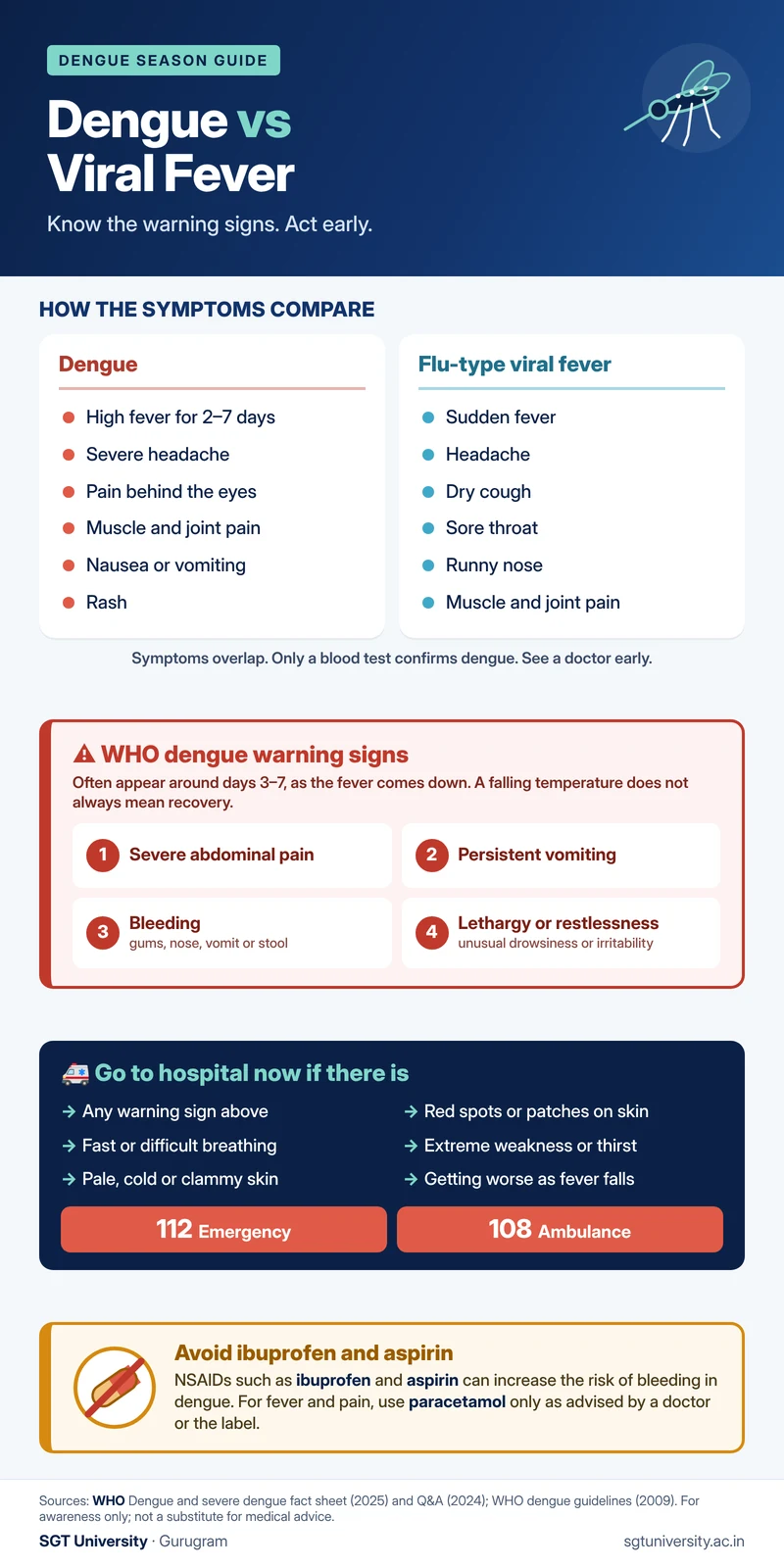
You are welcome to share this infographic with your family, residents' welfare association or community group. Please link back to this page so readers can find the full guidance.
Table of Contents
- Dengue or Viral Fever? The Short Answer
- Dengue vs Viral Fever: Symptom Comparison
- When Should You Get Tested for Dengue?
- The Danger Window: Days 3 to 7
- WHO Dengue Warning Signs
- Go to Hospital Now If You Notice Any of These
- Medicines: Paracetamol Yes, Ibuprofen and Aspirin No
- Caring for Someone with Dengue at Home
- What About Platelet Count?
- Preventing Dengue at Home and in Your Society
- Dengue Care at SGT Hospital, Gurugram
- Key Takeaways
- FAQs
- Sources
Dengue vs Viral Fever: Symptom Comparison
'Viral fever' is a loose term for many different infections. The table compares dengue with seasonal influenza, one of the most common causes of viral fever, using the WHO's descriptions of each. Treat it as a guide to what to tell your doctor, not as a way to rule dengue in or out.
| Symptom | Dengue | Influenza-type viral fever |
|---|---|---|
| Fever | High fever, usually lasting 2 to 7 days | Sudden onset of fever; most people recover within a week |
| Headache | Severe headache is common | Headache is common |
| Pain behind the eyes | A typical dengue symptom | Not listed among typical flu symptoms |
| Muscle and joint pain | Common | Common |
| Cough, sore throat, runny nose | Not among the typical dengue symptoms | Typical: usually a dry cough, sore throat and runny nose |
| Nausea and vomiting | Can occur | Not listed among typical flu symptoms |
| Rash | Can occur | Not listed among typical flu symptoms |
| Swollen glands | Can occur | Not listed among typical flu symptoms |
| When to be most careful | Around days 3 to 7, often as the fever falls | If symptoms are severe or the person is at higher risk of complications |
| Recovery | Most people recover within 1 to 2 weeks | Most recover within a week; the cough can last 2 weeks or more |
Sources: WHO dengue fact sheet (August 2025); WHO seasonal influenza fact sheet (February 2025). Other infections common in the same season can also cause fever, which is why a test matters.
When Should You Get Tested for Dengue?
See a doctor if you or a family member has a high fever during the dengue season, especially with severe headache, pain behind the eyes or body aches. Dengue is confirmed with a blood test. According to the WHO, tests that detect the virus or its proteins directly are used within the first week of illness (WHO), so do not wait several days to see whether the fever settles on its own. Your doctor will decide which test to order and whether repeat blood counts are needed.
If the patient is a baby, pregnant, elderly, or has a long-term illness such as diabetes or heart or kidney disease, see a doctor early rather than waiting.
The Danger Window: Days 3 to 7
The most important fact about dengue is also the least intuitive. The WHO describes a critical phase that begins around 3 to 7 days after the first sign of illness. During this phase, the temperature often falls, and the WHO warns that this does not necessarily mean the person is recovering (WHO dengue Q&A). The symptoms of severe dengue often appear after the fever has gone away (WHO fact sheet).
So keep watching the patient closely for a few days after the fever breaks, and act at once if any warning sign appears.
WHO Dengue Warning Signs
⚠ WHO dengue warning signs: get medical care immediately
- Severe abdominal pain or tenderness
- Persistent vomiting
- Bleeding: from the gums or nose, or blood in vomit or stool
- Lethargy or restlessness: unusual drowsiness, fatigue, restlessness or irritability
- Rapid breathing
- Pale, cold skin, being very thirsty, or feeling weak
Sources: WHO dengue fact sheet (August 2025); WHO's 2009 dengue guidelines (the warning-sign list, which also includes clinical fluid accumulation and liver enlargement that a doctor checks on examination), as set out in CDC: WHO 2009 dengue classification; WHO 2009 guidelines.
Doctors also watch blood test results. In the WHO 2009 classification, a rising haematocrit together with a rapidly falling platelet count is a laboratory warning sign, which is why your doctor may ask for repeat blood counts.
Go to Hospital Now If You Notice Any of These
🚑 Go to hospital now: do not wait for the next day
- Severe stomach pain, or vomiting that will not stop
- Bleeding from the nose or gums, red spots or patches on the skin, vomiting blood, or blood in the stool
- Difficulty breathing or very fast breathing
- Unusual drowsiness, irritability or restlessness
- Pale, cold or clammy hands, feet or skin
- Extreme weakness, or the patient seems to be getting worse as the fever comes down
- In an emergency, call 112 (national emergency number) or 108 (ambulance)
Sources: WHO dengue fact sheet; CDC: Dengue home care for patients and caregivers.
Medicines: Paracetamol Yes, Ibuprofen and Aspirin No
💊 Caution: avoid ibuprofen and aspirin if dengue is possible
- There is no specific medicine that cures dengue. Treatment supports the body while it recovers.
- Paracetamol can be used to bring down fever and relieve pain. Use only the dose advised by your doctor or printed on the label, and do not take extra doses.
- Avoid NSAIDs such as ibuprofen and aspirin, including combination cold and pain medicines that contain them. They can increase the risk of bleeding.
- If you are not sure whether a fever is dengue, avoid these medicines until a doctor has seen the patient.
- Do not start any other medicine on your own without asking a doctor.
Sources: WHO dengue fact sheet; WHO dengue Q&A; CDC dengue home care; India's national dengue clinical management guidance (as published by NHM Himachal Pradesh).
Caring for Someone with Dengue at Home
If a doctor has advised home care, these steps help the patient recover safely:
- Rest as much as possible.
- Drink plenty of fluids, unless the doctor has advised otherwise.
- Bring down high fever with paracetamol and by sponging the skin with cool water.
- Sleep under a mosquito net or use repellent while the patient has fever, so that mosquitoes cannot spread the infection to others in the house.
- Keep follow-up appointments and blood tests as the doctor advises.
- Keep watching for warning signs, especially in the days after the fever falls.
Sources: WHO dengue fact sheet; CDC dengue home care.
What About Platelet Count?
A falling platelet count worries many families, and requests for platelet transfusions rise every dengue season. Guidelines issued under India's national vector-borne disease programme limit prophylactic platelet transfusion to patients whose count is below 10,000 per cubic millimetre without bleeding, and recommend transfusion for patients who are bleeding. They also state that whole fresh blood transfusion has no role in managing a low platelet count (national guidance as published by NHM Himachal Pradesh; see also the National Guidelines for Clinical Management of Dengue Fever, 2023).
In practice, this means a low platelet number on its own is not a reason to demand a transfusion. Your treating doctor will decide based on the patient's overall condition, including warning signs, blood pressure and other test results.
Preventing Dengue at Home and in Your Society
The Aedes mosquitoes that spread dengue breed in clean, stagnant water and bite mainly during the day (WHO). Prevention works best when a whole building or society acts together.
For every household
- Wear clothing that covers as much skin as possible, especially during the day.
- Use mosquito repellents containing DEET, picaridin or IR3535, following the label instructions.
- Use bed nets and window screens.
- Empty, clean and cover water storage containers, coolers, flower vases and pet bowls at least once a week.
For residents' welfare associations and societies
- Run a weekly 'dry day' check of overhead tanks, coolers, rooftops, basements and construction areas.
- Clear discarded tyres, containers and other waste that can collect rainwater, and make sure garbage is disposed of properly.
- Cover or treat water storage that cannot be emptied, in coordination with the local health department.
- Share this guide and the infographic with residents so that families recognise warning signs early.
Source: WHO dengue fact sheet: prevention and control.
Dengue Care at SGT Hospital, Gurugram
SGT University runs an associated teaching hospital in Gurugram, where patients with fever can be assessed and tested, and patients with warning signs can be admitted for monitoring.
If you notice any of the warning signs above, go to the nearest hospital emergency department immediately. Do not travel a long distance to reach a particular hospital.
Key Takeaways
- Dengue and other viral fevers can look alike in the first few days; only a blood test confirms dengue.
- Pain behind the eyes, severe body ache, vomiting or rash suggest dengue; cough, sore throat and runny nose suggest a flu-type infection.
- The riskiest period is around days 3 to 7, often after the fever falls, so keep watching the patient.
- Severe abdominal pain, persistent vomiting, bleeding, rapid breathing, lethargy or restlessness mean: go to hospital now.
- Use paracetamol for fever; avoid ibuprofen and aspirin.
- Empty, clean and cover water containers every week, and protect yourself from daytime mosquito bites.
This article is for general information and awareness. It is not a substitute for medical advice, diagnosis or treatment. Always consult a qualified doctor about a specific illness.
FAQs
Q1. How can I tell if it is dengue or viral fever?
You cannot be sure from symptoms alone, so get a blood test if you have a high fever during
the dengue season. Dengue more often causes a high fever with severe headache, pain behind
the eyes, muscle and joint pain, nausea, vomiting or a rash. Cough, sore throat and a runny
nose point more towards influenza-type viral infections, which are listed among typical flu
symptoms by the World Health Organization.
Q2. What are the warning signs of dengue?
The WHO lists severe abdominal pain, persistent vomiting, rapid breathing, bleeding gums or
nose, fatigue, restlessness, blood in vomit or stool, being very thirsty, pale and cold
skin, and feeling weak. These often appear after the fever has gone away. Anyone with these
signs should get medical care immediately.
Q3. When should a dengue patient go to hospital?
Go to hospital immediately if there is severe abdominal pain, persistent vomiting, any
bleeding (gums, nose, vomit, stool, or red spots on the skin), difficulty or rapid
breathing, drowsiness, restlessness or irritability, extreme weakness, or pale, cold or
clammy skin. Do not wait for the fever to return; in dengue, these signs often appear as the
fever comes down.
Q4. Which day is most dangerous in dengue?
The WHO describes the critical phase as starting around 3 to 7 days after the first sign of
illness. The temperature often falls during this phase, which does not necessarily mean the
person is recovering. Watch closely for warning signs during this period.
Q5. Can I take ibuprofen or aspirin for dengue?
No. The WHO advises avoiding non-steroidal anti-inflammatory medicines such as ibuprofen and
aspirin in dengue because they can increase the risk of bleeding. Paracetamol can be used
for fever and pain, at the dose advised by your doctor or on the label. If you are not sure
whether a fever is dengue, avoid these medicines until a doctor has seen you.
Q6. Does a low platelet count always need a platelet transfusion?
No. Guidelines issued under India's national vector-borne disease programme reserve
prophylactic platelet transfusion for counts below 10,000 per cubic millimetre in the
absence of bleeding, or for patients who are bleeding. Your treating doctor decides, based
on the whole clinical picture and not only the platelet number.
Q7. How long does dengue last?
According to the WHO, symptoms usually begin 4 to 10 days after infection and last 2 to 7
days. Most people recover within 1 to 2 weeks.
Q8. Can you get dengue more than once?
Yes. There are four types of dengue virus, and a person can be infected more than once. The
WHO notes that a previous dengue infection increases the risk of severe dengue.
Q9. How can I prevent dengue at home?
The mosquitoes that spread dengue bite mainly during the day. Wear clothing that covers the
skin, use repellents containing DEET, picaridin or IR3535, and use nets and window screens.
Empty, clean and cover water storage containers every week, and remove anything outdoors
that can collect water.
Sources
- World Health Organization. Dengue and severe dengue: fact sheet. 21 August 2025.
- World Health Organization. Dengue and severe dengue: questions and answers. 2 October 2024.
- World Health Organization and TDR. Dengue: guidelines for diagnosis, treatment, prevention and control. 2009.
- US Centers for Disease Control and Prevention. Guidelines for classifying dengue (WHO 2009 classification). May 2025.
- US Centers for Disease Control and Prevention. Dengue: home care for patients and caregivers.
- World Health Organization. Influenza (seasonal): fact sheet. 28 February 2025.
- National Center for Vector Borne Diseases Control, MoHFW. National Guidelines for Clinical Management of Dengue Fever. 2023.
- National Health Mission, Himachal Pradesh. Guidelines for clinical management of dengue fever (based on national guidance).