MLT Career Path in India: Complete Roadmap from Diploma to Lab Director
Updated on: October 8, 2026
Introduction
Medical laboratory technology is one of India's most stable and steadily growing allied-health fields, quietly powering diagnosis in every hospital, pathology lab, and diagnostic chain across the country. Yet most students who enroll in a DMLT or BSc MLT program have little idea what actually comes after graduation: which designations they'll hold, how the salary ladder progresses, or how a fresh junior lab technician eventually becomes a lab director.
This guide maps out the complete MLT career path as a clear roadmap, covering the right educational foundation, certification requirements, specialization tracks, expected salary ranges at each stage, and the alternate routes into academics, government service, or entrepreneurship. Use it to plan your next decade in the field, not just your next exam.
Table of Contents
- What Is Medical Laboratory Technology (MLT)?
- Build the Right Educational Foundation
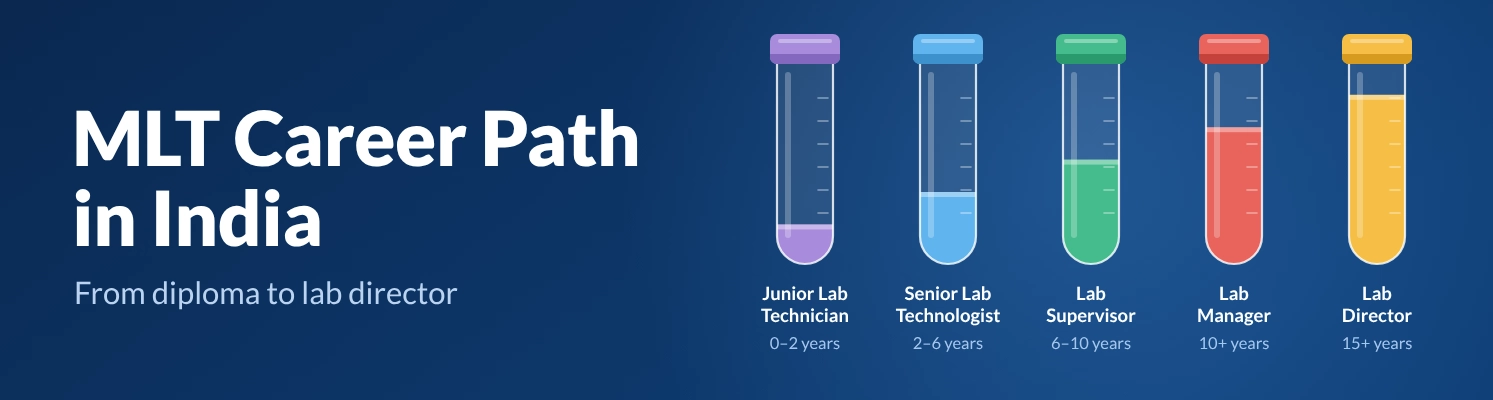
- Beginning as a Junior Lab Technician (0-2 Years)
- Senior Medical Lab Technologist (2-6 Years)
- Moving Up to Lab Supervisor (6-10 Years)
- Lab Manager, Quality Manager, or Lab Director (10+ Years)
- Alternate Paths on the Same Roadmap
- Key Takeaway
- FAQs
What Is Medical Laboratory Technology (MLT)?
Medical Laboratory Technology (MLT) is the allied-health discipline concerned with testing blood, urine, tissue, and other body samples to help doctors detect, diagnose, and monitor disease. MLT professionals perform the hands-on testing on which the diagnostic industry is built, such as running complete blood counts, urinalysis, and basic chemistry panels, blood typing and cross-matching, and screening cultures for pathogens.
An MLT graduate learns more in practical labs than in classrooms. Together, this hands-on training builds the confidence and experience graduates need to excel in their career path, and it is why MLT remains one of the most stable and in-demand allied-health careers in the country. For a closer look at the course itself, read our guide on how to become a medical lab technician.
Build the Right Educational Foundation
There is more than one way into an MLT career. Here are the three main qualifications students can choose from:
| Qualification | Duration | Best For | Recognition |
|---|---|---|---|
| DMLT (Diploma in Medical Laboratory Technology) | 2 years (+ 6-month internship in some institutes) | Direct entry into the workforce | State Paramedical Councils, AICTE-affiliated polytechnics |
| BSc MLT (Bachelor of Science in Medical Laboratory Technology) | 3-4 years | Long-term growth, higher starting designation | UGC-recognized universities, AIIMS, government medical colleges |
| BMLT / B.Voc in Medical Lab Technology | 3 years | Vocational + degree combination, practical focus | State and private universities |
Still weighing your options? Compare routes in our list of paramedical courses after 12th, and shortlist institutes with our guide to the top 10 paramedical colleges in India.
Is Certification Really Required?
A separate certification is not a legal requirement, but because it reflects an individual's hands-on experience and achievements, employers prefer certified MLT graduates. Most states do require registration with the State Paramedical Council or State Medical Faculty. This registration number is frequently mandatory for:
- PHC (Primary Health Centre) recruitment
- NABL-accredited private lab chains (Dr. Lal PathLabs, Agilus Diagnostics (formerly SRL Diagnostics), Metropolis, Thyrocare)
- Railway and defence paramedical posts
Beginning as a Junior Lab Technician (0-2 Years)
Fresh DMLT or BSc MLT graduates typically enter as junior lab technicians or medical lab technicians for the first 0-2 years. This is the point where the professional career officially begins, and where everything learned during the course is put to the test. Common workplaces include government hospitals, community health centres, NABL-accredited diagnostic chains, private hospital labs, pathology and radiology clinics, and blood banks. The salary at this stage is as follows:
| Detail | Typical Range |
|---|---|
| Monthly salary (private sector) | ₹12,000 to ₹22,000 |
| Monthly salary (government, post-pay-scale fixation) | ₹21,000 to ₹35,000 (Level 3-5 pay matrix, varies by state) |
| Common employers | District hospitals, PHCs, Apollo, Fortis, Dr. Lal PathLabs, Agilus Diagnostics, Thyrocare |
Senior Medical Lab Technologist (2-6 Years)
After approximately 2 years of professional experience, junior technicians are promoted to senior lab technologists. Here, the technician specializes in one department rather than handling general diagnostic work across the whole lab. Common specialization tracks at this stage are:
| Specialization | What It Involves | Where Demand Is High |
|---|---|---|
| Clinical Biochemistry | Automated analyzers, hormone panels, enzyme assays | Corporate diagnostic chains |
| Hematology | Complete blood counts, coagulation studies, peripheral smears | Hospitals, cancer centers |
| Microbiology | Culture and sensitivity testing, infection control | Government and teaching hospitals |
| Histopathology / Cytology | Tissue processing, staining, slide preparation | Cancer institutes, pathology labs |
| Blood Banking | Component separation, cross-matching, transfusion safety | Blood banks, trauma centers |
| Molecular Diagnostics / PCR | RT-PCR, genetic testing, NGS support | NABL-accredited advanced labs, post-COVID diagnostic boom |
To qualify for supervisor roles later, many professionals use this stage (2-6 years) to pursue a part-time MSc in Medical Laboratory Technology or a specialization diploma, which builds the experience and advanced knowledge those roles demand. To see where these specializations are heading, read about emerging trends in medical laboratory technology and molecular tools in diagnosis.
| Detail | Typical Range |
|---|---|
| Monthly salary (private sector) | ₹25,000 to ₹45,000 |
| Monthly salary (government) | ₹35,000 to ₹55,000 |
| Typical designation | Senior Lab Technologist, Technical Officer |
Moving Up to Lab Supervisor (6-10 Years)
With around 6 years of experience and demonstrated technical reliability, the senior medical lab technologist is promoted to lab supervisor (6-10 years). This is the first leadership role: supervisors manage equipment schedules, supervise junior lab technicians, coordinate with pathologists, and own quality compliance for their section.
An MSc in MLT, a postgraduate diploma in hospital administration, or an internal auditor certification in NABL/ISO 15189 substantially improves eligibility for this stage.
| Detail | Typical Range |
|---|---|
| Monthly salary (private sector) | ₹40,000 to ₹65,000 |
| Monthly salary (government) | ₹50,000 to ₹75,000 |
| Typical designation | Section In-Charge, Chief Lab Technician, Technical Supervisor |
Lab Manager, Quality Manager, or Lab Director (10+ Years)
These are the topmost positions in the MLT career path. After 10 or more years of experience, a lab supervisor can move into lab or quality management, and with 15+ years, into a lab director role. Professionals at this stage hold an MSc in MLT, an MBA in Healthcare/Hospital Administration, or an equivalent management qualification, combined with years of technical and supervisory experience.
| Role | Focus Area | Path to Get There |
|---|---|---|
| Lab Manager | Full lab operations, staffing, budgets | Section In-Charge → training in operations/finance basics |
| Quality Assurance Manager | NABL/NABH accreditation, audits, SOPs | Certified internal auditor + years of compliance work |
| Regional Operations Manager (diagnostic chains) | Multi-lab oversight across a city/state | Strong performance as a single-lab manager |
| Lab Director / Technical Director | Strategic decisions, new lab setup, vendor management | MSc/PhD or MBA plus 15+ years' experience |
Typical pay and employers at this stage:
| Detail | Typical Range |
|---|---|
| Monthly salary | ₹70,000 to ₹1,50,000+ |
| Typical employers | Corporate diagnostic chains, large private hospitals, NABL consultancy firms |
Alternate Paths on the Same Roadmap
Choosing a career path depends on the individual's interests and preferences. Beyond the lab-to-management route, there are three alternate branches:
- Academics: Pursuing an MSc or PhD in medical laboratory technology can open teaching and research opportunities in paramedical and allied-health institutes, subject to the institution's eligibility requirements and relevant regulations.
- Government Service: Stable, promotion-linked government posts (Lab Technician Grade I/II, Technical Assistant in ICMR/DRDO labs, Railway paramedical cadre) offer strong job security and pension benefits.
- Entrepreneurship: After gaining relevant experience in lab diagnostics, one can open an independent NABL-accredited diagnostic centre or a sample-collection franchise for an established diagnostic chain such as Dr. Lal PathLabs.
Key Takeaway
An MLT career isn't a single ladder; it's a branching roadmap. There are multiple ways to grow rather than one path: cross-training across departments, depth (a specialization), education (upgrading from a diploma to a BSc or MSc), or leadership (supervisor and management roles). Knowing which branch fits your goals is the real first step in planning your next move. To begin, explore the Department of Medical Laboratory Technology & Biochemistry at SGT University, or browse all its allied health sciences programmes.
FAQs
Q1. How long does it take to advance on the MLT career path?
Most technicians move from junior to senior technologist after about 2 years, spend
years 2-6 building a specialization, and reach a supervisor role at around 6-10 years.
Lab manager positions typically take 10+ years, and lab director roles usually need 15+
years of experience.
Q2. Do I need a bachelor's degree to advance as an MLT?
Not to get started. DMLT holders can enter the workforce directly and grow into senior
technician roles through experience and specialization. For supervisor and management
roles, however, a BSc MLT followed by an MSc in MLT or a management qualification
substantially improves eligibility, so upgrading your qualification while working
supports long-term growth. If you are still deciding, see why
students choose B.Sc MLT after 12th.
Q3. What is the difference between an MLT and an MLS?
In India, the two terms are largely used interchangeably: some universities name the
degree BSc MLT (Medical Laboratory Technology), while others call it BSc MLS (Medical
Laboratory Science). The stricter distinction comes from countries such as the US, where
an MLT typically holds an associate degree and performs routine to moderately complex
testing, while an MLS (Medical Laboratory Scientist) holds a bachelor's degree and
handles higher-complexity testing and method validation.
Q4. What certifications matter most for MLT career growth?
In India, registration with your State Paramedical Council or State Medical Faculty is
the baseline. Specialization diplomas (blood banking, microbiology, and molecular
diagnostics) matter most for technical advancement, while NABL/ISO 15189 internal
auditor certification and hospital administration qualifications matter most for
quality and leadership tracks. International certifications such as ASCP and AMT are
mainly relevant if you plan to work abroad.