
Dr. Arnab Mitra
Professor
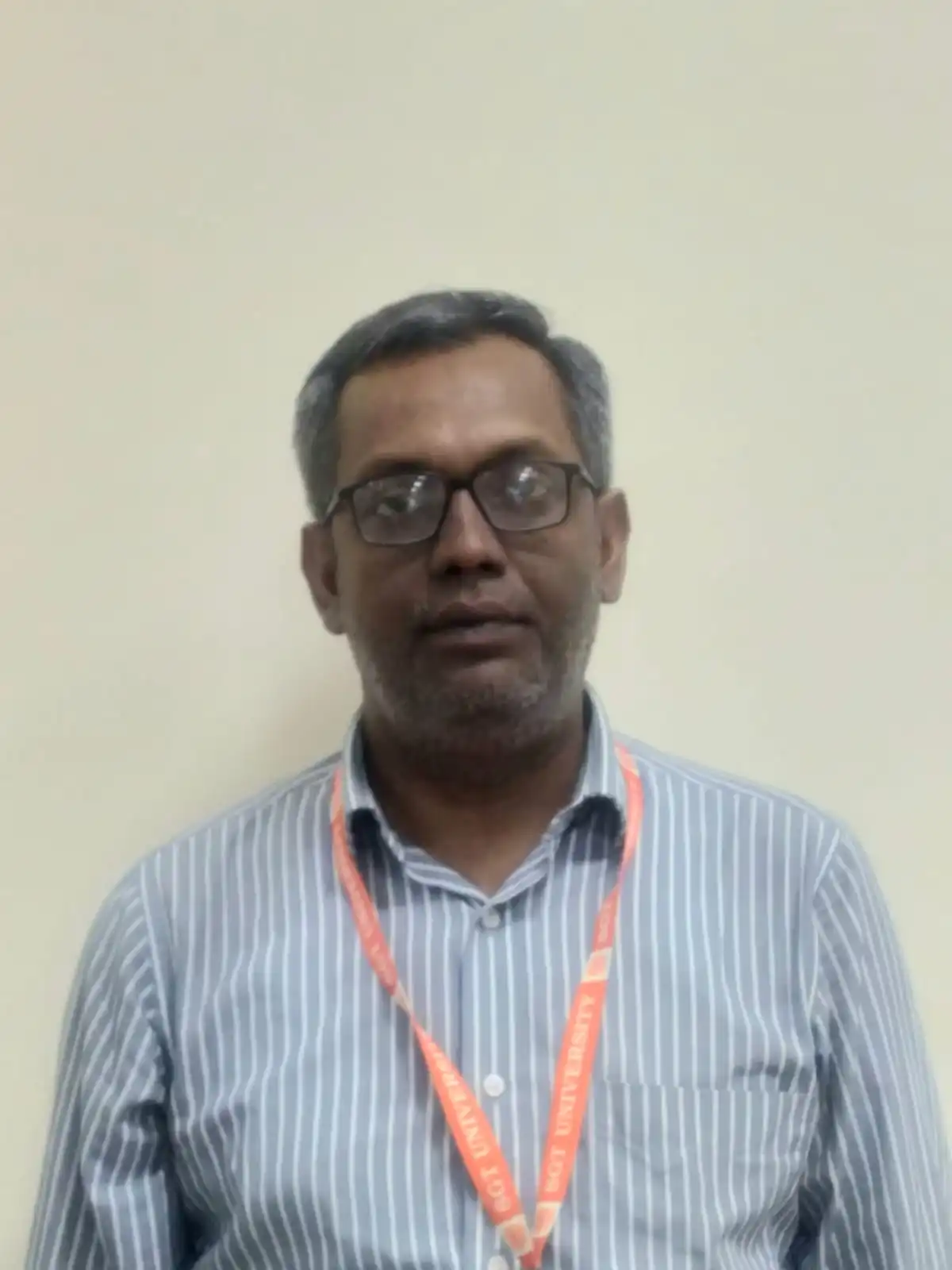
Ph.D. in Engineering
Prof. Arnab Mitra, Ph.D., is a Professor in the Department of Computer Science and Engineering at SGT University, Gurugram, India. He is a former Erasmus Mundus doctoral mobility research fellow and has held regular faculty positions at several reputed higher education institutions in India, including Techno International New Town, Kolkata; SR University, Warangal; SRM University-AP, Amaravati; Siksha ‘O’ Anusandhan (Deemed to be University), Bhubaneswar; Adamas Institute of Technology, Kolkata; and Guru Nanak Institute of Technology, Kolkata. Prof. Mitra earned his Ph.D. in Engineering from Jadavpur University, India. During his doctoral research, he was awarded the prestigious European Union-sponsored Erasmus Mundus doctoral research mobility fellowship at Gheorghe Asachi Technical University of Iași, Romania. Prior to completing his doctoral degree, he obtained his M.Tech. in Computer Science and Engineering from the West Bengal University of Technology, India, and his B.E. in Information Technology from the University of North Bengal, India. In addition to his academic responsibilities, Prof. Mitra is actively engaged in scholarly publishing and serves on the editorial boards of several international journals. His principal research interests encompass Cellular Automata (CA) and Theoretical Computer Science, with interdisciplinary applications in data security, eHealth, Industry 4.0, Industry 5.0, and social networks. His research focuses on exploring Cellular Automata as a unifying discrete mathematical and computational framework for developing secure, decentralized, explainable, and human-centric intelligent systems. By bridging theoretical foundations with emerging engineering paradigms, his work investigates the potential of CA-driven methodologies in advancing distributed intelligence, computational security, decentralized decision-making, and adaptive control. His broader research vision is to establish scalable and resource-efficient computational approaches that enhance security, transparency, interpretability, collaboration, resilience, and sustainability in next-generation intelligent systems.
Teaching Interests
- Theoretical Computer Science
- Compiler Design
- Cellular Automata
- System Programming
- Cyber Security
- Database Management Systems (DBMS)
- Research Methodology
Research Interests
- Cellular Automata
- Theoretical Computer Science
- Data Security
- eHealth
- Industry 4.0 and Industry 5.0
- Social Networks
- Distributed Intelligence
- Decentralized Decision-Making
- Adaptive Control
- Secure and Explainable Intelligent Systems
