
Introduction
Artificial Intelligence and Data Science are becoming important parts of the modern technology landscape. From analysing large volumes of information to improving business decisions and developing intelligent products, these fields are creating new academic and career pathways for students.
For students completing Class 12, however, choosing a course simply because it is popular may not be enough. The right decision requires an understanding of the course structure, eligibility, fees, practical exposure, career options and the kind of work a student actually wants to pursue.
So, what are the major AI and Data Science courses after 12th in India in 2026, and what should students consider before choosing one? This guide explains everything step by step. If you are still deciding on a broader stream, you can also read our guide on the best AI course after Class 12th.
AI & Data Science Courses After 12th: At a Glance
| Factor | What Students Should Consider |
|---|---|
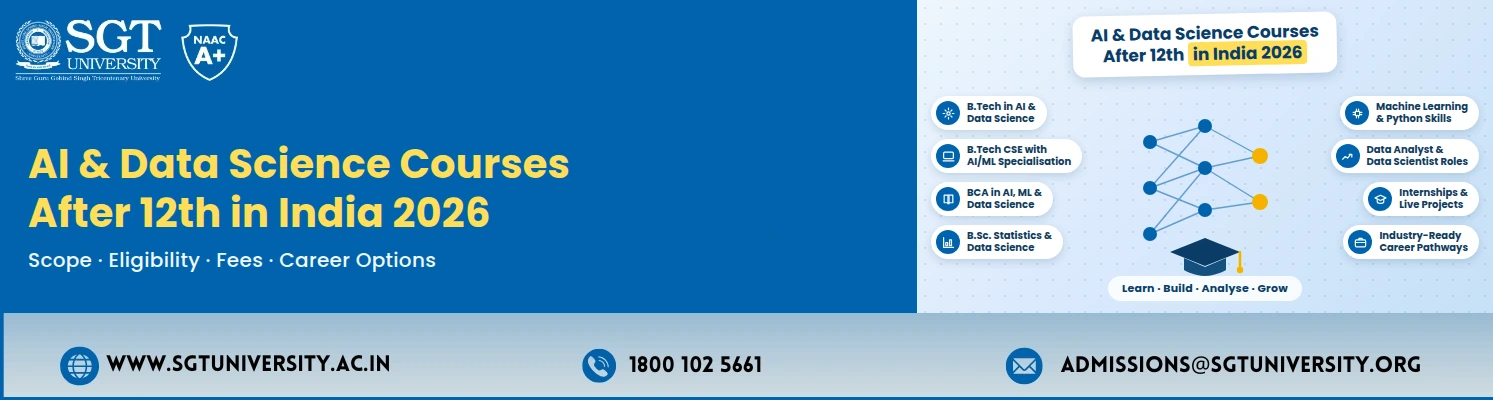
| Popular pathways | B.Tech in AI & Data Science, B.Tech CSE with relevant specialisation, BCA with Data Science/AI & ML, and B.Sc. Statistics & Data Science |
| Core skills | Programming, statistics, data analysis, machine learning, databases and problem-solving |
| Career areas | Data analysis, software and technology, business intelligence, machine learning, analytics and research |
| Main cost factors | Tuition, accommodation, learning resources, laptop/software, transport and other personal expenses |
| Best approach | Compare curriculum, practical learning, eligibility, total cost and career opportunities before applying |
What Are Artificial Intelligence and Data Science?
Artificial Intelligence refers to computer-based systems that can perform tasks such as recognising patterns, making predictions, learning from information and supporting decisions. Data Science, meanwhile, focuses on collecting, organising, analysing and interpreting data to find useful insights.
The two areas overlap, but they are not identical. A student interested in building intelligent systems may be more attracted to Artificial Intelligence and Machine Learning, while someone who enjoys statistics, analysis and working with datasets may find Data Science especially interesting. Many modern programmes bring both areas together. To understand the subject in more depth, read our detailed blog on the Data Science course: syllabus, career paths and salary in India.
AI and Data Science Courses After 12th
1. B.Tech in Artificial Intelligence and Data Science
A B.Tech in Artificial Intelligence and Data Science is an engineering-focused undergraduate route for students who want to develop strong foundations in computing while studying data-driven technologies.
Depending on the programme, students may study areas such as:
- Programming and problem-solving
- Mathematics and statistics
- Data structures and algorithms
- Data analysis and visualisation
- Machine learning
- Artificial Intelligence
- Database systems
- Cloud and computing technologies
- Projects and practical applications
2. B.Tech in Computer Science with a Relevant Specialisation
Students can also choose a broader B.Tech in Computer Science and Engineering and build expertise through a specialisation or minor in areas such as Artificial Intelligence and Machine Learning or Data Science. This route can suit students who want a strong computer science foundation alongside a focused area of study. Explore how this pathway prepares students for future roles in our B.Tech CSE AI careers guide.
3. BCA with Artificial Intelligence, Machine Learning or Data Science
A Bachelor of Computer Applications (BCA) can be another pathway for students who want to enter the computing and technology sector. Depending on the institution, BCA programmes may offer specialised learning in areas such as Artificial Intelligence and Machine Learning, Data Science, Cyber Security or Cloud Computing. Learn more about why to pursue a BCA in AI and Machine Learning.
4. B.Sc. Statistics and Data Science
Students who are comfortable with mathematics and statistics can explore an undergraduate programme like the B.Sc. (Hons.) in Statistics and Data Science that combines statistical reasoning with data analysis and computing. Such programmes can be relevant for students interested in analytics, research, forecasting and data-driven decision-making.
What Do Students Learn in These Courses?
The exact curriculum differs from one university to another, but a strong programme generally combines concepts with practical work. Important areas can include:
- Programming, especially Python and other tools used for analysis and computing
- Statistics, probability and mathematical reasoning
- Data handling, databases and SQL
- Data visualisation and interpretation
- Machine learning and predictive methods
- Problem-solving and algorithmic thinking
- Projects, laboratory work and research
- Communication and presentation of technical findings
For students, this distinction is important: knowing the terminology of a field is different from being able to apply it. Projects, laboratory work, internships and practical assignments can make a significant difference to learning.
Eligibility for AI and Data Science Courses After Class 12
Eligibility depends on the programme and university. Engineering programmes may have specific subject and minimum marks requirements, while BCA and B.Sc. programmes can have different criteria.
Students should therefore check the current eligibility requirements of the exact programme they are considering rather than relying on a general rule for every course. You can view all courses and their details on the SGT University list of programmes.
Career Scope After AI and Data Science Courses
The skills developed through these programmes can be applied across a wide range of industries. Technology is only one part of the picture; data and intelligent systems are also used in finance, healthcare, manufacturing, retail, education, media, telecommunications and consulting.
Depending on their qualification, skills and experience, graduates may work towards roles such as:
- Data Analyst
- Data Scientist
- Machine Learning Engineer
- AI Engineer
- Data Engineer
- Business Intelligence Analyst
- Analytics Professional
- Research Associate
A course does not guarantee a particular job title. Career outcomes depend on the student's technical ability, projects, internships, communication skills, experience and the requirements of individual employers. Students from a statistics background can also explore the career options after Statistics and Data Science.
Salary: What Can Students Realistically Expect?
Salary is an important consideration, but it should not be the only reason for choosing this field. Entry-level pay can vary considerably according to the role, employer, city, qualification and technical skills. Students with strong programming ability, relevant projects, internships and a clear understanding of their chosen area may be better positioned for competitive opportunities.
Instead of focusing only on an advertised salary figure, students should compare the total investment in the degree with the skills they are likely to gain and the career pathways available after graduation.
How Much Do AI and Data Science Courses Cost?
The cost of an AI or Data Science programme varies significantly between universities and course types. Tuition is only one part of the total education budget. Students should plan for:
- Tuition and academic fees
- Hostel or accommodation
- Food and transportation
- Books and learning resources
- Laptop and other equipment
- Certifications or additional training
- Personal and miscellaneous expenses
Students should compare the complete cost of the programme rather than judging a course only by its tuition fee. For a detailed breakdown, check the B.Tech fee structure at SGT University for 2026 admissions.
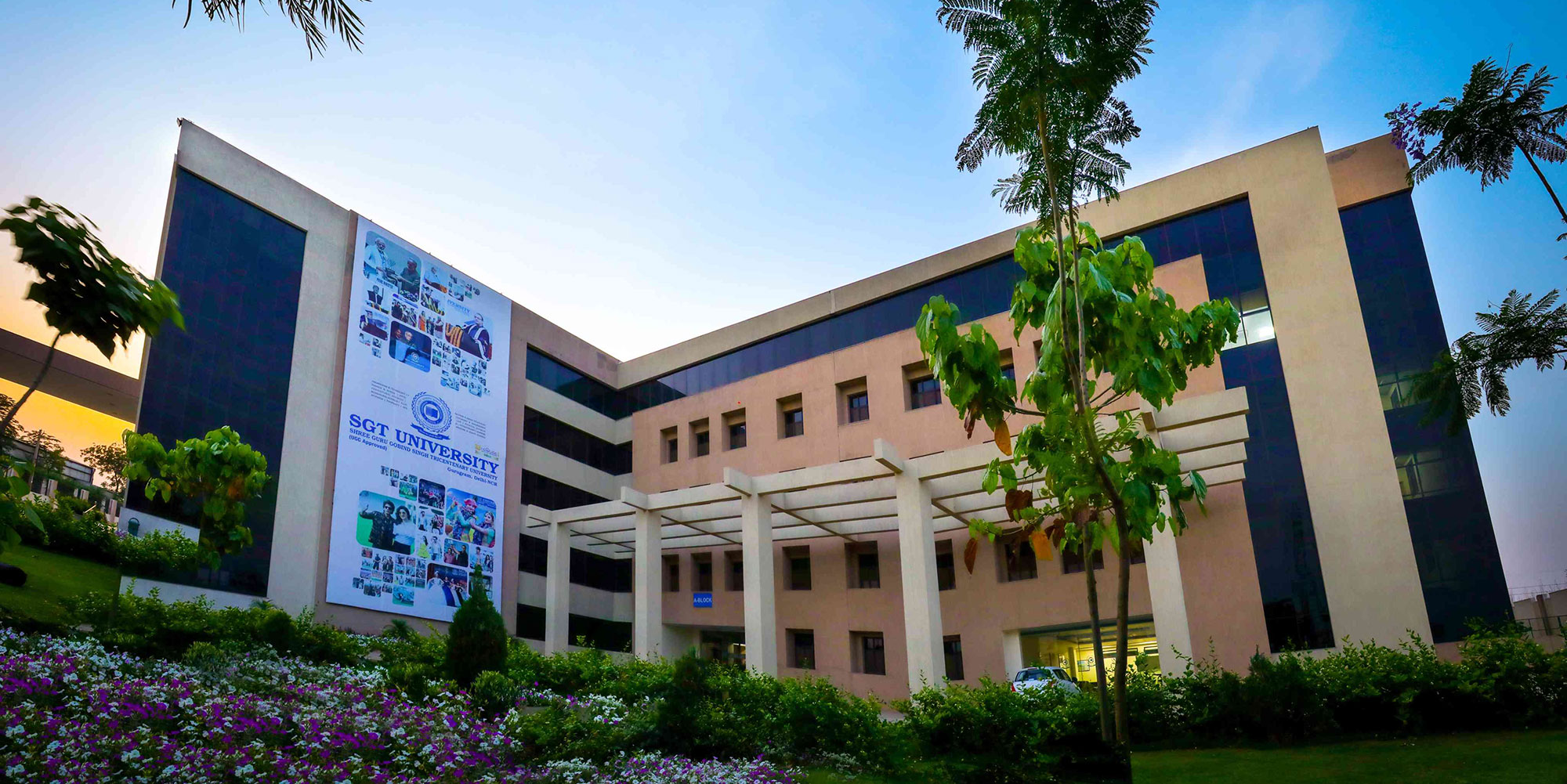
AI and Data Science at SGT University
For students considering higher education in this area, SGT University offers several pathways that connect computing, data and emerging technologies. The University's current programme offerings include a B.Tech in Artificial Intelligence & Data Science, B.Tech in Artificial Intelligence, B.Tech in Computer Science and Engineering with relevant specialisations, BCA pathways in Artificial Intelligence & Machine Learning and Data Science, and B.Sc. (Hons./Hons. with Research) in Statistics & Data Science.
The B.Tech in Artificial Intelligence & Data Science is a four-year undergraduate programme that brings together computer science fundamentals with areas such as Artificial Intelligence, Data Science, Machine Learning and analytics. The programme also emphasises practical learning through laboratories, projects, internships and workshops.
For students who prefer a statistics-led route, SGT University's B.Sc. Statistics & Data Science combines statistical methods with programming, data handling, machine learning and research-oriented learning. The University also offers an M.Sc. in Data Science for students planning to continue their education after graduation.
SGT University also has a Centre of Excellence in Artificial Intelligence (CoE-AI) that focuses on research, training, interdisciplinary work and practical applications across areas such as healthcare, agriculture, education, management and smart technologies. This provides an additional academic environment for students and researchers interested in the wider applications of the field.
Why Practical Exposure Matters
A technology-focused degree becomes more valuable when students get opportunities to apply what they learn. Working with datasets, writing programmes, building projects, participating in workshops and completing internships can help students understand how classroom concepts translate into real problems.
At SGT University, practical learning is incorporated into technology-oriented programmes through laboratories, projects, internships, workshops and research-based activities. For a student comparing universities, these learning opportunities are worth considering alongside the course title and fee structure.
How Should Students Choose the Right Course?
Before making a final decision, students should ask:
- Does the curriculum match my interests and academic strengths?
- What subjects will I study in each semester?
- What are the eligibility requirements?
- What is the complete cost of the programme?
- How much practical and project-based learning is included?
- Are internships and industry-oriented activities available?
- What skills will I have developed by graduation?
- What career and higher-study pathways can the programme support?
Most importantly, students should choose a course because it fits their interests and long-term plans, not simply because a particular technology is currently trending.
Conclusion
AI and Data Science offer several academic pathways for students after Class 12, from specialised engineering programmes to Computer Science, BCA and Statistics-based degrees. The right choice depends on a student's interests, academic background, budget and career plans.
A good programme should provide more than a popular course title. Strong fundamentals, practical learning, projects, industry exposure and opportunities to keep developing skills can make a meaningful difference to a student's long-term career journey.
For students exploring these fields in India, SGT University provides multiple options across Artificial Intelligence, Data Science and Computer Science, allowing students to choose a pathway according to their individual goals. The final decision should come after comparing the programme structure, eligibility, total cost, learning environment and career opportunities.
In a field that continues to change, the strongest advantage is not simply knowing a particular tool or technology. It is having the fundamentals, curiosity and practical ability to keep learning and applying those skills to real-world problems.
Frequently Asked Questions
Q1. Which are the best AI and Data Science courses after 12th in India?
Popular options include B.Tech in Artificial Intelligence and Data Science, B.Tech CSE with an AI/ML or Data Science specialisation, BCA with AI & ML or Data Science, and B.Sc. Statistics and Data Science.
Q2. What is the difference between Artificial Intelligence and Data Science?
Artificial Intelligence focuses on building systems that can learn, recognise patterns and make predictions, while Data Science focuses on collecting, analysing and interpreting data to find useful insights. The two fields overlap, and many programmes combine both.
Q3. What is the eligibility for AI and Data Science courses after 12th?
Eligibility depends on the programme and university. B.Tech programmes may require specific subjects and minimum marks, while BCA and B.Sc. programmes can have different criteria. Always check the current requirements of the exact programme.
Q4. What subjects are taught in AI and Data Science courses?
Common subjects include programming (especially Python), statistics and probability, databases and SQL, data visualisation, machine learning, algorithms, and project-based practical work.
Q5. What jobs can I get after an AI and Data Science course?
Graduates may work towards roles such as Data Analyst, Data Scientist, Machine Learning Engineer, AI Engineer, Data Engineer, Business Intelligence Analyst and Research Associate, depending on their skills and experience.
Q6. How much does an AI and Data Science course cost?
Fees vary significantly by university and course type. Students should consider the total cost, including tuition, hostel, food, transport, books, laptop and certifications, rather than only the tuition fee.
Q7. Why choose SGT University for AI and Data Science?
SGT University offers multiple pathways, including B.Tech in AI & Data Science, B.Tech CSE, BCA, B.Sc. Statistics & Data Science and M.Sc. Data Science, along with practical learning, internships, workshops and a dedicated Centre of Excellence in Artificial Intelligence.