
Board Exam 2027: A 90-Day Study Plan for Class 12 Students
Updated on: November 14, 2026
Introduction
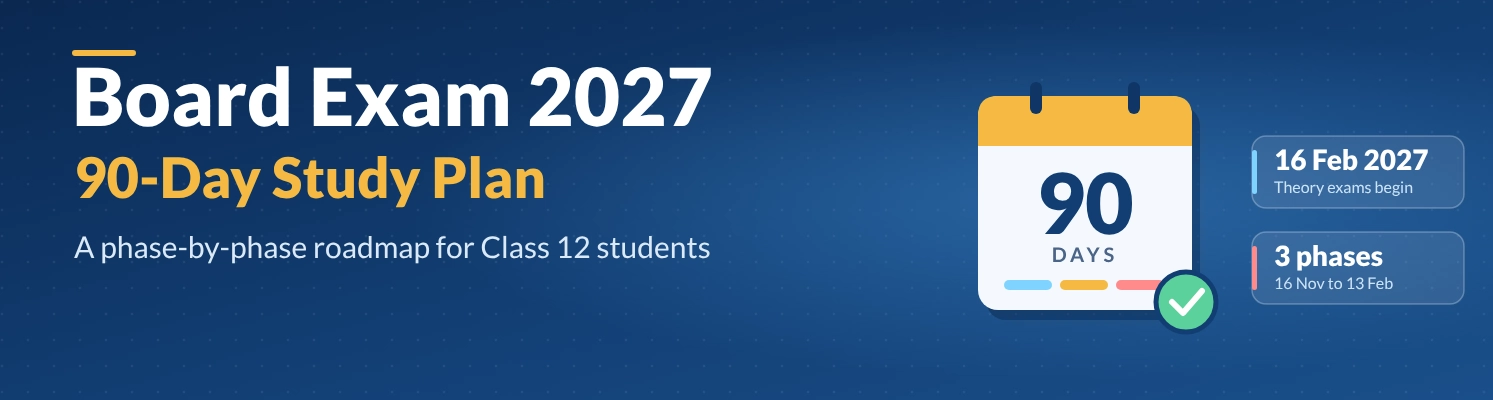
CBSE has released the Class 12 board exam date sheet for 2027, and the countdown has begun. Theory papers start on 16 February 2027 with Physics. If you start on Monday, 16 November 2026, you have exactly 90 days until 13 February, with two days to spare before your first paper.
Quick answer: The best way to use 90 days before the Class 12 board exams is to split them into three phases. In Days 1 to 35, finish the syllabus from NCERT and mark your weak chapters. In Days 36 to 65, revise every subject, solve previous years' questions and prepare for practicals. In Days 66 to 90, write full-length papers in 3 hours, review every mistake and revise in the order of your exams. Study 3 to 4 focused hours on school days and 6 to 8 on holidays, test yourself every week and sleep about 8 hours a night.
This guide gives you the dates, a day-by-day plan, a sample timetable, stream-wise tips and a way to use the gaps between papers. The plan follows the CBSE schedule, but students of state boards can use it too by shifting the dates to their own date sheet.
Table of Contents
- CBSE Class 12 Board Exam 2027: Key Dates
- How Your Class 12 Marks Are Counted
- The 90-Day Study Plan at a Glance
- Phase 1 (Days 1 to 35): Finish and Fix the Syllabus
- Phase 2 (Days 36 to 65): Revise and Practise
- Phase 3 (Days 66 to 90): Write Full Papers Like the Real Exam
- A Sample Daily Timetable
- How to Use the Gaps Between Your Papers
- Stream-Wise Tips for Science, Commerce and Humanities
- Preparing for JEE Main or NEET Too?
- Study Methods That Actually Work
- Handling Exam Stress and Staying Well
- Starting Late? 60-Day and 30-Day Versions
- Mistakes to Avoid in the Last 90 Days
- How Parents Can Help
- After the Boards: Plan Your Next Step
- Key Takeaways
- FAQs
- Sources
CBSE Class 12 Board Exam 2027: Key Dates
| Event | Date |
|---|---|
| Date sheet released | 6 November 2026 |
| Practical exams (winter-bound schools) | 9 November to 19 December 2026 |
| Practical exams (all other schools) | 1 January to 13 February 2027 |
| JEE Main 2027 Session 1 (tentative, as announced by NTA) | 22 to 24 and 28 to 30 January 2027 |
| Class 12 theory exams | 16 February to 9 April 2027 |
| Paper timing (most subjects) | 10:30 am to 1:30 pm |
CBSE says it checked more than 40,000 subject combinations so that no student has two papers on the same day. In 2026, CBSE gave students 15 minutes of reading time, from 10:15 to 10:30 am, before writing began. Check your 2027 admit card for the exact reporting time.
Class 12 subject-wise dates for major subjects
| Date | Subject |
|---|---|
| Tuesday, 16 February 2027 | Physics |
| Thursday, 18 February 2027 | Physical Education |
| Tuesday, 23 February 2027 | Accountancy |
| Thursday, 25 February 2027 | Geography |
| Saturday, 27 February 2027 | Chemistry |
| Tuesday, 2 March 2027 | Psychology |
| Friday, 5 March 2027 | English Core and English Elective |
| Tuesday, 9 March 2027 | Mathematics and Applied Mathematics |
| Saturday, 13 March 2027 | Hindi Core and Hindi Elective |
| Tuesday, 16 March 2027 | Economics |
| Friday, 19 March 2027 | Political Science |
| Thursday, 25 March 2027 | Biology |
| Saturday, 27 March 2027 | History |
| Tuesday, 30 March 2027 | Sociology |
| Wednesday, 31 March 2027 | Computer Science, Informatics Practices and Information Technology |
| Thursday, 1 April 2027 | Business Studies |
These dates come from the CBSE date sheet as reported by Careers360. Always confirm your subjects against the official PDF on cbse.gov.in and your admit card.
How Your Class 12 Marks Are Counted
Every Class 12 subject is marked out of 100, but the split between the board paper and school-based marks differs. Knowing it tells you where your marks really come from.
| Subject | Board theory paper | Practical or internal assessment |
|---|---|---|
| Physics, Chemistry, Biology | 70 | 30 (practical) |
| Computer Science, Geography | 70 | 30 |
| Mathematics, English Core | 80 | 20 |
| Accountancy, Business Studies, Economics | 80 | 20 |
| History, Political Science | 80 | 20 |
- Passing marks: You need at least 33% in each subject. Where a subject has practicals, you must pass the theory and practical parts separately.
- Question types: Papers mix multiple-choice questions, competency-based questions (case-based, source-based and application questions) and short and long answers. CBSE has said there is no change in the question paper design for 2026-27.
- Best guide to the paper: The official 2026-27 sample question papers and marking schemes, released in September 2026 on cbseacademic.nic.in, show the exact pattern and how marks are awarded step by step.
The splits above follow the 2025-26 scheme. Check the 2026-27 syllabus for each of your subjects, since a few subjects have their own pattern.
The 90-Day Study Plan at a Glance
| Phase | Days | Dates | Main goal |
|---|---|---|---|
| Phase 1: Finish and fix | 1 to 35 | 16 November to 20 December 2026 | Complete the syllabus from NCERT, make short notes and mark weak chapters |
| Phase 2: Revise and practise | 36 to 65 | 21 December 2026 to 19 January 2027 | Revise every subject once, solve previous years' questions, prepare for practicals |
| Phase 3: Exam rehearsal | 66 to 90 | 20 January to 13 February 2027 | Write full papers in 3 hours, review mistakes, revise in exam order |
| Final stretch | Buffer | 14 and 15 February 2027 | Light revision of Physics or your first paper, rest well |
Phase 1 (Days 1 to 35): Finish and Fix the Syllabus
The goal of the first five weeks is simple: no chapter should be new to you on 20 December. If your school has already finished the syllabus, use this phase to fill gaps.
- List every chapter in each subject and mark it green (confident), amber (shaky) or red (not done). Divide the red and amber chapters across the five weeks.
- Read NCERT line by line. Solve the in-text questions, examples and end-of-chapter exercises. Most board questions are built on this material.
- Make short notes as you go: one page of formulas, definitions, reactions, dates or key terms per chapter. These pages become your revision material later.
- Test yourself every Sunday. Take one 40 to 60 minute chapter test per subject on what you studied that week, and note every mistake in an error notebook.
- Keep English and your fifth subject alive. Give them two short sessions a week so they do not pile up later.
Phase 2 (Days 36 to 65): Revise and Practise
From 21 December, the focus moves from learning to remembering and applying. This phase overlaps with winter holidays and, for most schools, with practical exams from 1 January.
- Revise each subject once in full, using your one-page notes and NCERT, in the order of your exams.
- Solve previous years' board questions chapter by chapter. This shows you which ideas CBSE asks again and again and how many marks they carry.
- Practise competency-based questions from the 2026-27 sample papers: case studies, source passages and application questions.
- Get practicals ready. Complete your practical file, project and investigatory work, and revise likely viva questions before your school's practical dates.
- Write, do not just read. Write answers to long questions with headings, diagrams and labels, the way you will in the exam hall.
Phase 3 (Days 66 to 90): Write Full Papers Like the Real Exam
The last 25 days are about performing under exam conditions. Your brain needs to get used to writing for 3 hours, starting at 10:30 in the morning.
- Write full-length papers at the real time, from 10:30 am to 1:30 pm, with 15 minutes of reading time first. Use the official 2026-27 sample papers and the last few years' board papers.
- Aim for 6 to 8 full papers per main subject across these weeks, and spend almost as long reviewing each paper as writing it.
- Mark your paper with the CBSE marking scheme. Note where you lost step marks, missed keywords or ran out of time.
- Revise in exam order. Physics (or your first paper) gets the final week before 16 February, because there is no gap before it.
- Stop learning brand-new topics after 5 February unless they carry high marks. Use the time to strengthen what you already know.
A Sample Daily Timetable
Use this as a starting point and adjust it to your school hours and coaching classes.
| Time | School day | Holiday or study leave |
|---|---|---|
| 6:30 to 7:00 am | Wake up, 20 minutes of formula or note recall | Wake up by 7:00, light exercise |
| Morning | School | 8:00 to 10:00: Block 1 (hardest subject) |
| 10:30 am to 1:30 pm | School | Block 2, or a full timed paper in Phase 3 |
| Afternoon | 4:30 to 6:30: Block 1 (hardest subject) | 2:30 to 4:30: Block 3 (practice questions) |
| Evening | 7:00 to 8:30: Block 2 (second subject) | 5:00 to 6:00: walk or sport; 6:30 to 8:30: Block 4 |
| Night | 9:15 to 10:00: recall and error notebook | 9:30 to 10:00: recall and plan tomorrow |
| Sleep | By 10:30 pm | By 10:30 pm |
Inside each block, study for about 50 minutes and take a 10-minute break away from your phone. That gives roughly 3 to 4 focused hours on school days and 6 to 8 on holidays.
How to Use the Gaps Between Your Papers
The 2027 date sheet leaves very different gaps between papers. Plan your last revision around them, because a short gap means that subject must be almost ready before your exams begin.
| Stream | Paper order and days in between | What it means for your plan |
|---|---|---|
| PCM | Physics (16 Feb), 10 days, Chemistry (27 Feb), 5 days, English (5 Mar), 3 days, Maths (9 Mar) | Finish Maths revision before February. The 3 days after English are only for final practice. |
| PCB | Physics (16 Feb), 10 days, Chemistry (27 Feb), 5 days, English (5 Mar), 19 days, Biology (25 Mar) | Physics needs to be ready by 15 February. Biology gets a long final revision window in March. |
| Commerce | Accountancy (23 Feb), 9 days, English (5 Mar), 3 days, Maths or Applied Maths (9 Mar), 6 days, Economics (16 Mar), 15 days, Business Studies (1 Apr) | Accountancy formats come first. Keep Maths sharp through February because of the short gap. |
| Humanities (example) | Geography (25 Feb), 4 days, Psychology (2 Mar), 2 days, English (5 Mar), 13 days, Political Science (19 Mar), 7 days, History (27 Mar), 2 days, Sociology (30 Mar) | Psychology and English come close together, and so do History and Sociology. Revise those pairs early. |
Your own order may differ if you take subjects such as Physical Education (18 February), Computer Science (31 March) or a language. Write your exam dates on a wall calendar and count the gap days yourself.
Stream-Wise Tips for Science, Commerce and Humanities
Science (PCM and PCB)
- Physics: Practise derivations by writing them out, and solve NCERT examples and numericals with units. Draw ray diagrams and circuit diagrams neatly.
- Chemistry: Read NCERT closely for inorganic chemistry, keep a list of named reactions and conversions for organic chemistry, and practise physical chemistry numericals every day.
- Mathematics: Solve every NCERT exercise and example, then previous years' questions. Show each step, because CBSE awards marks for method.
- Biology: Use NCERT terms exactly, and practise labelled diagrams until you can draw them quickly.
Thinking about what comes next? See our guides to career options after 12th PCM and career options after 12th PCB.
Commerce
- Accountancy: Practise formats until they are automatic: partnership accounts, company accounts and cash flow statements. Keep your working notes neat.
- Business Studies: Learn the key terms and practise case-based questions, where you must spot the concept in a short business story.
- Economics: Draw diagrams with labelled axes, and practise numericals in national income and related topics.
Humanities
- History: Practise source-based questions and map work. Make a timeline of key events for quick revision.
- Political Science and Geography: Write answers in points with headings, and practise maps regularly.
- Psychology and Sociology: Learn key terms and theories with one example each, and practise application-based questions.
English Core
English is often left until the end, yet it carries the same 100 marks as any other subject. Practise writing formats (notice, invitation, letter, article, report) each week, and revise the prose and poetry chapters with their themes and character sketches.
Preparing for JEE Main or NEET Too?
JEE Main 2027 Session 1 is scheduled for 22 to 24 and 28 to 30 January 2027, according to NTA's tentative schedule. That falls inside Phase 3 and, for most schools, inside the practical exam window. A workable approach (see our JEE Main 2027 registration guide):
- Until December, study shared Physics, Chemistry and Maths topics for both exams together.
- In January, give JEE practice more time, but keep one board-style written answer session a day.
- From 1 February, switch fully to board-style papers, NCERT and English.
- NEET UG and CUET UG 2027 dates were not officially announced when this guide was written. Check nta.ac.in regularly and add them to your calendar.
If you are a PCB student weighing your options, our guide to career options beyond MBBS after NEET may help.
Study Methods That Actually Work
A well-known review of learning research by Dunlosky and colleagues, published in 2013 in Psychological Science in the Public Interest, found that two methods stood out: taking practice tests and spreading study sessions over time. Underlining and rereading were found to be of surprisingly low use. In practice, that means:
- Recall before you reread. Close the book and write down everything you remember about a chapter, then check what you missed.
- Space your revision. Revisit a chapter one day, three days and a week after you study it, instead of revising it many times in one sitting.
- Mix question types. In Phase 3, solve mixed sets from different chapters so you learn to recognise what each question needs.
- Keep an error notebook. Every mistake from tests goes here with the correct method. Read it every night in the final month.
- Teach it. Explain a topic aloud to a friend or family member. If you get stuck, that is your gap.
Sleep is part of studying, not a break from it. The US Centers for Disease Control and Prevention recommends 8 to 10 hours of sleep for teenagers aged 13 to 17 and at least 7 hours for adults. Cutting sleep to study more usually backfires. If your phone keeps pulling you away, read our piece on how social media affects academic life.
Handling Exam Stress and Staying Well
Some nervousness before the boards is normal and can even help you focus. It becomes a problem when it stops you from sleeping, eating or studying. Small habits help:
- Keep a fixed sleep and wake-up time, even on weekends.
- Move for 20 to 30 minutes a day: a walk, sport, yoga or stretching.
- Compare yourself with your own last test, not with friends' scores.
- Talk to a parent, teacher or friend when worry builds up.
- CBSE counselling: Each year CBSE runs a free psycho-social counselling service for board students. In 2026 it began on 6 January, with a 24x7 toll-free IVRS line (1800-11-8004) and tele-counselling from 9:30 am to 5:30 pm on working days.
- Tele-MANAS: The government's free 24x7 mental health helpline is 14416 or 1-800-891-4416.
For more ideas, read what causes exam stress and how to manage it. At university, support continues: SGT University's C.A.L.M Spaces offers students free counselling and peer support.
Starting Late? 60-Day and 30-Day Versions
Starting later than mid-November is not the end of the road. Compress the same three phases:
| If you start | Finish and fix | Revise and practise | Exam rehearsal |
|---|---|---|---|
| 60 days before (mid-December) | Days 1 to 20: only red and amber chapters | Days 21 to 40: one full revision plus previous years' questions | Days 41 to 60: 4 to 5 full papers per subject |
| 30 days before (mid-January) | Skip, except high-mark chapters you have not studied | Days 1 to 10: revise from short notes and NCERT | Days 11 to 30: 3 to 4 full papers per subject |
Mistakes to Avoid in the Last 90 Days
- Collecting too many reference books instead of finishing NCERT and the sample papers.
- Rereading notes for hours without testing yourself.
- Leaving English and the fifth subject until the last week.
- Skipping practical file work until the week before practicals.
- Never writing a full 3-hour paper before the real exam.
- Cutting sleep in the final month, and spending the night before a paper learning new topics.
How Parents Can Help
- Help your child build a timetable, then let them own it.
- Protect sleep and meals, and keep the home calm in the exam months.
- Ask what they learned this week, not only what marks they got.
- Watch for signs of serious stress, such as poor sleep, loss of appetite or withdrawal, and seek help early.
After the Boards: Plan Your Next Step
Once your last paper is over, take a few days off, then start planning the next step. Many universities open applications for the next session before board results come out.
- Explore streams and careers: commerce, arts and humanities and the highest-paying courses after 12th.
- Compare universities with our list of top private universities in India.
- Check how to get college scholarships and keep your admission documents ready.
- Browse the programmes offered at SGT University and read the admission procedure.
Key Takeaways
- CBSE Class 12 theory exams run from 16 February to 9 April 2027, starting with Physics.
- Starting on 16 November gives you 90 days until 13 February, plus two buffer days.
- Split the 90 days into three phases: finish and fix, revise and practise, then full exam rehearsal.
- Test yourself every week and space out your revision. Rereading alone is not enough.
- Plan your final revision around the gaps between your papers, especially short gaps.
- Protect your sleep and ask for help if stress builds up. Free helplines are available.
FAQs
Q1. When will the CBSE Class 12 board exams 2027 start?
CBSE Class 12 theory exams start on Tuesday, 16 February 2027, with Physics, and run
until 9 April 2027. Most papers begin at 10:30 am. The date sheet was released on 6
November 2026 on cbse.gov.in.
Q2. Is 90 days enough to prepare for the Class 12 board exams?
Yes, for most students. Ninety days gives you about five weeks to finish and
strengthen the syllabus, four weeks to revise and practise questions, and three to
four weeks to write full-length timed papers. The key is to start with a written plan
and test yourself every week instead of only rereading.
Q3. How many hours should a Class 12 student study every day?
A realistic target is 3 to 4 focused hours on school days and 6 to 8 focused hours on
holidays or study leave, split into blocks of about 50 minutes with short breaks.
Focused hours matter more than total hours, and you should still sleep about 8 hours a
night.
Q4. What is the best 90-day study plan for Class 12?
Divide the 90 days into three phases. Days 1 to 35: finish the syllabus from NCERT and
mark weak chapters. Days 36 to 65: revise every subject, solve previous years'
questions and prepare for practicals. Days 66 to 90: write full-length papers in 3
hours, review every mistake and revise in the order of your exams.
Q5. When are the CBSE Class 12 practical exams in 2027?
For most CBSE schools, practical exams and internal assessments run from 1 January to
13 February 2027. Winter-bound schools hold them earlier, from 9 November to 19
December 2026. Your school will give you the exact dates.
Q6. What are the dates of the main Class 12 science papers in 2027?
According to the date sheet as reported by Careers360, Physics is on 16 February,
Chemistry on 27 February, English Core on 5 March, Mathematics on 9 March and Biology
on 25 March 2027. Always confirm your dates on the official CBSE date sheet and your
admit card.
Q7. Are NCERT books enough for the Class 12 board exams?
For most subjects, NCERT textbooks are the base of the board paper, so finish them
line by line first, including in-text questions, examples and exercises. Then add CBSE
sample papers and previous years' questions to practise the question types and timing.
Q8. How many sample papers should I solve before the boards?
There is no fixed number, but aim for at least 6 to 8 full-length timed papers per
main subject in the last four weeks, including the official CBSE sample papers for
2026-27 and previous years' board papers. Reviewing each paper carefully matters more
than the count.
Q9. What are the passing marks in CBSE Class 12?
You need at least 33% in each subject. In subjects with practicals, such as Physics,
Chemistry and Biology, you must pass the theory and practical parts separately.
Q10. How can I balance JEE Main preparation with the Class 12 boards?
Keep studying the shared topics in Physics, Chemistry and Maths for both exams until
December. JEE Main 2027 Session 1 is scheduled for 22 to 24 and 28 to 30 January 2027,
so focus on JEE in January, then switch fully to board-style written answers from 1
February.
Q11. How can I deal with board exam stress?
Keep a fixed sleep time, take short breaks, exercise for 20 to 30 minutes a day and
talk to someone you trust. CBSE runs a free psycho-social counselling helpline
(1800-11-8004) before the board exams, and Tele-MANAS (14416 or 1-800-891-4416) offers
free mental health support 24x7.
Q12. What should I do after the Class 12 board exams?
Use the weeks after your last paper to shortlist courses and universities, check
entrance exams and admission dates, and prepare documents such as your marksheet,
transfer certificate and ID proof. Many universities open applications for the next
session before board results are announced.
Sources
The facts and figures in this article come from the sources below.
- CBSE, Date sheet for Class X and XII Board Examinations 2027 (official PDF) (6 November 2026). Used for: the official 2027 exam schedule.
- All India Radio News, CBSE releases date sheet for Class 10th and 12th board examinations 2027 (6 November 2026). Used for: the exam window, practical exam dates and 40,000 subject combinations.
- Careers360, CBSE Class 12 date sheet 2027 out (November 2026). Used for: subject-wise Class 12 dates and paper timing.
- Careers360, CBSE 10th, 12th sample papers out for board exams 2027 (22 September 2026). Used for: sample papers, unchanged paper design and 33% passing marks.
- Careers360, CBSE Class 12 marking scheme (2026). Used for: the theory and practical or internal assessment split by subject.
- Physics Wallah, CBSE board exams 2026: exam-day schedule (2026). Used for: the 15-minute reading time.
- Careers360, JEE Main 2027 exam dates out: Session 1 from January 22 (2026). Used for: JEE Main 2027 Session 1 dates.
- Free Press Journal, CBSE launches free psycho-social counselling for Class 10, 12 students (January 2026). Used for: CBSE counselling helpline details.
- Government of Assam, Dhubri Medical College and Hospital, Tele-MANAS: 24x7 mental health helpline (2025). Used for: Tele-MANAS numbers.
- Association for Psychological Science, Improving students' learning with effective learning techniques (January 2013). Used for: evidence on practice testing and spaced study.
- US Centers for Disease Control and Prevention, About sleep (2024). Used for: recommended sleep for teenagers and adults.