Drone Operations in Media and Entertainment: How Drones Are Transforming Content Creation and the Creator Economy
Updated on: August 20, 2026
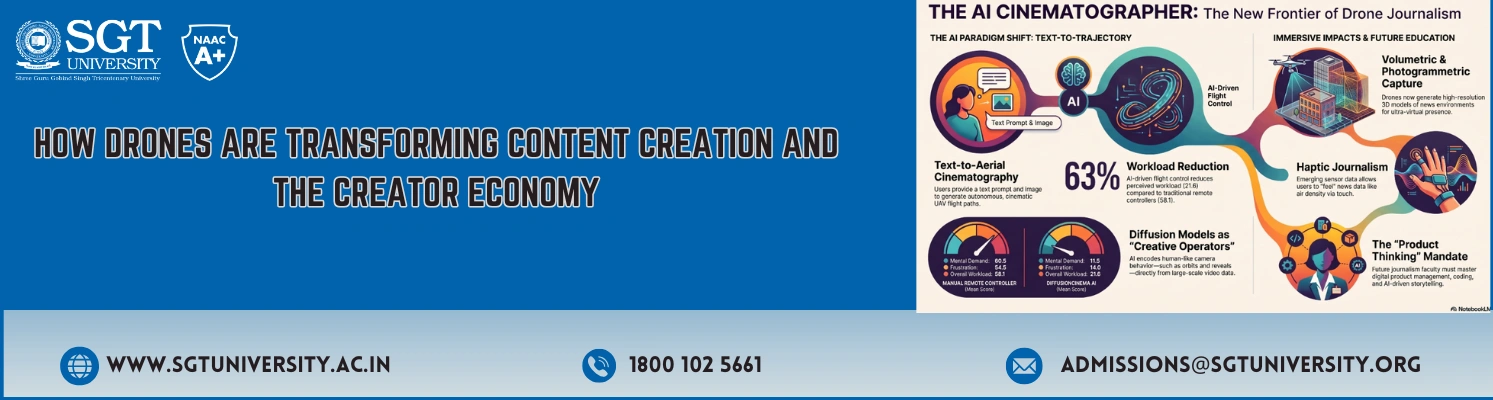
The media and entertainment sector is going through one of the biggest technological shifts in its history, and drone operations sit right at the centre of it. From feature films and live sports coverage to travel vlogs and news reporting, drones have changed how stories are captured and how audiences experience them.
Aerial cinematography was once possible only with helicopters, cranes and budgets that ruled out most productions. Today the same perspective is available to filmmakers, journalists, digital creators and independent producers through drone technology that costs a fraction of what it used to. Drone operations are no longer a niche technical skill — they have become a core part of modern media education and digital storytelling.
As the global creator economy expands, demand is rising fast for professionals who understand drone technology, AI-assisted production, immersive storytelling and digital content creation. Governments and institutions across India are responding, with new initiatives in Animation, Visual Effects, Gaming, Comics and Extended Reality (AVGC-XR), virtual production and creator-focused education. This guide covers what drone operations actually involve, where the footage is used, how AI and virtual production are reshaping the workflow, what India’s drone rules require, and the careers this skill opens up.
What are drone operations?
Drone operations refer to the planning, flying, management and execution of unmanned aerial vehicles (UAVs) for a defined purpose. In media and entertainment, that purpose is almost always visual storytelling. Typical applications include:
- Aerial photography;
- Cinematic filmmaking;
- News coverage;
- Event broadcasting;
- Sports coverage;
- Travel and tourism content creation;
- Advertising and brand films;
- Disaster and environmental reporting;
- Digital media content creation.
What separates a professional from a hobbyist is that professional drone operations combine four things at once: technical knowledge of the aircraft, flying and safety discipline, storytelling instinct, and a working understanding of the regulations that govern where and when a drone may fly. Miss any one of those and the footage either does not get shot or does not get used.
Why drone media production is the future of storytelling
The future of content creation belongs to creators who can combine technology with storytelling. Drones deliver perspectives that used to be prohibitively expensive, and they do it with a small crew and a short setup time. That is why drone footage now appears across almost every content format:
Journalism
- Disaster reporting and damage assessment;
- Election and large-gathering coverage;
- Environmental journalism;
- Investigative and long-form reporting.
Filmmaking
- Establishing shots;
- Action and chase sequences;
- Location cinematography;
- Documentary filmmaking.
Digital content creation
- YouTube travel videos;
- Instagram reels and short-form video;
- Brand storytelling;
- Tourism promotion.
Advertising and marketing
- Real estate films;
- Destination marketing;
- Corporate films;
- Product launches.
For anyone building a career in digital media, drone operations have moved from a nice-to-have to an expected part of the toolkit.
How AI is changing drone operations
Artificial intelligence is rapidly reshaping media production workflows, and drone work is no exception. AI now assists creators with:
- Shot planning and pre-visualisation;
- Storyboarding;
- Subject and object tracking during flight;
- Automated flight paths and repeatable camera moves;
- Building and populating virtual environments;
- Stabilisation, colour grading and faster post-production.
Current evidence points in a consistent direction: AI is most effective as a creative assistant that augments human judgement rather than replacing it. It removes repetitive execution work and shortens turnaround times, but the decisions that make a shot land — what to frame, when to move, what the shot is saying — still belong to the operator.
This is precisely why the future of media education sits at the intersection of drone technology, artificial intelligence, storytelling and immersive media. A graduate who can operate a drone but cannot work alongside AI tools, or who can use AI tools but has no storytelling grounding, is only half-equipped.
Drone operations and virtual production
Virtual production is one of the most significant developments in filmmaking and digital media in the last decade. Films, OTT series, advertisements and immersive experiences are increasingly produced using:
- LED volume stages;
- Real-time rendering engines;
- XR environments;
- AI-assisted workflows;
- Digital twins;
- Virtual cinematography.
Drones matter here in a way that is often missed. Aerial scans and drone-captured plates of real locations are fed into virtual environments to build believable digital backdrops, which means drone footage now serves two masters: the final edit and the virtual set. Industry-focused institutions are responding by adding virtual production and AVGC-XR modules to media curricula, so students learn the pipeline rather than a single tool.
Drone rules in India: what every media student should know
Creative skill alone does not get a drone into the air legally. In India, drone operations are governed by the Drone Rules, 2021, administered by the Directorate General of Civil Aviation (DGCA) through the Digital Sky platform. A working knowledge of this framework is now part of the job, and clients increasingly ask for it before a shoot is booked.
The essentials most media professionals need to understand:
- Weight decides the rules. Drones are classified by maximum all-up weight, and the 250-gram nano threshold is the most important line. Lighter drones face the fewest requirements; heavier categories attract registration, insurance and certification obligations.
- Registration. Drones above the nano category are registered on Digital Sky and carry a Unique Identification Number.
- Pilot certification. Commercial flying above the nano category requires a Remote Pilot Certificate, earned through a DGCA-approved Remote Pilot Training Organisation.
- Airspace zones. Green, yellow and red zones are mapped on Digital Sky. Yellow zones need permission; red zones are off-limits.
- Operating conditions. Visual line of sight, daylight operation, altitude limits and no flying over crowds are standard conditions that apply to most media shoots.
These rules are amended periodically, so the professional habit is to check Digital Sky and current DGCA guidance before every commercial shoot rather than relying on what was true last year. Treat this section as an orientation, not a substitute for the current official guidance.
Career pathways in drone media production
Because drone skills sit across several industries at once, the career map is unusually wide for a media specialisation. Roles graduates commonly move into include:
- Drone cinematographer;
- Aerial camera operator on film and OTT productions;
- Video journalist and news drone operator;
- Documentary filmmaker;
- Live event and sports coverage crew;
- Real estate and destination film producer;
- Brand content creator and advertising film crew;
- Independent creator or freelance aerial content specialist.
The same skill set also travels outside entertainment — into survey, infrastructure inspection, agriculture documentation and environmental monitoring — which gives drone-trained media graduates a second market to work in. For a broader view of where media graduates land, see our guide on how students get media jobs after graduation.
Skills that make a drone media professional employable
| Skill area | What it covers |
|---|---|
| Flight competence | Manual and assisted flight, smooth camera moves, orbit and reveal manoeuvres, recovery from wind and signal issues |
| Camera and exposure | Gimbal control, frame rates, ND filters, log profiles and exposure control for aerial conditions |
| Shot planning | Storyboarding aerial sequences, scouting locations, matching aerial shots to the edit |
| Safety and compliance | Pre-flight checklists, airspace and weather checks, permissions, insurance, crowd and crew safety |
| Post-production | Stabilisation, colour grading, editing aerial footage into a narrative sequence |
| AI and emerging tools | AI-assisted planning and tracking, virtual production workflows, XR and immersive formats |
SMCF at SGT University: pioneering drone media production education
The media industry now needs professionals who understand traditional journalism and filmmaking and the emerging technologies reshaping storytelling. Recognising this shift, the School of Emerging Media, Communication and Film Studies (SMCF), SGT University, Gurugram, Delhi NCR, was among the first in India to bring Drone Media Production into a bachelor’s curriculum.
SMCF’s approach goes beyond conventional media education by integrating:
- Drone media production;
- AI-enabled content creation;
- Digital storytelling;
- Creator economy education;
- Immersive media practices;
- Film and documentary production;
- Virtual production techniques;
- Entrepreneurship in media.
Drone Media Production is offered as a specialisation within the BA in Journalism and Mass Communication (BJMC), alongside cinematography, photography, podcasting, radio production, graphics, event management and advertising & public relations. Students work with practical production studios — film, television and radio — and an in-campus media museum, and learn through a project-based pedagogy that puts equipment in students’ hands early.
Short-format professional certificates in production skills are also offered through SMCF — you can see the current list on the SMCF programmes page, including the Professional Certificate in Film Production Techniques. Together with drone training, these give students hands-on grounding in aerial cinematography, safety protocols, visual storytelling and real-world media applications.
By combining technology, creativity and industry-oriented training, SMCF is preparing students for careers that did not exist a decade ago. As India positions itself as a global hub for creative technologies, schools that pioneer future-focused education in drone media production, emerging media technologies and creator-driven innovation have an outsized role to play.
Key information at a glance
| Particulars | Details |
|---|---|
| School | School of Emerging Media, Communication and Film Studies (SMCF) |
| Where drone media production is taught | Specialisation within the BA in Journalism and Mass Communication (BJMC) |
| BJMC eligibility | 10+2 or equivalent in any stream with a minimum of 55% marks, with English as a subject |
| Other specialisations | Photography, Cinematography, Cultural Communication, Graphics, Event Management, Advertising & PR, Podcasting, Digital Radio Production |
| Campus | Gurugram, Haryana — Delhi NCR |
| Application status | Apply online |
Conclusion
The sky is no longer the limit for content creators. Drone technology, artificial intelligence, immersive media and an expanding creator economy have combined to reward creators who can think beyond traditional boundaries and capture stories from genuinely new perspectives. What was once the preserve of studios with helicopter budgets is now a skill a student can build during a degree.
If you want to work in this space, the practical route is to build all four pillars together — flight skill, camera craft, regulatory literacy and storytelling — rather than one at a time. You can explore how SMCF structures that on the School of Emerging Media, Communication and Film Studies page, or apply online for the upcoming admission cycle.
Frequently Asked Questions (FAQs)
Q.1 What are drone operations in the media and entertainment sector?
Drone operations refer to planning, flying, managing and executing unmanned aerial vehicle (UAV) flights for media purposes. In film and entertainment this covers aerial photography, cinematic filmmaking, news coverage, event and sports broadcasting, travel content, advertising films and environmental reporting.
Q.2 What is drone media production?
Drone media production is the use of drones as a storytelling tool rather than just a flying camera. It combines flight skill, camera and gimbal control, shot planning, safety and regulatory compliance, and post-production editing, so that aerial footage serves the narrative of a film, documentary, news story or branded video.
Q.3 Do I need a licence to fly a drone for filming in India?
It depends on the weight of the drone and whether the work is commercial. Under the Drone Rules 2021, nano drones weighing 250 grams or less have the lightest requirements, while heavier categories require registration on the Digital Sky portal and a Remote Pilot Certificate for commercial flying. Because these rules are periodically amended, always check current DGCA and Digital Sky guidance before a paid shoot.
Q.4 What is a Remote Pilot Certificate (RPC) and who issues it?
A Remote Pilot Certificate is India’s equivalent of a licence for drone pilots. It is obtained by completing training at a Remote Pilot Training Organisation approved by the Directorate General of Civil Aviation (DGCA), and the certificate is issued through the Digital Sky platform. Applicants generally need to be at least 18 years old and to have passed Class 10.
Q.5 Can I fly a drone anywhere for a shoot?
No. Indian airspace is mapped into green, yellow and red zones on the Digital Sky platform. Green zones allow the freest operation, yellow zones need permission from air traffic authorities, and red zones are prohibited. Standard conditions also apply — keeping the drone within visual line of sight, flying in daylight, staying within the permitted altitude and never flying over crowds.
Q.6 Do I need an engineering or technical background to learn drone operations?
No. Drone media production is taught as a creative and applied skill, and students from arts, commerce, science and humanities backgrounds can learn it. What matters more is visual sense, spatial awareness, discipline around safety procedures and a willingness to practise flying regularly.
Q.7 What is the difference between drone operations and aerial cinematography?
Aerial cinematography is the creative craft of composing and capturing shots from the air. Drone operations is the wider discipline around it — mission planning, airspace and weather assessment, battery and equipment management, safety protocols, regulatory permissions and crew coordination. A working professional needs both.
Q.8 What careers can I build after learning drone media production?
Common roles include drone cinematographer, aerial camera operator, video journalist, documentary filmmaker, live event and sports coverage crew, real estate and destination film producer, brand content creator, and freelance aerial content specialist. The skill also supports work in survey, inspection and environmental documentation.
Q.9 How much does a drone cinematographer earn in India?
Earnings vary widely with experience, equipment ownership, certification and location. Entry-level media roles typically start modestly, while experienced freelance drone operators who own their equipment and hold a Remote Pilot Certificate usually command significantly higher day rates for advertising, film and event work. Check current market listings rather than relying on general estimates.
Q.10 How is artificial intelligence changing drone operations?
AI is used across the production workflow for shot planning, storyboarding, subject and object tracking, automated flight paths, scene stabilisation and faster post-production. Current evidence suggests AI works best as a creative assistant that speeds up execution, while creative judgement, framing and storytelling remain with the human operator.
Q.11 What is virtual production and how do drones fit into it?
Virtual production uses LED volume stages, real-time rendering engines, XR environments and digital twins to shoot scenes without traditional location work. Drone-captured plates and aerial scans of real locations are increasingly fed into these virtual environments, so drone footage now feeds virtual sets as well as the final edit.
Q.12 What does AVGC-XR mean and why does it matter for media students?
AVGC-XR stands for Animation, Visual Effects, Gaming, Comics and Extended Reality — the umbrella term used in Indian policy discussions for the creative technology sector. It matters because it identifies where new media jobs are being created, and because curricula built around it prepare students for pipelines that combine live capture, animation and immersive technology.
Q.13 What equipment and software will I work with in a drone media course?
Training typically covers camera drones and their gimbal and flight controls, flight planning and airspace apps, ND filters and exposure control for aerial work, and post-production tools for colour grading, stabilisation and editing. Students also learn pre-flight checklists, battery discipline and equipment care, which matter as much as creative skill on a live set.
Q.14 How do drones help creators in the creator economy?
Drones give independent creators access to visuals that once required helicopters and large budgets. For travel vloggers, reel creators, tourism and real estate marketers and brand storytellers, a single aerial establishing shot raises production value immediately — which improves watch time and makes a creator’s work more competitive for paid brand collaborations.
Q.15 Does SGT University offer drone media production?
Yes. Drone Media Production is offered as a specialisation within the BA in Journalism and Mass Communication at the School of Emerging Media, Communication and Film Studies (SMCF), SGT University, Gurugram, Delhi NCR. SMCF was among the first in India to bring drone media production into a bachelor’s curriculum, alongside training in digital content creation, podcasting, film and emerging media.
Related Blogs
- Digital Media Courses in India: Content Creation, Podcasting & Mobile Journalism
- Podcast Production Course in India: A Complete Guide
- Top 4 BJMC Colleges in India 2026
- How Students Get Media Jobs After Graduation: A Complete Career Guide
Written By:
Gauri Joshi
Assistant Professor
School of Emerging Media, Communication & Film
Studies (SMCF),
SGT University