Choosing a pharmacy college is one of the most consequential decisions you will make after Class 12, because it shapes your licensing eligibility, your clinical and industry exposure, and the career doors that open once you graduate. In Gurgaon, Haryana, and the wider Delhi NCR, the choice is crowded, and the marketing all sounds the same. This guide cuts through it: what actually separates a top pharmacy college from an average one, how to verify a college before you apply, and where SGT University fits when you measure it against those criteria rather than against advertising.
What Is the Best Pharmacy College in Gurgaon, Haryana & Delhi NCR?
The best pharmacy college in Gurgaon, Haryana, and Delhi NCR is a PCI-approved, NAAC-accredited institution that combines a NEP-2020 aligned B.Pharm curriculum with well-equipped laboratories, structured internships, active research, and a strong placement cell. SGT University in Gurugram meets these benchmarks and is worth shortlisting alongside other established NCR options for 2026 admission.
Table of Contents
- In Short
- What Makes a Pharmacy College the "Best"?
- Why Study Pharmacy After 12th in 2026?
- SGT University's Pharmacy Programmes at a Glance
- Accreditation, Approvals & Why They Matter
- Curriculum, Labs & Clinical Exposure
- Placements, Internships & Industry Links
- Research, Innovation & Entrepreneurship
- Career Paths & Salary After B.Pharm
- Government vs Private & How to Compare Colleges
- Pharmacy Admission 2026: Eligibility & Process
- How to Verify Any Pharmacy College Before Applying
- Key Takeaways
- Frequently Asked Questions
In Short
A strong pharmacy college is defined by five non-negotiables: current PCI approval, a valid NAAC grade, real laboratory and clinical exposure, structured internships with genuine industry tie-ups, and a placement cell that can show its record. SGT University in Gurugram offers B.Pharm, D.Pharm, and higher pharmacy programmes on a health-sciences campus with an associated teaching hospital, which supports the hands-on training that pharmacy demands. Before applying anywhere, verify approvals on the official PCI portal, check the NAAC grade, and ask the placement cell for its most recent, specific data rather than headline promises.
What Makes a Pharmacy College the "Best"?
"Best" is not a trophy a college hands itself. For pharmacy specifically, it is the sum of a few things that are easy to verify and hard to fake. Get these right and the marketing becomes irrelevant.
The single most important filter is regulatory approval. Pharmacy education in India is governed by the Pharmacy Council of India (PCI), a statutory body created under the Pharmacy Act, 1948. Only a PCI-approved programme lets you register as a pharmacist and practise legally, so a college without current PCI approval for the specific programme you want is a non-starter, no matter how impressive the campus looks.
The second filter is accreditation and academic standing. A NAAC grade signals independently assessed quality across teaching, infrastructure, and governance. National recognition such as an NIRF ranking, where a college participates, adds another external reference point. These are not everything, but they are third-party checks that a brochure cannot manufacture.
The third filter is practical training. Pharmacy is a laboratory and patient-facing discipline, not a lecture-only one. PCI mandates laboratory practicals in every semester and a substantial final-year internship precisely because the skill lives in the hands, not just the notes. Colleges attached to a hospital or partnered with pharmaceutical companies give students exposure that distant, classroom- only institutions cannot.
The fourth and fifth filters are outcomes and people: a placement cell that can produce specific, recent data on recruiters and roles, and faculty who bring research and industry experience into the classroom. When you weigh a college, weigh it on these five, in this order. Everything else, from the cafeteria to the campus photos, is secondary.
Why Study Pharmacy After 12th in 2026?
Pharmacy sits at the intersection of healthcare and industry, which is exactly why it stays resilient. A pharmacy qualification is not a single job description; it is a passport into a wide set of sectors that all keep hiring.
India is a global hub for pharmaceutical manufacturing, and that scale creates sustained demand for trained professionals across production, quality control, quality assurance, regulatory affairs, and pharmacovigilance. Unlike careers tied to a single employer type, pharmacy graduates move between industry, hospitals, community practice, research, and government roles.
The clinical and research side is expanding too. Clinical research, drug discovery, and pharmacovigilance have grown as India takes on more of the global pharmaceutical value chain. For students who prefer science over sales, these paths reward analytical skill and precision, and they increasingly value formal training over on-the-job improvisation.
There is also a healthcare dimension that is easy to overlook. Hospital and clinical pharmacists play a direct role in patient safety, medication management, and rational drug use. As Indian hospitals professionalise their pharmacy functions, demand for clinically trained pharmacists rises. If you want a healthcare career that is scientific, respected, and not dependent on a single national entrance bottleneck, pharmacy is a strong answer. For a fuller view of the field before you decide, our guide on why to choose B.Pharm after 12th is a useful next read.
SGT University's Pharmacy Programmes at a Glance
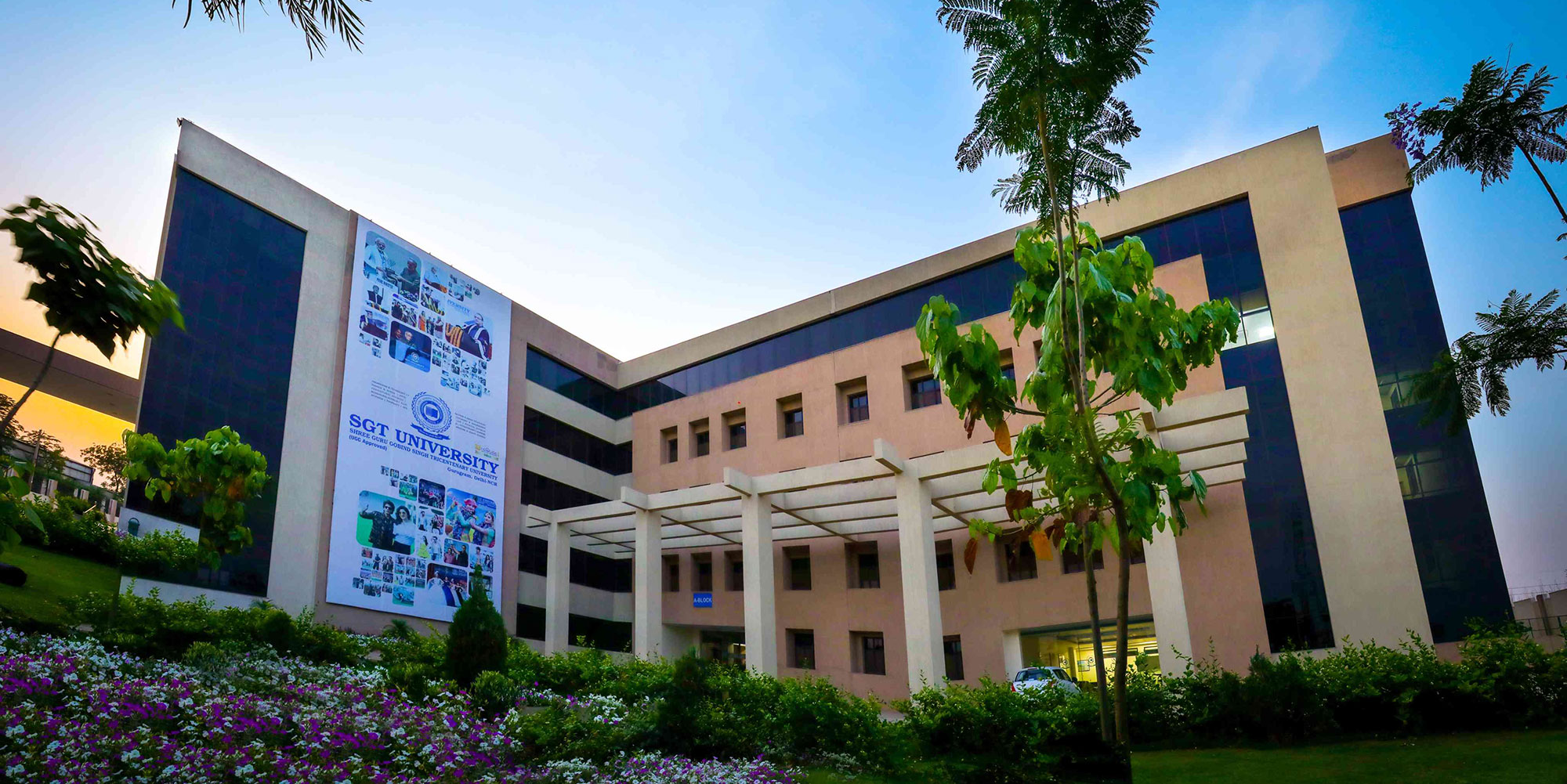
SGT University (Shree Guru Gobind Singh Tricentenary University) is a NAAC A+ accredited private university in Gurugram, Haryana, within Delhi NCR. Its pharmacy programmes sit inside a health-sciences-focused campus with an associated teaching hospital, which is a meaningful advantage for a discipline that depends on clinical and laboratory exposure.
The table below summarises the pharmacy programmes. Confirm the exact current intake, fees, and eligibility on the official SGT College of Pharmacy page before applying, since these are updated each admission cycle.
| Programme | Typical duration | Who it's for |
|---|---|---|
| D.Pharm (Diploma in Pharmacy) | 2 years | A faster route into pharmacy practice after 12th |
| B.Pharm (Bachelor of Pharmacy) | 4 years (8 semesters) | The core professional degree after 12th (PCB/PCM) |
| M.Pharm (Master of Pharmacy) | 2 years | Specialisation after B.Pharm |
| Pharm.D / Ph.D (where offered) | Varies | Clinical / research and academic careers |
Accreditation, Approvals & Why They Matter
This is the section most students skim and later regret skipping. In pharmacy, approvals are not a formality; they determine whether your degree lets you register and practise at all.
PCI approval is the foundation. The Pharmacy Council of India regulates pharmacy education and the profession under the Pharmacy Act, 1948. Approval is programme-specific and reviewed on a cycle, so a college can be approved for one course and not another. Always confirm approval for the exact programme you want, for the current academic year, on the official PCI portal, not just on the college website.
NAAC accreditation is the second pillar. SGT University holds a NAAC A+ accreditation, an institution-level quality benchmark assessed independently across teaching, research, infrastructure, and governance. For a private university, that grade is a useful external signal of overall academic standing.
Beyond these, look for alignment with the latest national framework. The PCI's B.Pharm syllabus has been updated for 2026 in line with NEP 2020, including guidance on integrating the Indian Knowledge System. A college that has moved to the current NEP-aligned curriculum is teaching to today's standard, not last decade's. When you evaluate SGT or any competitor, ask directly: is the B.Pharm running on the 2026 NEP-2020 aligned PCI syllabus? The answer tells you how current the programme really is.
Curriculum, Labs & Clinical Exposure
A pharmacy degree is only as good as the hands-on training behind it. This is where a health-sciences campus with a teaching hospital changes the experience, because the gap between theory and practice closes far faster when real labs and real patients are on site.
The PCI framework builds practical work into every semester, and mandates a substantial internship in the final year, commonly in a hospital or industry setting. That structure exists because pharmacy skills, from formulation to dispensing to pharmacovigilance, are learned by doing. When you compare colleges, ask how many practical hours students actually get, on what equipment, and under whose supervision.
SGT University's pharmacy programmes sit within a wider health- sciences ecosystem that includes an associated teaching hospital and multiple clinical faculties. For pharmacy students, proximity to a functioning hospital supports exposure to hospital and clinical pharmacy practice, which is difficult to replicate on a standalone campus.
Curriculum currency matters as much as facilities. With the PCI B.Pharm syllabus refreshed for 2026 under NEP 2020, students on the updated curriculum cover contemporary areas alongside the core pharmaceutical sciences. Ask any college whether its labs and syllabus reflect that update, because a modern curriculum taught in dated labs, or vice versa, leaves a gap you will feel at internship and placement time.
Placements, Internships & Industry Links
Placements are where marketing meets reality. A college can claim anything; a good placement cell can show you specifics. When you evaluate any pharmacy college, including SGT, ask for recent, named data rather than headline figures.
The questions that matter are concrete. Which companies actually recruited from the pharmacy programme in the last one to two years? What roles, in industry, hospital, regulatory, or research functions? What proportion of the eligible batch was placed, and how is "eligible" defined? Vague averages tell you little; a list of real recruiters and roles tells you a lot.
Internships are the bridge to those placements. The PCI-mandated final-year internship is your first real industry or hospital exposure, and its quality varies enormously between colleges. A structured internship with genuine partners, pharmaceutical companies, hospitals, or research organisations, is worth more than a nominal one arranged on paper. Industry tie-ups also feed guest lectures, live projects, and recruitment pipelines.
For a broader picture of where a pharmacy qualification can take you, see our guide to top government and private jobs after B.Pharm.Research, Innovation & Entrepreneurship
For students who see pharmacy as a scientific career rather than just a job, research depth matters. Drug discovery, formulation science, pharmacovigilance, and clinical research all reward students who train in a research-active environment where questions are investigated, not just memorised.
A research-oriented pharmacy department typically offers a few things worth looking for: faculty engaged in active research and publication, functional research laboratories, opportunities for students to work on real projects, and pathways into M.Pharm and Ph.D study. These experiences are what separate a graduate who can follow a protocol from one who can design and question it.
Entrepreneurship is an increasingly realistic path too. Pharmacy graduates start ventures in community pharmacy, nutraceuticals, cosmetics, medical devices, and health technology. A university with incubation support and an innovation ecosystem gives aspiring founders somewhere to test ideas before they graduate.
Career Paths & Salary After B.Pharm
One of pharmacy's biggest strengths is optionality. A single degree opens several distinct career tracks, and you can move between them as your interests evolve. The table below maps the main paths.
| Career track | Representative roles | Where you work |
|---|---|---|
| Pharmaceutical industry | Production, QC, QA, formulation, regulatory affairs | Pharma manufacturers, CROs, MNCs |
| Clinical & research | Clinical research associate, pharmacovigilance, drug safety | CROs, research institutes, hospitals |
| Hospital & clinical pharmacy | Hospital pharmacist, clinical pharmacist | Hospitals, clinics, healthcare chains |
| Community & retail | Registered pharmacist, pharmacy owner | Community pharmacies, retail chains |
| Government & regulatory | Drug inspector, govt pharmacist (via exams) | Public health, regulatory bodies |
| Academia & entrepreneurship | Lecturer, researcher, founder | Universities, startups |
On salary, be wary of anyone quoting a single confident figure. Starting pay for B.Pharm graduates varies widely by track, employer, city, and your own skills, and it typically rises meaningfully with specialisation (an M.Pharm or Pharm.D), experience, and moves into regulatory, research, or managerial roles. For a specific, current sense of numbers, speak to professionals in your target role and city rather than relying on a brochure figure.
Government vs Private & How to Compare Colleges
A common dilemma is government versus private. Neither is automatically better; they trade off on different things, and the right answer depends on your priorities.
| Factor | Government college | Established private university |
|---|---|---|
| Fees | Generally lower | Higher, sometimes with scholarships |
| Entry | Highly competitive, seat- limited | More accessible, merit-based |
| Infrastructure | Varies widely | Often modern; hospital tie-ups common |
| Placement support | Depends on the institution | Usually a dedicated placement cell |
The honest takeaway: a well-run private university near an industry hub can deliver strong hands-on exposure and placement support, while a government college can offer lower fees and prestige if you clear its competitive entry. Compare the specific colleges in front of you on the five filters from earlier, not on the government-versus-private label alone. If you want a regional shortlist, our roundup of the top pharmacy colleges in Haryana & Delhi NCR is a good place to start.
Pharmacy Admission 2026: Eligibility & Process
Eligibility for B.Pharm generally requires Class 12 with Physics and Chemistry, plus Biology or Mathematics, from a recognised board, subject to the minimum marks set by the university. D.Pharm has similar science-stream requirements. Exact criteria differ by institution, so always confirm against the official page.
At SGT University, pharmacy programmes are typically merit-based, and applying early matters because seats and deadlines move through the cycle. The broad steps are: register on the official admissions portal, choose your programme, submit documents (Class 10 and 12 mark sheets, ID, photographs, and category or domicile proof if applicable), complete any required verification or interaction, and confirm your seat.
When you're ready, you can begin your SGT University application online, and for the full pharmacy admission picture, our Pharmacy Admission 2026 guide walks through it step by step.
How to Verify Any Pharmacy College Before Applying
Treat this as your pre-application checklist, and run it on every college you consider, SGT included. It takes an afternoon and can save you four years and a lot of money.
- Check PCI approval for the exact programme and current year on the official PCI portal, not just the college site.
- Confirm the NAAC grade and any NIRF ranking on their official portals.
- Ask about the curriculum: is the B.Pharm on the 2026 NEP-2020 aligned PCI syllabus?
- Inspect the labs and internship structure: practical hours, equipment, and named internship partners.
- Demand specific placement data: recent recruiters, roles, and a clearly defined placement rate.
- Visit the campus and, for pharmacy, ask to see the labs and any hospital or clinical exposure in person.
A trustworthy institution will welcome every one of these questions. If a college is evasive about approvals, curriculum currency, or placement specifics, treat that as the answer.
Key Takeaways
- The "best" pharmacy college is defined by PCI approval, NAAC accreditation, real lab and clinical exposure, structured internships, and verifiable placements — in that order.
- Pharmacy offers wide career optionality across industry, clinical research, hospital practice, community pharmacy, government, and entrepreneurship.
- SGT University is a NAAC A+ accredited private university in Gurugram, Delhi NCR, with pharmacy programmes on a health-sciences campus and an associated teaching hospital.
- The PCI B.Pharm syllabus is updated for 2026 under NEP 2020 — confirm any college teaches the current version.
- Always verify approvals, curriculum, and placement data on official sources before applying anywhere.
Frequently Asked Questions
Q.1 Which is the best pharmacy college in Gurgaon?
The best pharmacy college in Gurgaon is one that is PCI-approved, NAAC-accredited, and offers strong lab and clinical exposure with good placements. SGT University in Gurugram meets these benchmarks and is worth shortlisting alongside other established options. Always verify approvals on the official PCI portal before applying.
Q.2 Is SGT University good for B.Pharm?
SGT University is a NAAC A+ accredited private university in Gurugram with pharmacy programmes on a health-sciences campus and an associated teaching hospital, which supports hands-on training. Confirm current PCI approval, intake, and fees on the official College of Pharmacy page before applying.
Q.3 What is the eligibility for B.Pharm admission in 2026?
B.Pharm eligibility generally requires Class 12 with Physics and Chemistry, plus Biology or Mathematics, from a recognised board, meeting the university's minimum marks. Exact criteria vary by college, so confirm the current-year requirement on the official admissions page.
Q.4 Is B.Pharm a good career option after 12th?
Yes. B.Pharm opens careers across the pharmaceutical industry, clinical research, hospital and community pharmacy, regulatory affairs, and academia. India's large pharma sector sustains steady demand, and the degree offers unusual flexibility to move between tracks over a career.
Q.5 What is the difference between D.Pharm and B.Pharm?
D.Pharm is a two-year diploma offering a faster entry into pharmacy practice, while B.Pharm is a four-year professional degree with broader career scope and access to higher study like M.Pharm. B.Pharm generally opens more industry and research roles.
Q.6 Why does PCI approval matter for a pharmacy college?
PCI approval is what allows you to register as a pharmacist and practise legally after graduating. It is programme-specific and reviewed each cycle, so a college may be approved for some courses and not others. Always confirm it on the official PCI portal.
Q.7 Is pharmacy better in a government or private college?
Neither is automatically better. Government colleges often have lower fees but very competitive entry, while established private universities may offer modern labs, hospital tie-ups, and dedicated placement support at higher fees. Compare specific colleges on approvals, labs, and placements rather than the label.
Q.8 What are the career options after B.Pharm?
Options include pharmaceutical industry roles (production, QC, QA, regulatory affairs), clinical research and pharmacovigilance, hospital and clinical pharmacy, community pharmacy, government roles via competitive exams, academia, and entrepreneurship. The degree is deliberately versatile.
Q.9 What is the salary after B.Pharm in India?
Starting salaries vary widely by role, employer, city, and skills, and rise meaningfully with specialisation and experience. Regulatory, research, and managerial roles typically pay more. For accurate current figures, speak to professionals working in your target role and location.
Q.10 Does SGT University have a teaching hospital for pharmacy students?
SGT University's pharmacy programmes sit within a health-sciences campus that includes an associated teaching hospital, supporting exposure to hospital and clinical pharmacy practice. Confirm the specific clinical rotations available to pharmacy students with the admissions team.
Q.11 Is the B.Pharm syllabus updated for 2026?
Yes. The Pharmacy Council of India has updated the B.Pharm syllabus for 2026 in line with NEP 2020, including guidance on integrating the Indian Knowledge System. Ask any college whether its programme runs on this current, NEP-aligned syllabus.
Q.12 Can I study pharmacy without NEET?
Yes. Pharmacy programmes such as B.Pharm and D.Pharm generally do not require NEET, and are admitted on Class 12 merit or a university-level process. This makes pharmacy an accessible healthcare-linked career for science students.
Q.13 What documents are needed for pharmacy admission?
Typically Class 10 and 12 mark sheets and certificates, a government photo ID, passport-size photographs, and a category or domicile certificate if applicable. Keep originals and photocopies ready, and check the exact list on the official admissions page.
Q.14 Are there scholarships for pharmacy students at SGT University?
Many private universities offer merit and category-based scholarships. Check the current scholarship policy with the admissions team before applying.
Q.15 Does pharmacy have good placement opportunities?
Pharmacy has broad placement potential across industry, hospitals, research organisations, and regulatory bodies, especially given India's large pharmaceutical sector. Placement outcomes depend heavily on the individual college's industry links and placement cell, so ask for recent, specific data.
Q.16 Which pharmacy specialisation is best?
There is no single best specialisation; it depends on your interests. Popular M.Pharm branches include pharmaceutics, pharmacology, pharmaceutical chemistry, pharmacognosy, and pharmaceutical analysis. Choose based on whether you prefer formulation, drug action, chemistry, natural products, or quality and analysis.
Q.17 Is pharmacy a good option for students interested in research?
Yes. Pharmacy offers strong research pathways in drug discovery, formulation science, pharmacovigilance, and clinical research, extending through M.Pharm and Ph.D study. A research-active department with functional labs is important if research is your goal.
Q.18 How do I choose the right pharmacy college in Delhi NCR?
Run the same checklist on each option: verify PCI approval and NAAC grade, confirm the curriculum is current, inspect labs and internships, demand specific placement data, and visit the campus. Compare colleges on these fundamentals rather than on advertising.
Q.19 Can pharmacy graduates work abroad?
Pharmacy graduates can pursue international opportunities, though each country has its own licensing and registration requirements that you must clear separately. Industry, regulatory, and research roles connected to multinational pharma also offer global exposure from within India.
Q.20 How do I apply for pharmacy admission at SGT University in 2026?
Register on the official SGT University admissions portal, select your pharmacy programme, submit your documents, complete any required verification, and confirm your seat. Applying early is wise, since seats and deadlines move through the admission cycle. Confirm current-year details on the official admissions page.
If pharmacy is the direction you want, the next step is simple: verify the essentials, compare your shortlist honestly, and reach out to the colleges that pass. You can apply to SGT University, explore the College of Pharmacy programmes, or contact the admissions team to arrange a campus visit and see the labs and hospital exposure for yourself before you decide.