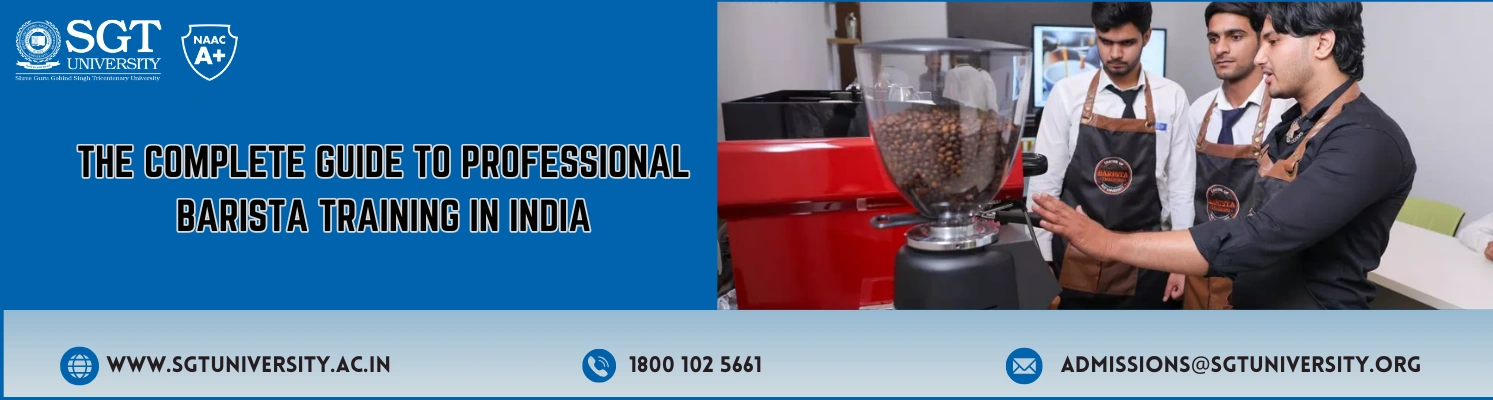
Professional barista training is structured, hands-on instruction in espresso extraction, milk texturing, brewing methods, equipment care, and customer service: the full skill set cafes, hotels, and specialty coffee brands look for when hiring.
Today, coffee culture is shaping careers and driving demand for skilled baristas across India's thriving café scene. Step into a decent cafe in Delhi, Bangalore, or Chandigarh, and you'll see baristas debating origin and roast like sommeliers discuss vintage. Cafes, hotels, and independent brands are racing to match that experience, requiring baristas who can deliver it, not just mimic it.
That's where professional barista training comes in. It isn't about memorizing a handful of drink recipes. It's not about memorizing recipes; it's about grasping why extraction, milk texture, and workflow behave as they do, then practising until that understanding becomes second nature.
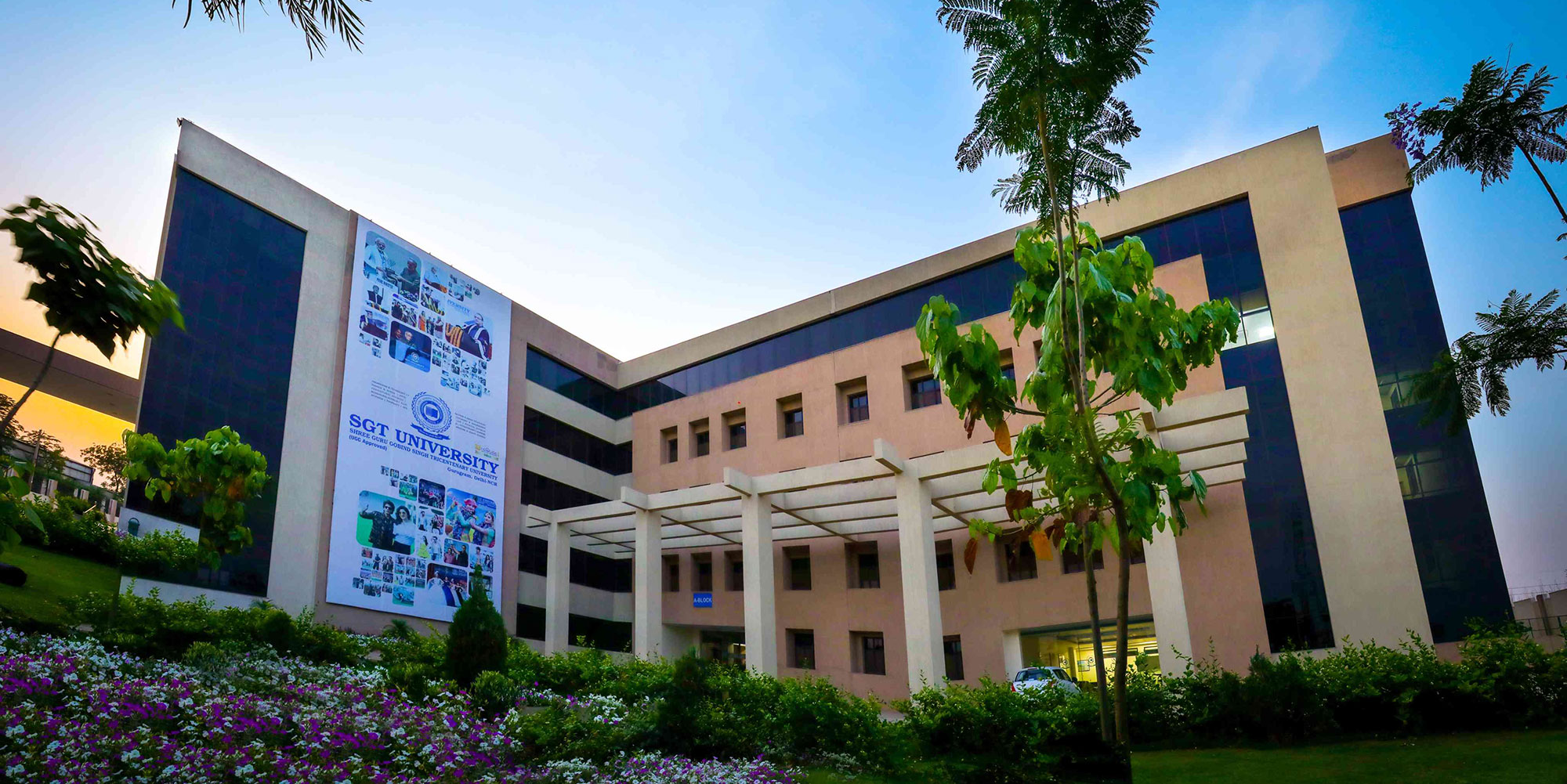
The post also examines how the Centre of Barista Training at SGT University's School of Hotel & Tourism Management integrates coffee craft with hospitality skills, instead of treating them as separate disciplines.
Table of Contents
- What Is Professional Barista Training?
- Why Professional Barista Training Matters Today
- Skills You Learn During Professional Barista Training
- Structured Training vs. Learning on the Job
- Who Should Join a Professional Barista Course?
- How to Choose the Right Barista Training Institute
- Career Opportunities After Professional Barista Training
- Why Choose the Centre of Barista Training (CBT), SGT University?
- Key Takeaways
- Frequently Asked Questions
What Is Professional Barista Training?
Strip away the jargon and professional barista training is a structured way to learn the technical, operational, and people-facing sides of making good coffee — on commercial equipment, under real cafe conditions, not at home with your own machine and a lot of trial and error.
A barista's job is bigger than most people assume: consistency shift after shift, a clean and organised station, servicing the machine, plating a drink so it looks the part, and staying composed with a customer in a hurry.
To ensure baristas are fully prepared for the demands of the role, comprehensive training typically includes:
- Coffee origins, bean varieties, and processing methods
- Espresso extraction and grinder calibration
- Milk steaming and texturing
- Latte art fundamentals
- Brewing methods
- Cafe workflow and equipment maintenance
- Customer service and hospitality etiquette
None of these sits in isolation. Grind size changes extraction, extraction changes taste, and taste changes what ends up in the customer's hands.
Even after reading countless articles online about espresso extraction, your first attempt on a real machine might still result in a burnt, sour shot—highlighting that hands-on practice is essential to bridge the gap between theory and skill. There's no substitute for standing at the grinder, dialling in settings, and steaming milk over and over until the microfoam looks right. It's closer to learning an instrument than memorising a textbook.
Industry Insight: A busy cafe barista might pull dozens of shots in a single hour during peak time. What separates someone who copes from someone who thrives isn't just technique — it's organisation and calm communication while the queue keeps growing.
Why Professional Barista Training Matters Today
India's coffee scene has shifted shape over the last several years. People know more now about origin, brew methods, and what "specialty" even means, and that awareness raises the bar for anyone serving them.
Given these rising expectations, structured training offers several tangible benefits:
- Builds real technical confidence: time on commercial machines takes the guesswork out of pulling a good shot.
- Improves what ends up in the cup: training teaches people to read variables like grind size and milk texture, and fix problems on the fly.
- Sharpens the hospitality side of the job: making coffee is half the job; the other half is staying organised and adding something positive to the customer experience.
- Gives career growth a foundation: a recognised training background signals real effort, though it doesn't guarantee a job on its own.
- Builds a habit of continuous learning, since coffee techniques, equipment, and customer expectations keep evolving.
Skills You Learn During Professional Barista Training
A genuinely useful programme covers a lot more ground than "how to steam milk." At the Centre of Barista Training (CBT), School of Hotel & Tourism Management (SHTM), SGT University, sessions pair coffee craft with hospitality standards rather than treating them as separate subjects.
Coffee Fundamentals
Training usually starts with the bean itself: coffee-growing regions, Arabica and Robusta varieties, processing methods, roasting basics, and how grind size and freshness affect flavour.
Espresso Preparation
Trainees learn to operate a commercial espresso machine, adjust grinder settings, measure dose accurately, tamp correctly, monitor extraction time, and spot under- or over-extracted shots. The goal is understanding how grind size, water temperature, pressure, and timing push flavour one way or another, not memorising a checklist.
Milk Steaming and Latte Art
Cappuccino, latte, and flat white live or die on how well the milk is steamed, not the espresso underneath it. Training covers microfoam technique, then builds into latte art basics like the heart, rosetta, and tulip. Latte art practice is really milk-handling practice in disguise, since it sharpens consistency.
Best Practice: Steam only what a drink needs, not a jug full "just in case." It's better for quality and keeps the workflow behind the counter moving.
Brewing Methods
Most programmes also introduce pour-over, French press, AeroPress, cold brew, and drip coffee, so a barista can recommend something based on what a customer actually wants, instead of pouring the same drink for everyone.
Equipment Handling and Common Mistakes
Daily cleaning routines, grinder maintenance, and backflushing keep the machine and the coffee safe and consistent. New learners typically slip up on grind settings, milk temperature, tamping pressure, and rushing the extraction; good training catches these habits early, before they turn into muscle memory.
Customer Service and Cafe Workflow
Technical skill alone won't get you through a Saturday morning rush. This side of training covers customer communication, order management, team coordination, and workspace organisation, showing learners how coffee-making fits into the bigger hospitality picture.
Structured Training vs. Learning on the Job
A common question: structured course, or just learn on the job? Structured training teaches the fundamentals systematically and explains the why behind each technique, which usually makes it easier to adapt when the equipment, the menu, or the cafe itself changes. Learning purely on the job depends entirely on the workplace and moves at whatever pace a shift allows.
| Aspect | Professional Barista Training | Learning on the Job |
|---|---|---|
| Learning approach | Structured curriculum | Depends entirely on the workplace |
| Practical experience | Guided, hands-on practice | Real-world exposure during shifts |
| Coffee fundamentals | Taught systematically | Picked up gradually, if at all |
| Espresso skills | Step-by-step instruction | Varies a lot by workplace |
| Brewing methods | Several techniques covered | Often limited to the cafe's menu |
| Latte art practice | Dedicated practice sessions | Squeezed in during service |
| Equipment knowledge | Broad and comprehensive | Limited to whatever's on-site |
| Customer service | Built around hospitality principles | Learned through daily trial and error |
Neither route is wrong, but structured training tends to close the gap between watching and actually understanding.
Who Should Join a Professional Barista Course?
This kind of training isn't just for people who want to work behind a counter forever — coffee skills carry over into hospitality, food service, and even running your own business one day. You might get real value out of a course if you're a Class 12 student exploring hospitality careers, a hotel management student, a graduate curious about specialty coffee, a working professional looking to upskill, a cafe owner wanting better beverage quality, an aspiring entrepreneur, or simply a coffee enthusiast. Most beginner-friendly programmes assume zero prior experience and build knowledge step by step.
How to Choose the Right Barista Training Institute
Picking an institute shapes both how confident you feel and how far your skills actually go. Worth comparing before you commit:
- Practical learning environment: real practice time on commercial equipment, not just lectures and slides
- Industry-relevant curriculum: covering fundamentals, espresso, milk texturing, brewing, equipment maintenance, workflow, and customer service, not just drink recipes
- Experienced trainers who've actually worked in cafes and bring real-world context
- A structured learning path that builds up gradually rather than throwing complex skills at learners on day one
- Clear learning outcomes, since course length matters less than what you'll actually be able to do afterward
Developing technical skills is only part of the journey; the next question is how these capabilities translate into career opportunities.
Career Opportunities After Professional Barista Training
Training opens more doors than just "barista." How far it goes depends on practical experience, communication skills, and how much you keep learning, but structured training gives you a real starting point instead of a blank one.
- Cafe Barista: prepares espresso and specialty drinks while keeping the customer experience front and centre
- Hotel Barista: runs in-house coffee counters, balancing speed, quality, and guest satisfaction
- Specialty Coffee Barista: leans into premium beans, precise brewing, and educating the customer
- Cafe Supervisor: manages daily operations, staff, inventory, and quality standards
- Coffee Trainer: runs demonstrations and structured training for the next batch of learners
- Cafe Entrepreneur: opens a cafe, coffee cart, or beverage brand of their own
Industry Insight: Running a cafe well takes more than good coffee. Owners who make it work pair coffee knowledge with business sense: inventory, service, marketing, and the numbers.
India's specialty coffee scene is still young compared to mature markets like Australia or the US, which leaves real room to grow as homegrown roasters expand beyond metro cities and hotel groups invest more in in-house coffee programmes.
Why Choose the Centre of Barista Training (CBT), SGT University?
Where you train matters almost as much as what you train in. The Centre of Barista Training (CBT) sits within the School of Hotel & Tourism Management (SHTM) at SGT University — a school that has spent more than a decade building hospitality expertise since its founding in 2014. CBT isn't a standalone coffee school bolted onto a random campus; it's built for learners who want to understand coffee from both the technical and hospitality sides, not just one.
Sessions lean into experiential learning: commercial coffee equipment, espresso preparation, brewing methods, milk texturing, and cafe workflow, all practised hands-on, designed to close the gap between "classroom" and "actual cafe." Coffee education is woven into hospitality principles — communication, teamwork, professionalism, and customer service — alongside the technical skills. Whether you're just starting in coffee or already have some experience and want to sharpen it, structured training here gives you a clearer path toward long-term growth.
Key Takeaways
- Professional barista training pairs coffee knowledge with real, hands-on practice.
- Skills span espresso, brewing, milk texturing, latte art, equipment care, and customer service.
- Structured training teaches the science behind coffee, not just recipes to memorise.
- Career paths stretch beyond cafes — hotels, restaurants, specialty coffee, training, entrepreneurship.
- CBT, SGT University blends coffee education with hospitality learning for aspiring coffee professionals.
- India's specialty coffee market is still young, which means genuine room to grow for anyone trained now.
Frequently Asked Questions
Q.1 What is professional barista training?
Structured instruction in espresso extraction, milk texturing, brewing, equipment handling, and customer service, combining theory with real practice.
Q.2 Is prior coffee experience required?
No. Most beginner-friendly programmes start with coffee basics before moving on to espresso, milk steaming, and service.
Q.3 What's the difference between training and learning on the job?
On-the-job learning depends entirely on the workplace; structured training covers fundamentals systematically and explains the why behind each technique.
Q.4 Do I need a hospitality background to join?
No, though hotel management students often find the hospitality side of the course reinforces what they're already studying.
Q.5 How do I choose the right institute?
Look at practical learning time, curriculum depth, trainer experience, and access to real commercial equipment.
Q.6 What career opportunities are available afterward?
Cafes, hotels, restaurants, resorts, and specialty coffee brands, with room to grow into supervisory, training, or entrepreneurial roles.
Q.7 Why choose CBT, SGT University?
It combines hands-on coffee skill-building with hospitality principles inside a supportive academic setting.
Q.8 How long does it take to become job-ready?
It depends on the programme's depth. Check the specific course structure and duration on the official programme page before enrolling.
Q.9 Is professional barista training worth it?
For anyone genuinely interested in coffee or hospitality, yes. It provides practical knowledge and real technical confidence, rather than piecemeal on-the-job learning.
In summary, professional barista training equips you with essential technical skills, operational know-how, and a hospitality mindset—key ingredients for success in any coffee or hospitality role. Whether your ambition is to work in a café, advance your career, or launch your own business, structured courses provide a solid starting point. Ready to take the next step? Explore CBT's Certificate Courses, read SHTM's Hospitality Blogs, or check the Admissions page for details on eligibility and upcoming sessions.