
Government Jobs After B.Sc Agriculture: Exams, Eligibility and Salary
Updated on: October 10, 2026
Introduction
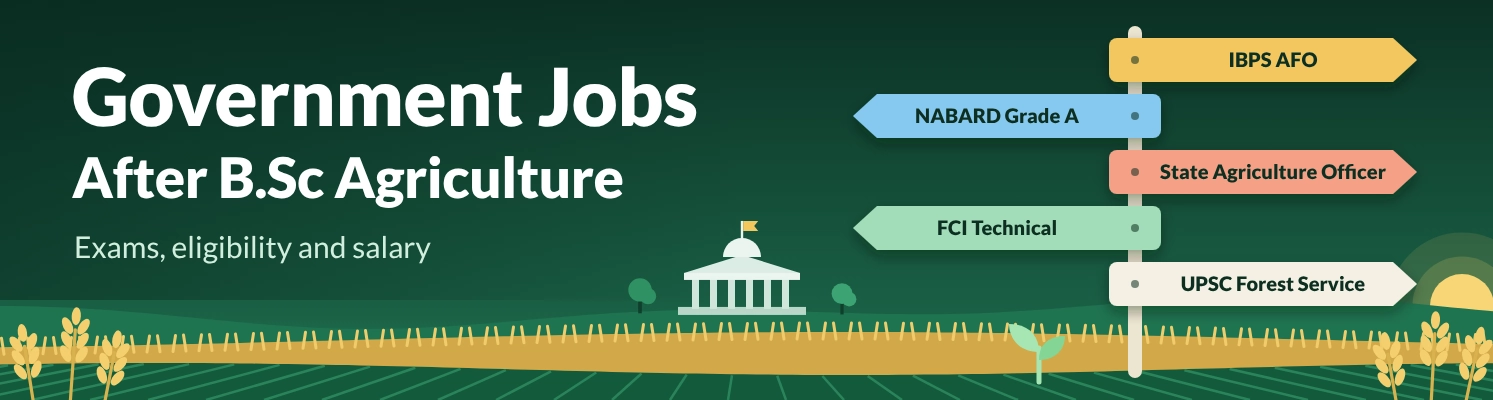
A B.Sc Agriculture degree opens more government doors than most students expect. Banks, state agriculture departments, NABARD, the Food Corporation of India and the forest service all recruit agriculture graduates, and each has its own exam.
Quick answer: The main government jobs after B.Sc Agriculture are Agricultural Field Officer in public sector banks (through IBPS), Assistant Manager at NABARD, Agriculture Development Officer in state agriculture departments, technical posts in the Food Corporation of India, and the Indian Forest Service (through UPSC). Starting basic pay ranges from about ₹28,200 to ₹56,100 a month, depending on the post. Scientist and teaching posts need a master's degree first.
The eligibility and pay figures in this guide come from the latest notifications available in October 2026. Recruiters revise them, so confirm each detail in the official notification before you apply.
Table of Contents
- Government Jobs After B.Sc Agriculture at a Glance
- Bank Jobs: IBPS Agricultural Field Officer
- NABARD Grade A (Assistant Manager)
- UPSC: Indian Forest Service and Civil Services
- State Agriculture Department Jobs
- Food Corporation of India and Food Safety Jobs
- Research and Teaching Jobs After M.Sc
- Other Government and Public Sector Options
- How to Choose and Prepare
- Does Your Degree Qualify?
- Key Takeaways
- FAQs
Government Jobs After B.Sc Agriculture at a Glance
| Post | Recruiting body | Who can apply | Starting pay |
|---|---|---|---|
| Agricultural Field Officer (Scale I) | IBPS, for public sector banks | Four-year degree in agriculture or an allied subject; age 20 to 30 | Basic pay ₹48,480 a month |
| Assistant Manager (Grade A) | NABARD | Bachelor's degree with 60% marks (55% for SC, ST and PwBD); age 21 to 30 | Basic pay ₹44,500 a month; about ₹1 lakh gross |
| Indian Forest Service officer | UPSC | Degree in agriculture, forestry or a listed science subject; age 21 to 32 | Pay Level 10; basic pay ₹56,100 a month |
| Agriculture Development Officer | State public service commissions | B.Sc. (Hons.) Agriculture in Haryana; rules differ by state | As per state pay rules |
| Assistant Grade III (Technical) | Food Corporation of India | B.Sc Agriculture or a listed science degree | Pay scale ₹28,200 to ₹79,200 |
| Food Safety Officer | State food safety departments | A degree in agricultural science is one accepted qualification | As per state pay rules |
| Scientist (ARS) and NET | ASRB | Master's degree in the relevant discipline | Open after M.Sc |
Bank Jobs: IBPS Agricultural Field Officer
The Agricultural Field Officer (AFO) post is the most direct banking route for agriculture graduates. The Institute of Banking Personnel Selection (IBPS) recruits AFOs every year as Specialist Officers for public sector banks. In 2026, applications opened in July.
- Qualification: a four-year degree in agriculture, horticulture, animal husbandry, veterinary science, dairy science, fishery science, agricultural marketing and cooperation, agro-forestry, forestry, agricultural biotechnology, food science, agribusiness management, dairy technology, agricultural engineering, sericulture or another subject listed in the notification.
- Age: 20 to 30 years, with relaxation of 3 years for OBC and 5 years for SC and ST candidates.
- Selection: a preliminary exam, a main exam and an interview.
- Pay: basic pay of ₹48,480 a month in the scale ₹48,480 to ₹85,920, plus allowances.
The exam tests general aptitude and agriculture together, as the 2026 pattern shows.
| Stage | Sections | Marks | Time |
|---|---|---|---|
| Preliminary exam | English, Reasoning, Quantitative Aptitude, Professional Knowledge | 125 | 80 minutes |
| Main exam | English, Reasoning, Quantitative Aptitude, Professional Knowledge and a descriptive paper | 225 | 155 minutes |
| Interview | For candidates shortlisted from the main exam | 100 | Not applicable |
An AFO assesses and disburses farm loans, checks that loans are used for their stated purpose, follows up on repayment and takes the bank's schemes to farmers. Professional Knowledge, the agriculture section, carries the most weight in both written exams, which is where an agriculture graduate has the advantage. The official notification is published on ibps.in.
NABARD Grade A (Assistant Manager)
The National Bank for Agriculture and Rural Development (NABARD) recruits Assistant Managers in Grade A for its Rural Development Banking Service. It is among the better-paid entry-level posts open to agriculture graduates.
- Disciplines: General, and specialised disciplines that include agriculture, plantation and horticulture, animal husbandry, fisheries, food processing and forestry.
- Qualification: for the General discipline, a bachelor's degree in any subject with 60% marks, or 55% for SC, ST and PwBD candidates. Specialised disciplines need a degree in the relevant subject.
- Age: 21 to 30 years, with relaxation for reserved categories.
- Selection: a preliminary exam (Phase I), a main exam (Phase II) and an interview.
- Pay: starting basic pay of ₹44,500 a month, with gross pay of about ₹1 lakh including allowances.
The 60% requirement is the detail to plan for early, because it depends on your marks across the whole degree. Notifications appear on nabard.org.
UPSC: Indian Forest Service and Civil Services
Indian Forest Service (IFoS)
A degree in agriculture is one of the qualifications UPSC accepts for the Indian Forest Service Examination. The others are a degree in forestry or engineering, or a bachelor's degree with at least one of animal husbandry and veterinary science, botany, chemistry, geology, mathematics, physics, statistics or zoology.
- Age: 21 to 32 years. For the 2026 examination the reference date was 1 August 2026.
- Attempts: six for General and EWS candidates and nine for OBC candidates, with no limit for SC and ST candidates.
- Selection: the Civil Services Preliminary Examination works as the screening test, followed by the IFoS Main Examination and a personality test.
- Pay: officers start at Pay Level 10, with a basic pay of ₹56,100 a month.
Civil Services Examination
The Civil Services Examination is open to graduates of any discipline, and Agriculture is one of the optional subjects in the main exam. Notifications for both exams are published on upsc.gov.in.
State Agriculture Department Jobs
State agriculture departments are the largest employers of agriculture graduates. They recruit through the state public service commission or a staff selection board, and the post titles differ from state to state.
Haryana is a useful example. The Haryana Public Service Commission (HPSC) advertised 785 posts of Agriculture Development Officer in 2025. Candidates needed a B.Sc. (Hons.) in Agriculture, had to have studied Hindi or Sanskrit up to matriculation, and had to be between 18 and 42 years old. Selection was through a written exam and an interview.
| State | Post | Recruiting body |
|---|---|---|
| Haryana | Agriculture Development Officer | Haryana Public Service Commission (HPSC) |
| Rajasthan | Agriculture Supervisor | Rajasthan Staff Selection Board (RSSB) |
| Uttar Pradesh | Technical Assistant (Group C), Subordinate Agriculture Service | Uttar Pradesh Subordinate Services Selection Commission (UPSSSC) |
| Madhya Pradesh | Rural Agriculture Extension Officer | Madhya Pradesh Employees Selection Board |
| Bihar | Block Agriculture Officer | Bihar Public Service Commission (BPSC) |
These officers work with farmers directly. They advise on seed, fertiliser and pest control, carry out government schemes, and report on crop conditions each season. A sound grasp of crop seasons helps here, and our guide to kharif, rabi and zaid crops covers the basics.
Food Corporation of India and Food Safety Jobs
- FCI Assistant Grade III (Technical): the Food Corporation of India accepts a B.Sc in Agriculture, or a B.Sc with botany, zoology, biotechnology, biochemistry, microbiology or food science, for this post. The pay scale is ₹28,200 to ₹79,200. The work covers quality checks on food grains during procurement and storage, pest control in godowns and laboratory testing. Selection is through a written exam.
- Food Safety Officer: a degree in agricultural science is among the qualifications accepted for Food Safety Officer posts, which state food safety departments fill through their own recruitment.
FCI does not recruit every year, so watch for its notifications.
Research and Teaching Jobs After M.Sc
Scientist and teaching posts are not open straight after B.Sc. The Agricultural Scientists Recruitment Board (ASRB) holds the Agricultural Research Service (ARS) examination for scientist posts in ICAR and the NET for teaching posts in agricultural universities. Both need a master's degree in the relevant discipline.
If research is your goal, plan for a master's degree first. SGT University offers:
- M.Sc. Agriculture in Agronomy
- M.Sc. in Soil Science and Agricultural Chemistry
- M.Sc. in Plant Pathology
- M.Sc. in Genetics and Plant Breeding
Our guide to career opportunities after M.Sc Agriculture covers what opens up after the master's degree.
Other Government and Public Sector Options
- Seed and fertiliser organisations: the National Seeds Corporation, state seed corporations and fertiliser companies recruit agriculture graduates as trainees and field officers. Cooperatives such as IFFCO and KRIBHCO hire for similar roles, though they are not government bodies.
- General graduate exams: SSC CGL, bank probationary officer exams and state civil services exams are open to graduates of any discipline.
- Agri-business roles: graduates who prefer management can look at an MBA in Agri-Business.
How to Choose and Prepare
- Pick two or three exams, not ten. IBPS AFO, NABARD Grade A and your state's agriculture officer exam share a large part of their agriculture syllabus, so they can be prepared together.
- Start with the agriculture section. It carries the most marks in specialist exams and is where your degree gives you an edge. Revise agronomy, soil science, horticulture, plant protection and agricultural economics from your B.Sc notes.
- Add aptitude practice early. Reasoning, quantitative aptitude and English decide the cut-off in bank exams, and they improve only with regular practice.
- Follow current schemes. Questions on government agriculture schemes, MSP and recent farm data are common in NABARD and state exams.
- Read the notification line by line. Check the exact degree wording, the age reference date and the marks required before you apply.
- Use your field experience. Your Rural Agricultural Work Experience (RAWE) gives you real examples for interviews.
Does Your Degree Qualify?
Small details in your degree decide whether an application is accepted.
- Duration: IBPS asks for a four-year degree for the AFO post.
- Honours: some state posts, such as Haryana's Agriculture Development Officer, ask for a B.Sc. (Hons.) in Agriculture.
- Marks: NABARD asks for 60% in the bachelor's degree for most candidates.
- Recognition: the degree must come from a recognised university. If you plan to study further, also check whether the programme is accredited by ICAR.
The B.Sc. (Hons.) Agriculture programme at SGT University is a four-year honours degree accredited by ICAR, and it includes Rural Agricultural Work Experience. Students train on a research and demonstration farm of more than 55 acres. For course details, read our guides on the B.Sc Agriculture course, fees and syllabus and on B.Sc Agriculture career opportunities in India.
These pages will help you plan the next step:
- Top ICAR approved agriculture colleges in India
- Admission procedure at SGT University
- How to get college scholarships
- Faculty of Agricultural Sciences at SGT University
Key Takeaways
- B.Sc Agriculture graduates can apply to banks, NABARD, state agriculture departments, FCI and UPSC.
- IBPS AFO needs a four-year degree in agriculture or an allied subject and an age of 20 to 30.
- NABARD Grade A needs 60% marks in the bachelor's degree for most candidates.
- A degree in agriculture is accepted for the Indian Forest Service Examination.
- Scientist and teaching posts need a master's degree, through the ASRB examinations.
- Always confirm eligibility, dates and pay in the official notification.
FAQs
Q1. Which government jobs can I get after B.Sc Agriculture?
The main options are Agricultural Field Officer in public sector banks through IBPS,
Assistant Manager at NABARD, Agriculture Development Officer and similar posts in
state agriculture departments, technical posts in the Food Corporation of India, Food
Safety Officer, and the Indian Forest Service through UPSC.
Q2. What is the salary of a government job after B.Sc Agriculture?
It depends on the post. As per the latest notifications, the starting basic pay is
₹48,480 a month for an IBPS Agricultural Field Officer and ₹44,500 for a NABARD Grade
A officer, whose gross pay is about ₹1 lakh. The Indian Forest Service starts at Pay
Level 10, with a basic pay of ₹56,100. Allowances are added to basic pay.
Q3. Is B.Sc Agriculture eligible for IBPS AFO?
Yes. IBPS asks for a four-year degree in agriculture or an allied subject such as
horticulture, dairy science, agricultural engineering or forestry. Candidates must be
between 20 and 30 years old, with age relaxation for reserved categories.
Q4. Can a B.Sc Agriculture graduate apply for UPSC exams?
Yes. A degree in agriculture is one of the qualifications accepted for the Indian
Forest Service Examination. Agriculture graduates can also take the Civil Services
Examination, which is open to graduates of any discipline and offers Agriculture as an
optional subject.
Q5. Can I become an Agriculture Officer after B.Sc Agriculture?
Yes. State governments recruit agriculture graduates as Agriculture Development
Officers, Agriculture Supervisors or extension officers through their public service
commissions or selection boards. In Haryana, the post of Agriculture Development
Officer needs a B.Sc. (Hons.) in Agriculture.
Q6. Do I need an M.Sc to become a scientist in ICAR?
Yes. Scientist posts in ICAR are filled through the Agricultural Research Service
examination held by ASRB, which needs a master's degree in the relevant discipline.
The ASRB NET, needed for teaching posts in agricultural universities, also needs a
master's degree.
Q7. Is NABARD Grade A open to agriculture graduates?
Yes. NABARD recruits Assistant Managers in a General discipline and in specialised
disciplines that include agriculture. The General discipline needs a bachelor's degree
with 60% marks, or 55% for SC, ST and PwBD candidates, and the age limit is 21 to 30
years.
Q8. Which is the best government exam after B.Sc Agriculture?
There is no single best exam. IBPS AFO and state agriculture officer exams are open
only to agriculture and allied graduates, so you compete with a smaller group than in
general exams. NABARD and UPSC exams are harder to clear but lead to senior roles.
