
Kharif, Rabi and Zaid Crops in India: Seasons, Examples and Sowing Months
Updated on: October 10, 2026
Introduction
Every crop in India belongs to a season. Farmers plan their year around it, and students meet it in geography, in agriculture courses and in competitive exams. The three names, kharif, rabi and zaid, are still easy to mix up.
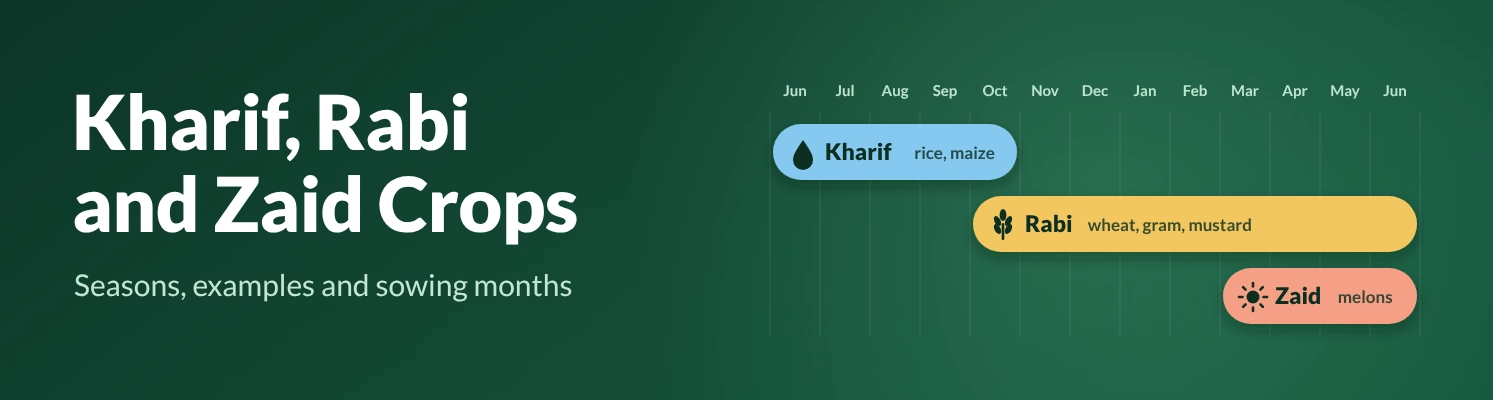
Quick answer: India has three cropping seasons. Kharif crops are sown with the onset of the monsoon, around June and July, and harvested in September and October; rice, maize, cotton and soybean are examples. Rabi crops are sown in winter, from October to December, and harvested from April to June; wheat, gram and mustard are examples. Zaid crops grow in the short summer season between the two, from about March to June; watermelon, muskmelon, cucumber and fodder crops are examples.
This guide explains each season, lists the crops grown in it, and clears up the common doubts, such as where sugarcane fits and which crops grow in more than one season.
Table of Contents
- Kharif, Rabi and Zaid Crops at a Glance
- What Are Kharif Crops?
- What Are Rabi Crops?
- What Are Zaid Crops?
- Difference Between Kharif and Rabi Crops
- List of Kharif, Rabi and Zaid Crops
- Crops That Grow in More Than One Season
- Kharif and Rabi Crops Covered Under MSP
- Why Crop Seasons Matter
- How to Remember the Three Seasons
- Where Crop Seasons Fit in an Agriculture Degree
- Key Takeaways
- FAQs
Kharif, Rabi and Zaid Crops at a Glance
| Feature | Kharif | Rabi | Zaid |
|---|---|---|---|
| Also called | Monsoon crops | Winter crops | Summer crops |
| Sowing time | June to July, with the onset of the monsoon | October to December | Around March |
| Harvesting time | September to October | April to June | By June |
| Weather needed | Warm and humid, with plenty of rain | Cool growing season, bright sunshine at ripening | Hot and dry, with long days |
| Main source of water | Monsoon rain | Stored soil moisture, winter rain and irrigation | Irrigation |
| Main crops | Rice, maize, jowar, bajra, arhar, moong, urad, cotton, jute, groundnut, soybean | Wheat, barley, gram, peas, mustard | Watermelon, muskmelon, cucumber, vegetables, fodder crops |
India's agricultural year runs from July to June, so it begins with the kharif season and ends after the zaid crops are harvested.
The season definitions and climate figures in this guide follow NCERT's Class 10 geography textbook, which is also the source most exam questions are drawn from.
What Are Kharif Crops?
Kharif crops are grown with the onset of the monsoon and harvested in September and October. They need warm weather and a lot of water, so sowing follows the arrival of the southwest monsoon, which reaches different states at different times.
Rice is the main kharif crop. It needs a temperature above 25°C, high humidity and annual rainfall above 100 cm. The important rice-growing regions include Assam, West Bengal, coastal Odisha, Andhra Pradesh, Telangana, Tamil Nadu, Kerala and the Konkan coast of Maharashtra, along with Uttar Pradesh and Bihar. Canal and tubewell irrigation have also made paddy an important crop of Punjab and Haryana.
The main kharif crops are:
- Cereals and millets: rice (paddy), maize, jowar, bajra and ragi
- Pulses: arhar (tur), moong and urad
- Oilseeds: groundnut, soybean, sesamum (til) and nigerseed
- Fibre crops: cotton and jute
In Assam, West Bengal and Odisha, farmers grow three paddy crops in a year. They are called aus, aman and boro.
What Are Rabi Crops?
Rabi crops are sown in winter, from October to December, and harvested in summer, from April to June. They grow through the cool months and ripen as the weather warms.
Wheat is the main rabi crop. It needs a cool growing season, bright sunshine at the time of ripening, and 50 to 75 cm of annual rainfall spread evenly over the growing season. Winter rain brought by western temperate cyclones, often called western disturbances, helps these crops. The states of the north and north-west, such as Punjab, Haryana, Himachal Pradesh, Jammu and Kashmir, Uttarakhand and Uttar Pradesh, are important for wheat and other rabi crops.
The main rabi crops are:
- Cereals: wheat, barley and oats
- Pulses: gram (chana), lentil (masur) and peas
- Oilseeds: rapeseed and mustard, linseed and safflower
- Vegetables: potato, cauliflower and carrot
In Punjab, the festival of Baisakhi in mid-April marks the wheat harvest.
What Are Zaid Crops?
Between the rabi harvest and the kharif sowing there is a short summer season called zaid. Zaid crops grow fast, suit hot and dry weather, and depend mostly on irrigation, because little rain falls in these months.
The main zaid crops are:
- Fruits: watermelon and muskmelon
- Vegetables: cucumber, bitter gourd and pumpkin
- Pulses: summer moong
- Fodder crops: grown to feed livestock through the dry months
Because the season is short, farmers choose crops and varieties that mature in about two to three months.
Difference Between Kharif and Rabi Crops
| Basis | Kharif crops | Rabi crops |
|---|---|---|
| Season | Monsoon | Winter |
| Sowing | June to July | October to December |
| Harvesting | September to October | April to June |
| Temperature | Warm | Cool while growing, warm at ripening |
| Water need | High; mostly met by monsoon rain | Lower; met by soil moisture, winter rain and irrigation |
| Main cereal | Rice | Wheat |
| Other examples | Maize, bajra, arhar, cotton, groundnut, soybean | Barley, gram, peas, mustard, lentil |
| Origin of the name | From the Arabic word for autumn, when the crop is harvested | From the Arabic word for spring, when the crop is harvested |
List of Kharif, Rabi and Zaid Crops
The table groups common crops by type, which is how exam questions usually ask for them.
| Crop type | Kharif | Rabi | Zaid |
|---|---|---|---|
| Cereals and millets | Rice, maize, jowar, bajra, ragi | Wheat, barley, oats | None of note |
| Pulses | Arhar (tur), moong, urad | Gram, lentil (masur), peas | Summer moong |
| Oilseeds | Groundnut, soybean, sesamum, nigerseed | Rapeseed and mustard, linseed, safflower | None of note |
| Fibre crops | Cotton, jute | None of note | None of note |
| Fruits and vegetables | Okra, brinjal, bottle gourd | Potato, peas, cauliflower, carrot | Watermelon, muskmelon, cucumber, bitter gourd, pumpkin |
| Fodder crops | Jowar and bajra grown for fodder | Berseem, oats | Maize and cowpea grown for fodder |
Crops That Grow in More Than One Season
The three seasons are a guide, not a rule. Climate and irrigation let several crops cross over.
- Rice: mainly a kharif crop, but grown three times a year in Assam, West Bengal and Odisha.
- Maize: a kharif crop that is also grown in the rabi season in some states, such as Bihar.
- Sesamum: a kharif crop in north India and a rabi crop in south India.
- Castor: grown as both a rabi and a kharif crop.
- Moong: a kharif pulse that is also raised as a short summer crop.
- Sugarcane: takes almost a year to grow, so it does not belong to a single season.
Kharif and Rabi Crops Covered Under MSP
The season labels also matter for prices. The Government of India announces minimum support prices (MSP) for 22 mandated crops, on the recommendation of the Commission for Agricultural Costs and Prices (CACP). The list is split by season.
| Group | Number | Crops |
|---|---|---|
| Kharif crops | 14 | Paddy, jowar, bajra, ragi, maize, tur (arhar), moong, urad, groundnut, sunflower seed, soybean, sesamum, nigerseed, cotton |
| Rabi crops | 6 | Wheat, barley, gram, masur (lentil), rapeseed and mustard, safflower |
| Commercial crops | 2 | Jute, copra |
Sugarcane is covered separately, through a fair and remunerative price (FRP). The kharif prices are announced before the kharif sowing and the rabi prices before the rabi sowing, so farmers know the floor price when they choose a crop.
Why Crop Seasons Matter
- Water: kharif sowing depends on the monsoon, so a late or weak monsoon delays it. Rabi crops rely on stored soil moisture, winter rain and irrigation.
- Soil health: pulses are legumes that fix nitrogen from the air, so they are usually grown in rotation with other crops. A soil test before sowing shows what the next crop will need. Our guide explains how soil testing improves crop yield.
- Planning: seed, fertiliser, labour and credit are all arranged season by season.
- Technology: irrigation, short-duration varieties and precision farming let farmers fit an extra crop into the year. Read more in our guide to sustainable agriculture and farm technology.
How to Remember the Three Seasons
- Kharif = monsoon. Think of rice fields filling with rain.
- Rabi = winter. Think of wheat growing through the cold and turning golden by April.
- Zaid = summer. Think of watermelon and muskmelon in the hottest months.
- The names follow the harvest. Kharif and rabi come from Arabic words for autumn and spring, the seasons in which each crop is harvested.
Where Crop Seasons Fit in an Agriculture Degree
Crop seasons are the starting point of agronomy, the branch of agriculture that deals with crop production. In the B.Sc. (Hons.) Agriculture programme at SGT University, a four-year degree accredited by ICAR, students study crops season by season and work on the university's research and demonstration farm of more than 55 acres.
Graduates who want to go deeper can specialise at the master's level:
- M.Sc. Agriculture in Agronomy, for crop production and cropping systems
- M.Sc. in Soil Science and Agricultural Chemistry, for soils and nutrients
- M.Sc. in Genetics and Plant Breeding, for developing crop varieties
- M.Sc. Horticulture in Vegetable Science, for vegetable crops
If you are weighing the field itself, our posts on the difference between horticulture and agriculture and on government jobs after B.Sc Agriculture are useful next reads. You can also learn more about the Faculty of Agricultural Sciences.
Key Takeaways
- India has three cropping seasons: kharif (monsoon), rabi (winter) and zaid (summer).
- Kharif crops are sown in June and July and harvested in September and October. Rice is the main one.
- Rabi crops are sown from October to December and harvested from April to June. Wheat is the main one.
- Zaid crops fill the gap between the two, from about March to June, and depend on irrigation.
- Rice, maize, sesamum and castor are grown in more than one season. Sugarcane takes almost a year.
- MSP covers 14 kharif crops, 6 rabi crops and 2 commercial crops.
FAQs
Q1. What are kharif crops? Give examples.
Kharif crops are sown with the onset of the monsoon, around June and July, and
harvested in September and October. They need warm, humid weather and plenty of water.
Rice, maize, jowar, bajra, arhar, moong, urad, cotton, jute, groundnut and soybean are
kharif crops.
Q2. What are rabi crops? Give examples.
Rabi crops are sown in winter, from October to December, and harvested from April to
June. They need a cool growing season and bright sunshine at ripening. Wheat, barley,
gram, peas, lentil and mustard are rabi crops.
Q3. What are zaid crops?
Zaid crops are grown in the short summer season between the rabi harvest and the
kharif sowing, from about March to June. They mature quickly and depend mostly on
irrigation. Watermelon, muskmelon, cucumber, vegetables and fodder crops are zaid
crops.
Q4. What is the difference between kharif and rabi crops?
Kharif crops are monsoon crops, sown in June and July and harvested in September and
October. Rabi crops are winter crops, sown from October to December and harvested from
April to June. Kharif crops need warm, wet weather, while rabi crops need cool weather
and less water.
Q5. Is wheat a rabi or kharif crop?
Wheat is a rabi crop. It is sown in winter and harvested in summer, and it needs a
cool growing season with bright sunshine at the time of ripening.
Q6. Is rice a kharif crop?
Yes, rice is mainly a kharif crop. It needs a temperature above 25°C, high humidity
and annual rainfall above 100 cm. In Assam, West Bengal and Odisha, three paddy crops
are grown in a year, called aus, aman and boro.
Q7. Is sugarcane a kharif or rabi crop?
Sugarcane does not fit neatly into either season, because it takes almost a year to
grow. It stays in the field through the monsoon and the winter.
Q8. Is cotton a kharif crop?
Yes, cotton is a kharif crop. Jute is the other major fibre crop of the kharif season.
Q9. Which season do pulses belong to?
Pulses are grown in more than one season. Arhar (tur), moong and urad are kharif
pulses. Gram, lentil (masur) and peas are rabi pulses. Moong is also raised as a short
summer crop.
Q10. How many crops are covered under MSP?
The Government of India announces minimum support prices for 22 mandated crops: 14
kharif crops, 6 rabi crops and 2 commercial crops, jute and copra. Sugarcane is
covered separately by a fair and remunerative price.
