
Types of Farming in India: Subsistence, Commercial, Organic and More
Updated on: October 14, 2026
Introduction
Farming in India ranges from a family clearing a forest patch in the north-east hills to a tea estate in Assam and a mechanised wheat farm in Punjab. The way people farm depends on the land, the rainfall, the market and the money they can invest.
Quick answer: NCERT's Class 10 geography textbook describes three main types of farming in India: primitive subsistence farming (shifting or slash-and-burn cultivation), intensive subsistence farming and commercial farming, with plantation farming as a type of commercial farming. Farming is also grouped by method and water supply, which gives types such as mixed, dry, terrace, organic, natural and precision farming.
This guide explains each type with examples from India, and compares the ones students most often mix up.
Table of Contents
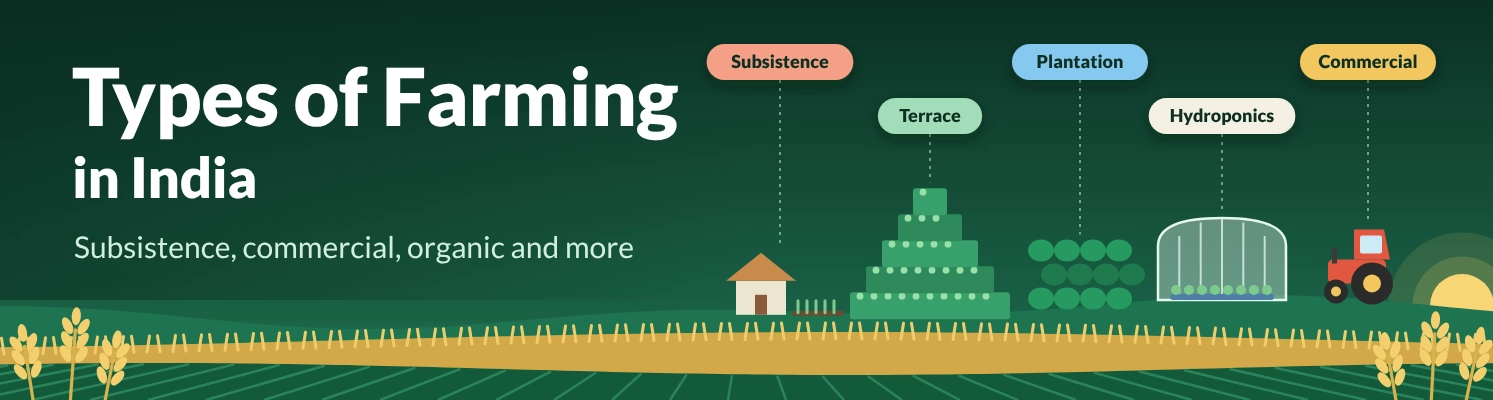
- Types of Farming in India at a Glance
- How Farming Types Are Classified
- Primitive Subsistence Farming (Shifting Cultivation)
- Intensive Subsistence Farming
- Commercial Farming
- Plantation Farming
- Subsistence vs Commercial Farming
- Mixed Farming
- Dry, Dryland and Rainfed Farming
- Terrace Farming
- Organic Farming
- Natural Farming
- Precision Farming and Hydroponics
- Studying Farming Systems
- Key Takeaways
- FAQs
Types of Farming in India at a Glance
| Type of farming | What it means | Example in India |
|---|---|---|
| Primitive subsistence | Slash-and-burn farming on small plots with simple tools, for the family's own needs | Jhumming in Assam, Meghalaya, Mizoram and Nagaland |
| Intensive subsistence | Heavy use of labour, inputs and irrigation on small holdings to feed the family | Densely populated farming regions |
| Commercial | Growing crops for sale with HYV seeds, fertilisers and pesticides | Rice in Punjab and Haryana |
| Plantation | A single crop on a large estate, supplying industry | Tea in Assam and North Bengal, coffee in Karnataka |
| Mixed | Crops and livestock on the same farm | Crop farms that also keep dairy cattle |
| Dry farming | Rain-dependent farming where annual rainfall is below 750 mm | Drought-tolerant crops in dry regions |
| Terrace | Fields cut as steps into hill slopes | Hill farming in the Himalayas |
| Organic | Farming without synthetic fertilisers and pesticides | Sikkim, fully organic since 2016 |
| Natural | Chemical-free farming with inputs made on the farm | Supported by the National Mission on Natural Farming |
| Precision and hydroponics | Technology-led farming; hydroponics grows plants without soil | Sensor-guided fields, soil-less vegetable units |
How Farming Types Are Classified
There is no single list of farming types, because farming can be grouped in several ways. The four most useful are:
- By purpose: subsistence farming (for the family) or commercial farming (for the market). This is the grouping NCERT uses.
- By water supply: rainfed or dry farming, and irrigated farming.
- By method: mixed, organic and natural farming, which differ in how fertility and pests are managed.
- By land and technology: terrace farming on slopes, and precision farming or hydroponics using modern tools.
One farm can belong to several groups at once. A rainfed hill farm can be terraced, organic and subsistence all together.
Primitive Subsistence Farming (Shifting Cultivation)
Primitive subsistence farming is still practised in a few pockets of India. It is done on small plots with simple tools such as the hoe, the dao and digging sticks, using family or community labour. It depends on the monsoon, the natural fertility of the soil and the right environmental conditions.
It is also called slash-and-burn agriculture. Farmers clear a patch of land and grow food crops on it. When the soil loses its fertility, they move to a fresh patch and let nature restore the old one. Because no fertilisers or modern inputs are used, productivity is low.
Shifting cultivation has different local names across India:
| Local name | Region |
|---|---|
| Jhumming | Assam, Meghalaya, Mizoram, Nagaland |
| Pamlou | Manipur |
| Dipa | Bastar, Chhattisgarh |
| Bewar or Dahiya | Madhya Pradesh |
| Podu or Penda | Andhra Pradesh |
| Pama Dabi, Koman or Bringa | Odisha |
| Kumari | Western Ghats |
| Valre or Waltre | South-eastern Rajasthan |
| Khil | Himalayan belt |
| Kuruwa | Jharkhand |
The same practice is known as milpa in Mexico and Central America, conuco in Venezuela, roca in Brazil, masole in Central Africa, ladang in Indonesia and ray in Vietnam.
Intensive Subsistence Farming
Intensive subsistence farming is practised where population pressure on land is high. It is labour intensive, and farmers use high doses of biochemical inputs and irrigation to get more from each plot.
The reason is the size of holdings. Land is divided among heirs in each generation, so plots keep shrinking until they are uneconomical. With few other ways to earn a living, families have to get the most they can out of very little land.
Commercial Farming
Commercial farming grows crops for sale. Its main feature is the use of higher doses of modern inputs, such as high-yielding variety (HYV) seeds, chemical fertilisers, insecticides and pesticides, to raise productivity.
How commercial a crop is depends on the region. Rice is a commercial crop in Punjab and Haryana, but in Odisha it is mostly a subsistence crop. The minimum support prices announced for major crops each season shape what commercial farmers sow; our guide to kharif, rabi and zaid crops lists the crops covered.
Plantation Farming
Plantation farming is a type of commercial farming in which a single crop is grown over a large area. It sits where agriculture meets industry: plantations use capital-intensive inputs and migrant labour, and all of their produce goes to industry as raw material.
- Main plantation crops: tea, coffee, rubber, sugarcane and banana.
- Tea: grown mainly in Assam and North Bengal.
- Coffee: grown mainly in Karnataka.
In the south, tea and coffee are grown on the laterite soils of the hills of Karnataka, Kerala and Tamil Nadu. Our guide to the types of soil in India explains which soils suit which crops.
Subsistence vs Commercial Farming
| Basis | Subsistence farming | Commercial farming |
|---|---|---|
| Purpose | To feed the farmer's family | To sell in the market |
| Size of holding | Usually small | Usually larger |
| Inputs | Simple tools and family labour; intensive farming adds fertiliser and irrigation | HYV seeds, chemical fertilisers, pesticides and machinery |
| Crops | A mix of food crops | Often one or two cash or food crops |
| Productivity | Low in primitive farming | High |
| Example | Jhumming in the north-east | Rice in Punjab and Haryana; tea estates in Assam |
Mixed Farming
Mixed farming combines crops and livestock on the same farm. The land grows food and fodder crops, and the animals give milk, draught power and manure that goes back into the soil. Spreading income across crops and animals also lowers the risk from a single bad season.
Dry, Dryland and Rainfed Farming
Much of India's farming depends on rain rather than irrigation. One estimate puts the unirrigated area at 73 million of the country's 142 million hectares of net sown area, or about half. Farming without irrigation is grouped by how much rain falls in a year:
| Type | Annual rainfall | What it involves |
|---|---|---|
| Dry farming | Below 750 mm | Conserving every bit of soil moisture and growing drought-tolerant crops |
| Dryland farming | Above 750 mm | Rainfed crops with some risk of dry spells; moisture conservation still matters |
| Rainfed farming | Above 1,150 mm | Rain is usually enough; the bigger problems are drainage and erosion |
Terrace Farming
On steep hill slopes, farmers cut the land into a series of level steps, or terraces. Each step holds water and soil, so terraces reduce soil erosion and make it possible to farm land that would otherwise wash away. Terrace farming is common in the Himalayan states and other hilly regions.
Organic Farming
Organic farming grows crops without synthetic fertilisers and pesticides, relying instead on compost, manure, crop rotation and biological pest control.
- Sikkim: became India's first fully organic state in 2016.
- Paramparagat Krishi Vikas Yojana (PKVY): launched in 2015, it promotes organic farming through clusters of farmers and Participatory Guarantee System (PGS) certification.
- Mission Organic Value Chain Development for North Eastern Region: launched in 2015 to build certified organic production in the north-eastern states.
Natural Farming
Natural farming is chemical-free farming based on agro-ecology. It integrates crops, trees and livestock and relies on inputs that farmers prepare on the farm, often from the dung and urine of indigenous desi cows.
The Government of India launched the National Mission on Natural Farming in November 2024 as a standalone centrally sponsored scheme, with an outlay of ₹2,481 crore. It aims to reach 1 crore farmers and bring 7.5 lakh hectares under natural farming through 15,000 clusters.
Precision Farming and Hydroponics
- Precision farming: uses sensors, satellite data and machinery to apply water, seed and fertiliser only where and when they are needed. Read more in our post on precision farming.
- Hydroponics: grows plants without soil, with their roots in a nutrient solution. It suits leafy vegetables and herbs in protected structures, including in cities.
- Protected cultivation: polyhouses and shade nets let farmers control temperature and moisture and grow high-value vegetables and flowers out of season.
For more on how technology is changing farms, see our guide to sustainable agriculture and farm technology.
Studying Farming Systems
Farming systems are at the centre of the B.Sc. (Hons.) Agriculture programme at SGT University, a four-year degree accredited by ICAR. Students work on a research and demonstration farm of more than 55 acres, and the faculty's labs include a hydroponic lab for soil-less farming, a mushroom unit and a nursery.
Students who want to specialise can continue with:
- M.Sc. Agriculture in Agronomy, for crop production and farming systems
- M.Sc. Horticulture in Fruit Science, for orchards and plantation-style fruit crops
- MBA in Agri-Business, for the commercial side of farming
If you are planning a career in the field, read about government jobs after B.Sc Agriculture and the importance of horticulture in India, or learn more about the Faculty of Agricultural Sciences.
Key Takeaways
- NCERT describes three main types of farming in India: primitive subsistence, intensive subsistence and commercial, with plantation farming as a type of commercial farming.
- Shifting cultivation has many local names, such as jhumming in the north-east and podu in Andhra Pradesh.
- Rice is a commercial crop in Punjab and Haryana but mostly a subsistence crop in Odisha.
- Dry farming is practised where annual rainfall is below 750 mm.
- Sikkim became India's first fully organic state in 2016.
- The National Mission on Natural Farming, launched in November 2024, aims to reach 1 crore farmers.
FAQs
Q1. What are the main types of farming in India?
NCERT's Class 10 geography textbook describes three main types: primitive subsistence
farming, intensive subsistence farming and commercial farming, with plantation farming
as a type of commercial farming. Other common types include mixed, dry, terrace,
organic, natural and precision farming.
Q2. What is subsistence farming?
Subsistence farming is farming mainly to feed the farmer's own family, with little
left over to sell. In India it takes two forms: primitive subsistence farming, done
with simple tools on small plots, and intensive subsistence farming, where heavy
inputs are used to get the most from small holdings.
Q3. What is jhum cultivation?
Jhum, or jhumming, is the name for slash-and-burn shifting cultivation in Assam,
Meghalaya, Mizoram and Nagaland. Farmers clear and burn a patch of forest, grow food
crops, and move to a fresh patch when the soil loses its fertility.
Q4. What are the other names of shifting cultivation in India?
Shifting cultivation is called pamlou in Manipur, dipa in Bastar (Chhattisgarh), bewar
or dahiya in Madhya Pradesh, podu or penda in Andhra Pradesh, pama dabi, koman or
bringa in Odisha, kumari in the Western Ghats, valre or waltre in south-eastern
Rajasthan, khil in the Himalayan belt and kuruwa in Jharkhand.
Q5. What is commercial farming? Give an example.
Commercial farming grows crops for sale, using high doses of modern inputs such as
high-yielding variety seeds, chemical fertilisers and pesticides. Rice grown in Punjab
and Haryana is an example: it is a commercial crop there, while in Odisha it is mostly
a subsistence crop.
Q6. What is plantation farming?
Plantation farming is a type of commercial farming in which a single crop is grown
over a large area, with capital-intensive inputs and migrant labour, and the produce
goes to industry as raw material. Tea, coffee, rubber, sugarcane and banana are
important plantation crops in India.
Q7. What is the difference between organic and natural farming?
Organic farming avoids synthetic fertilisers and pesticides and can use organic inputs
bought from outside the farm. Natural farming goes further: it relies on inputs that
farmers prepare on the farm, often from the dung and urine of desi cows, and
integrates crops, trees and livestock.
Q8. Which is the first organic state in India?
Sikkim became the first fully organic state in India in 2016.
Q9. What is dry farming?
Dry farming is the growing of crops in areas with annual rainfall below 750 mm,
without irrigation. It depends on conserving soil moisture and on drought-tolerant
crops.
Q10. What is mixed farming?
Mixed farming combines growing crops with rearing livestock on the same farm. The land
produces food and fodder crops, and the animals provide milk, draught power and manure
that goes back to the fields.
