
Types of Soil in India: Features, Regions and Crops
Updated on: October 13, 2026
Introduction
Soil decides what a farmer can grow, how much water a field needs and which fertiliser will pay off. India's soils change sharply from the floodplains of the north to the lava plateau of the Deccan and the deserts of Rajasthan, and knowing them is the first step in understanding Indian farming.
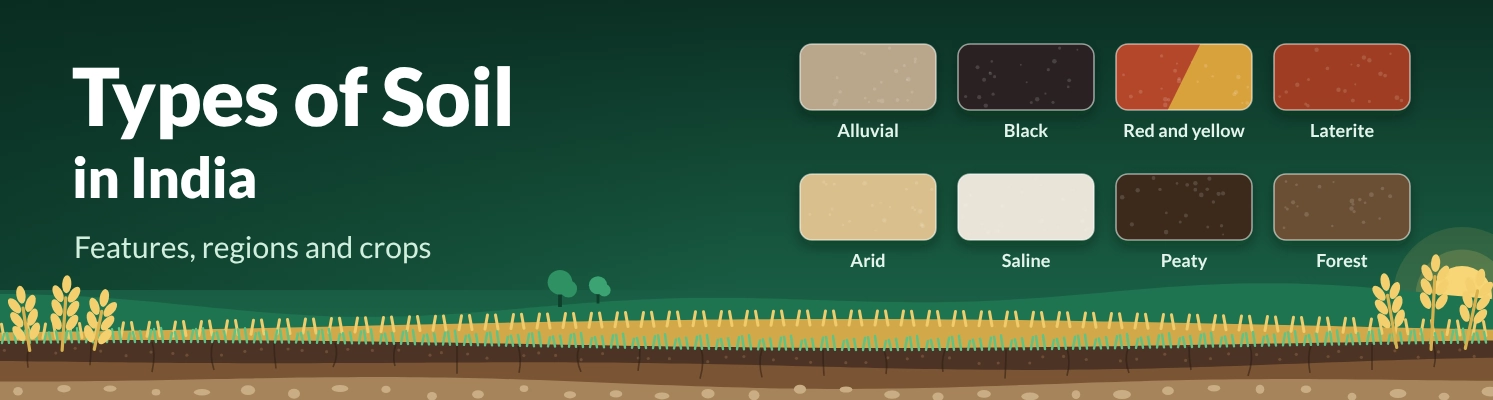
Quick answer: The Indian Council of Agricultural Research (ICAR) groups the soils of India into eight types: alluvial, black (regur), red and yellow, laterite, arid, saline, peaty and forest soils. Alluvial soil is the most widespread, covering about 40 per cent of the country. Black soil is best known for cotton, laterite soil is used to make bricks, and arid soil is typical of western Rajasthan.
This guide explains each soil type, where it is found, what it contains and which crops suit it. It also covers soil problems and how to get your own soil tested.
Table of Contents
- Types of Soil in India at a Glance
- How Indian Soils Are Classified
- Alluvial Soil
- Black Soil (Regur)
- Red and Yellow Soil
- Laterite Soil
- Arid (Desert) Soil
- Saline Soil
- Peaty and Marshy Soil
- Forest and Mountain Soil
- Soil Erosion, Salinity and How to Conserve Soil
- How to Find Out Your Soil's Type and Health
- Soils of Haryana
- Studying Soil Science
- Key Takeaways
- FAQs
Types of Soil in India at a Glance
| Soil type | Where it is found | Key features | Main crops |
|---|---|---|---|
| Alluvial | Northern plains, river valleys, east coast deltas | Rich in potash, poor in phosphorus; most fertile | Rice, wheat, sugarcane, pulses |
| Black (regur) | Deccan Plateau: Maharashtra, parts of Gujarat, Madhya Pradesh, Andhra Pradesh, Tamil Nadu | Clayey, holds moisture, self-ploughing | Cotton, sugarcane, groundnut, millets |
| Red and yellow | Eastern and southern Deccan, Odisha, Chhattisgarh | Red from iron; poor in nitrogen, phosphorus and humus | Millets, pulses, groundnut, ragi |
| Laterite | Higher parts of the peninsular plateau, hilly Odisha and Assam | Heavily leached; rich in iron oxide, poor in nitrogen | Tea, coffee, cashew |
| Arid (desert) | Western Rajasthan | Sandy, often saline, low in humus; kankar layer below | Bajra, barley and other drought-tolerant crops, with irrigation |
| Saline | Western Gujarat, east coast deltas, Sundarbans, over-irrigated parts of Punjab and Haryana | Excess sodium, potassium and magnesium; infertile until treated | Salt-tolerant crops such as barley, after reclamation |
| Peaty and marshy | North Bihar, southern Uttarakhand, coastal West Bengal, Odisha and Tamil Nadu | Heavy, black, 40 to 50 per cent organic matter | Rice in waterlogged tracts, once drainage is managed |
| Forest and mountain | Himalayan and other forested hill slopes | Varies with altitude; acidic and low in humus higher up | Tea, fruit orchards and spices on hill slopes |
How Indian Soils Are Classified
In ancient India, soils were simply divided into urvara (fertile) and usara (sterile). Today there are three classifications you will meet:
- ICAR's eight groups: based on how the soils formed, their colour, composition and location. This is the classification used in this guide.
- NCERT Class 10: a simpler list of six, which merges some groups: alluvial, black, red and yellow, laterite, arid, and forest and mountain soils.
- USDA soil taxonomy: the scientific system ICAR's soil survey uses, which sorts soils into orders.
Under the USDA system, the share of India's area in each soil order is as follows:
| Soil order | Share of area |
|---|---|
| Inceptisols | 39.74% |
| Entisols | 28.08% |
| Alfisols | 13.55% |
| Vertisols | 8.52% |
| Aridisols | 4.28% |
| Ultisols | 2.51% |
| Mollisols | 0.40% |
| Others | 2.92% |
Most exam questions and farm advice in India use the eight-group system, so the rest of this guide follows it.
Alluvial Soil
Alluvial soil is laid down by rivers. It is the most widespread soil in India, covering about 40 per cent of the country's area, and it supports the most intensive farming.
- Where found: the northern plains and river valleys, and the deltas of the Mahanadi, Godavari, Krishna and Kaveri on the east coast.
- Khadar and bhangar: khadar is new alluvium, renewed by floods almost every year and very fertile. Bhangar is old alluvium away from the floodplains, often with kankar nodules.
- Nutrients: rich in potash, poor in phosphorus. The colour ranges from light grey to ash grey.
- Crops: rice, wheat, sugarcane and pulses.
Black Soil (Regur)
Black soil is called regur or black cotton soil. It formed largely from the volcanic rock of the Deccan Trap, and it is the classic soil for cotton.
- Where found: most of the Deccan Plateau, including Maharashtra, parts of Gujarat, Madhya Pradesh, Andhra Pradesh and Tamil Nadu, and the upper reaches of the Godavari and Krishna valleys.
- Self-ploughing: the clayey soil swells and turns sticky when wet, then shrinks and cracks when dry. The cracks let air in, which loosens the soil.
- Moisture: it holds water for a long time, which helps crops in low-rainfall areas.
- Nutrients: rich in lime, iron, magnesia and alumina, and contains potash. Poor in nitrogen, phosphorus and organic matter.
- Crops: cotton, along with sugarcane, groundnut and millets.
Red and Yellow Soil
Red soil develops on crystalline igneous rocks in areas of low rainfall. Its red colour comes from iron spread through the parent rock, and the same soil looks yellow when the iron is hydrated.
- Where found: the eastern and southern parts of the Deccan Plateau, the foothills of the Western Ghats, and parts of Odisha, Chhattisgarh and the southern middle Ganga plain.
- Fertility: fine-grained red soils are fairly fertile. Coarse-grained red soils in dry uplands are poor.
- Nutrients: generally poor in nitrogen, phosphorus and humus.
- Crops: millets, pulses, groundnut and ragi, especially with fertiliser and irrigation.
Laterite Soil
Laterite soil forms where high temperature and heavy rain alternate with dry spells. The rain leaches out lime and silica, leaving a soil rich in iron oxide and aluminium. Its name comes from the Latin word later, meaning brick, and it is still cut into bricks for houses.
- Where found: the higher parts of the peninsular plateau in Karnataka, Kerala, Tamil Nadu and Madhya Pradesh, and the hilly areas of Odisha and Assam.
- Nutrients: poor in organic matter, nitrogen, phosphate and calcium; rich in iron oxide and potash. It needs manure and fertiliser to be productive.
- Crops: tea and coffee on the hills of Karnataka, Kerala and Tamil Nadu, and cashew on the red laterite soils of Tamil Nadu, Andhra Pradesh and Kerala.
Arid (Desert) Soil
Arid soil ranges from red to brown. It is sandy and often saline, and in some places it is so salty that common salt is obtained by evaporating its water.
- Where found: typical of western Rajasthan.
- Kankar layer: calcium increases with depth and forms a hard kankar layer, which stops water soaking in.
- Nutrients: low in humus and moisture, with too little nitrogen and normal phosphate.
- Crops: with irrigation, drought-tolerant crops such as bajra and barley do well, as farming in western Rajasthan shows.
Saline Soil
Saline soils, also called usara soils, contain too much sodium, potassium and magnesium, which makes them infertile. They form where the climate is dry and drainage is poor.
- Where found: western Gujarat, the deltas of the east coast and the Sundarbans of West Bengal.
- Over-irrigation: in parts of Punjab and Haryana, heavy irrigation in a dry climate draws salts up to the surface, turning fertile alluvial soil saline.
- Treatment: farmers are advised to add gypsum, which helps reclaim the soil.
- Crops: after reclamation, salt-tolerant crops such as barley.
Peaty and Marshy Soil
Peaty soil forms in areas of heavy rain and high humidity, where plenty of dead plant matter builds up. It can contain 40 to 50 per cent organic matter, and it is heavy, black and alkaline in many places.
- Where found: the northern part of Bihar, the southern part of Uttarakhand, and the coastal areas of West Bengal, Odisha and Tamil Nadu.
- Use: rice in waterlogged tracts, once drainage is managed.
Forest and Mountain Soil
Forest soils form in forested areas with enough rainfall. Their texture changes with the slope and the height of the land.
- Texture: loamy and silty on valley sides, coarse-grained on upper slopes.
- Fertility: in the snow-bound parts of the Himalayas, they are acidic and low in humus. In the lower valleys they are fertile.
- Crops: tea, fruit orchards and spices on hill slopes.
Soil Erosion, Salinity and How to Conserve Soil
Soil takes a very long time to form and can be lost quickly. The main threats in India are erosion by water and wind, salinity from over-irrigation, and falling fertility from heavy cropping without enough organic matter.
- Contour ploughing: ploughing along the contours of a slope slows the flow of water.
- Terrace farming: cutting steps into hill slopes reduces erosion.
- Strip cropping: strips of grass between crops break the force of the wind.
- Shelter belts: rows of trees protect fields and help stabilise sand dunes in dry areas.
- Crop rotation with pulses: pulses fix nitrogen from the air and help restore fertility. Our guide to kharif, rabi and zaid crops explains which pulses grow in which season.
How to Find Out Your Soil's Type and Health
The type of soil tells you a lot, but only a soil test tells you what your own field needs. The Government of India's Soil Health Card scheme, launched on 19 February 2015 at Suratgarh in Rajasthan, gives farmers a card showing the status of their soil on 12 parameters, along with fertiliser advice.
| Group | Parameters |
|---|---|
| Major nutrients | Nitrogen (N), phosphorus (P), potassium (K) |
| Secondary nutrient | Sulphur (S) |
| Micronutrients | Zinc (Zn), iron (Fe), copper (Cu), manganese (Mn), boron (B) |
| Physical and chemical | pH, electrical conductivity (EC), organic carbon (OC) |
Details of the scheme are on soilhealth.dac.gov.in. SGT University's Faculty of Agricultural Sciences runs a State Soil Testing Laboratory sponsored by the Government of Haryana, and its Khet Bachao Abhiyan 2026 took soil testing to villages in Rewari. Our guide explains how soil testing helps improve crop yield and farm productivity.
Soils of Haryana
Most of Haryana lies on the alluvial soils of the northern plains, which support its wheat, paddy, mustard and sugarcane. Towards the south-west, near the Rajasthan border, the soils become sandy and dry. Salinity is a concern in parts of the state, where heavy irrigation has drawn salts to the surface, and gypsum is the standard remedy.
Studying Soil Science
Soil science is a core subject in the B.Sc. (Hons.) Agriculture programme at SGT University, a four-year degree accredited by ICAR, where students test soils in the laboratory and work on a research farm of more than 55 acres. Those who want to specialise can continue with:
- M.Sc. in Soil Science and Agricultural Chemistry
- M.Sc. Agriculture in Agronomy
- Ph.D. in Soil Science
For a wider view of farming methods, read our guide to sustainable agriculture and farm technology, or learn more about the Faculty of Agricultural Sciences.
Key Takeaways
- ICAR groups Indian soils into eight types: alluvial, black, red and yellow, laterite, arid, saline, peaty and forest soils.
- Alluvial soil covers about 40 per cent of India and supports rice, wheat and sugarcane.
- Black soil (regur) is self-ploughing, holds moisture and is best for cotton.
- Laterite soil is heavily leached, is cut into bricks, and suits tea, coffee and cashew.
- Arid soil in western Rajasthan has a kankar layer; saline soil is treated with gypsum.
- A soil test under the Soil Health Card scheme reports 12 parameters for your own field.
FAQs
Q1. How many types of soil are there in India?
The Indian Council of Agricultural Research (ICAR) groups Indian soils into eight
types: alluvial, black, red and yellow, laterite, arid, saline, peaty and forest
soils. The NCERT Class 10 geography textbook uses a shorter list of six: alluvial,
black, red and yellow, laterite, arid, and forest and mountain soils.
Q2. Which is the most common soil in India?
Alluvial soil is the most widespread soil in India. It covers about 40 per cent of the
country's area, mainly the northern plains and the river valleys and deltas.
Q3. Which soil is best for growing cotton?
Black soil is best for cotton, which is why it is also called black cotton soil or
regur. It holds moisture for a long time and is rich in lime, iron and magnesia.
Q4. Why is black soil called self-ploughing?
Black soil swells and becomes sticky when wet, and shrinks and develops wide cracks
when it dries. The cracks let air into the soil, which loosens it in the same way that
ploughing would.
Q5. Why is red soil red in colour?
Red soil gets its colour from iron that has spread through the crystalline and
metamorphic rocks it forms from. The same soil looks yellow when the iron is in a
hydrated form.
Q6. Which soil is found in Rajasthan?
Arid or desert soil is typical of western Rajasthan. It is sandy, often saline, and
low in humus and moisture. A hard layer of kankar lower down limits how far water can
soak in.
Q7. What is the difference between khadar and bhangar?
Both are alluvial soils. Khadar is new alluvium, laid down by floods almost every
year, so it is fine-grained and fertile. Bhangar is old alluvium found away from the
floodplains, and it often contains kankar nodules.
Q8. Which soil is used to make bricks?
Laterite soil is cut into bricks for building houses. Its name comes from the Latin
word later, meaning brick.
Q9. Which soil is best for rice and wheat?
Alluvial soil is the main soil for both rice and wheat in India, along with sugarcane
and pulses. It is rich in potash, though usually poor in phosphorus.
Q10. How can I find out my soil's type and health?
Get your soil tested at a soil testing laboratory. Under the government's Soil Health
Card scheme, a test reports 12 parameters, including nitrogen, phosphorus, potassium,
pH and organic carbon, along with fertiliser advice.
